
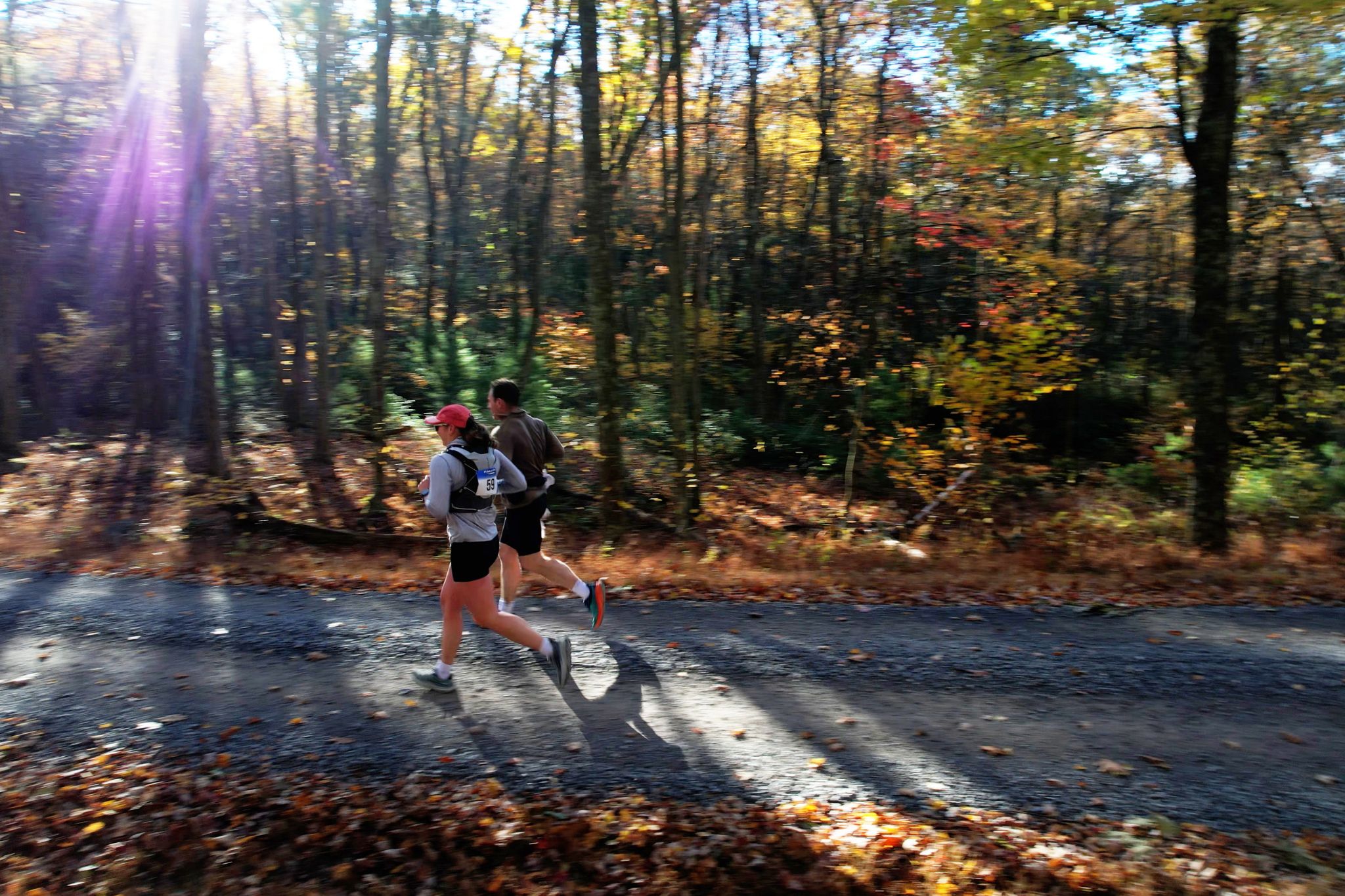
Fall foliage was bursting in shades of gold and red, but you wouldn’t know it as runners gathered on a late October Saturday for the 6:30 p.m. start of the Tussey Mountainback’s 100-mile race in Central Pennsylvania’s Rothrock State Forest. Why such a start time? This moment marked the official end of Saturday hunting and a green light for the event from the PA Department of Conservation and Natural Resources.
The Tussey Mountainback may best be known for its iconic, single-loop 50-mile course on mostly unpaved forest roads. The Mountainback’s 50-mile race has seen 26 incarnations since its inception in 2000. The 100-miler was added in 2024, and that year, runners navigated the huge certified loop once through the night before having a second go-round in daylight. This year, to boost simplicity and safety, runners covered four shorter loops for the first 50 miles before tackling the broader 50-mile circuit. Nighttime temperatures dipped into the low 30s as the runners looped, their headlamps illuminating the bright colors of foliage.
Having twice run Tussey’s 50-miler, Georgetta Frederick, of Johnstown, was ready for a new challenge and wanted to add to her 100-miler experience. “I started with a 3:1 approach – run 3 minutes, walk 1. I held this for around 25 miles, then switching to walking uphills and running downhills.” Frederick used natural fuels through part of the night, along with aid station hot chocolate and tacos, later switching to just the aid station fare.
Frederick began running in 2013, inspiring her daughter, Kaylee, then 7 years old. Later, following a hiatus from running, Kaylee got her mother back into distance running, and both Frederick’s now share the same passion. Georgetta Frederick has completed 13 ultramarathons, including a 100-mile hiking challenge in Allegheny National Forest and the Buckeye 200 course.
Nik Suckinos, of nearby Cresson, posted the new CR for this roving, updated 100-mile course. Suckinos was easily drawn to the Mountainback’s 100-miler. “I did the 50-miler four years ago and enjoyed the race a lot. Living close by, when I saw the 100-mile option was added, it was an easy decision to do it.”
Suckinos kept a consistent pace for the early loops and met his pacer at mile 70. “When uphill climbs presented themselves, I’d power hike to preserve energy. The flats, downhills and rolling hills were sections I’d run. When I reached mile 90 and learned I was not far out of first place, my pacer, Travis, and I started to run the remainder of the course, even the uphill sections.”
Suckinos also recognized a familiar friend: fatigue. “At mile 29 around midnight, fatigue started to set in. I was able to push through and overcome this first barrier and felt good until approximately 5 a.m., when the fatigue set in again. Luckily the sun rose and my pacer was waiting for me at mile 70. Together these factors helped energize me and propelled me through the second wave of fatigue. Some of the biggest hurdles we face during an ultramarathon are mental. Knowing this, it’s important to keep yourself grounded and focused on the task at hand, which is finishing the race. Pain, fatigue and all the other emotions that present themselves are temporary. It’s important to keep the main thing the main thing, and that’s finishing what you started.”
Master’s winner Phil Perkins, of West Chester, had run Tussey’s 50-miler and read about the new 100-miler in an UltraRunning article earlier this year. Perkins had a clear strategy for it. “Pacing was to run/walk a 12-minute pace until I couldn’t anymore, then hold on for dear life.” For feeding the furnace, Perkins added, “Fifty calories of candy per mile is my unorthodox fueling strategy of choice.”
The 50-mile race saw Andrew Weir, of Media, hold out over Julian Schima, of Boulder, Colorado, for the win. Meanwhile, Bianca Pourmussa, of Philadelphia, clicked off the hill-and-dale miles to win more than 45 minutes faster than her win in 2023. “My strategy was to drink lots of cola at the aid stations and run hard on the flats and downhills.”
Pourmussa ran the first 20 miles or so with Joshua Finger “before he took off into the distance with some speedy uphill miles. It was really wonderful to speak with him, as he is the RD for another race that I’ve done, and he has a ton of valuable running experience/advice to share.”
In a broader context, Pourmussa has taken a liking to this event. “Tussey Mountainback is one of my favorite races. Not only is the course beautiful (peak fall leaves in PA), but the race is incredibly well organized and accessible. This made it easy to focus on running, rather than on logistics. I appreciated the frequent aid stations (so frequent, I could even leave the pack in the car), easy start and finish line parking access, and kind and helpful volunteers. This race is peaceful, simple and enjoyable, and I will certainly be signing up again.”
Danielle Barney, of Lock Haven, the top female master’s finisher, had heard of the event over the years. “My friend and running coach, Sayard Tanis, had done the relay a few times in the past, and mentioned the 50-miler as a possibility. I entered a new age bracket this year and was looking for something of the same mileage to celebrate!”
Barney also saw the course of unpaved roads as unique. “I’m not the strongest or fastest runner, and I’ve been running on trails, primarily, over the past number of years, so this was an exciting and different challenge. I did drive down to run a few times, so I knew what to expect on some of the sections, and how to approach them to the best of my abilities and fitness (especially that never-ending Alan Seeger climb everyone seemed to talk about). I planned to run everything I possibly could and alternate power-hiking and running on long climbs. I definitely have respect for the unique toughness that the Tussey Mountainback course presented. At the same time, the natural beauty featured all along the course helped to distract me from complaints my legs were trying to register. The volunteers were so friendly, encouraging and helpful, and I enjoyed the festival-type atmosphere.”
Men’s master’s winner Ben Jones caught the Tussey bug this year, too. “I live in State College, so I’ve known about the Tussey Mountainback for a while. It’s been this epic race in my backyard, and I finally worked up the courage to sign up for it.”
As a road runner up to marathon distance, Jones knew this race would be a new experience. “I focused on keeping a controlled pace, taking in fuel every few miles, and going slow through the aid stations to stay hydrated. Once I got past 50k, I was in uncharted territory for me and wasn’t quite sure how my body would respond. I started to fade around mile 35, but the last few aid stations gave me the boost I needed to finish.”
Jones also offered a vivid event summary. “It’s a magnificently grueling way to tour some of the best recreational sites in the area – Whipple Dam, Colyer Lake, Alan Seeger Natural Area. The course is demanding with its five climbs. I had to remind myself at several points in the race to take in the vistas and fall foliage, which helped take my mind off the pain.”
The 50k women’s winner Meira Minard, of State College, had first encountered the Tussey Mountainback in 2006 in a draft for 50-mile relay teams, which she continued until COVID arrived. This was her third outing in the 50k race, which debuted in 2022. After major surgery on both feet in 2023, Minard returned last year, and again this year. “My goal this year was to just try to run faster than i did last year (4:50:52). My secondary goal was not to walk on any of the hills. And of course, my mantra for the whole race was to run with appreciation – appreciation for the day, for the amazing volunteers, for the other incredibly brave and strong runners out there, for my legs (and my remodeled feet) and for this stunning natural world around me. I was just extremely grateful to be out there doing what I love. And I love sharing that experience with others. I’m so glad this race will continue to be a part of our community, and my favorite way to celebrate fall.”
Richard Koubek, of Alto, Michigan, took the win in the men’s category of the 50k. Koubek was familiar with Tussey from doing the 50-mile relay event. “The strategy for the 50k was about measured pacing and effort,” recalled Koubek. “I knew from the elevation profile showing the elevation gains heavily weighted in the back half of the course that the first 15–20 miles needed to feel comfortable, and I needed to get in as much fueling in the first 20 miles as possible.” He also noted that hills were missing from his training at home. “This course was beautiful, but tough. To have those long, grinding hills late in the race made this one a challenge for me coming from Michigan, where I don’t quite have the hills to simulate the elevation experienced here. The challenge is well worth it.”
Master’s winner Todd Lewis, of Altoona, began ultrarunning in 2012 with the Tussey Mountainback’s 50-miler. “In January of 2021, I had two heart attacks within days of one another, and that year I ran the Mountainback again, setting a PR in the 50-mile with a time of 9 hours flat.” Bugged by plantar fasciitis this year, Lewis opted for the 50k. “My goal for this race was just to finish out the year on a positive note. For me it was not about my placement but finishing with no issues. I was fortunate to have a fantastic race. The course is one of those courses that will humble you. Yes, it is fast, but it will challenge you, trust me. The race is one of the best in Pennsylvania, from the amazing volunteers to the well-stocked aid stations, it’s a win-win.”
This was founding RD Mike Casper’s 26th year with the Tussey Mountainback, having passed the baton of leadership this summer to four local athletes via Nittany Multisport, which has enthusiastically engaged to take the Tussey Mountainback forward.
Race results can be found at https://falconracetiming.com/event/tussey-mountainback-boalsburg-pa-2/