
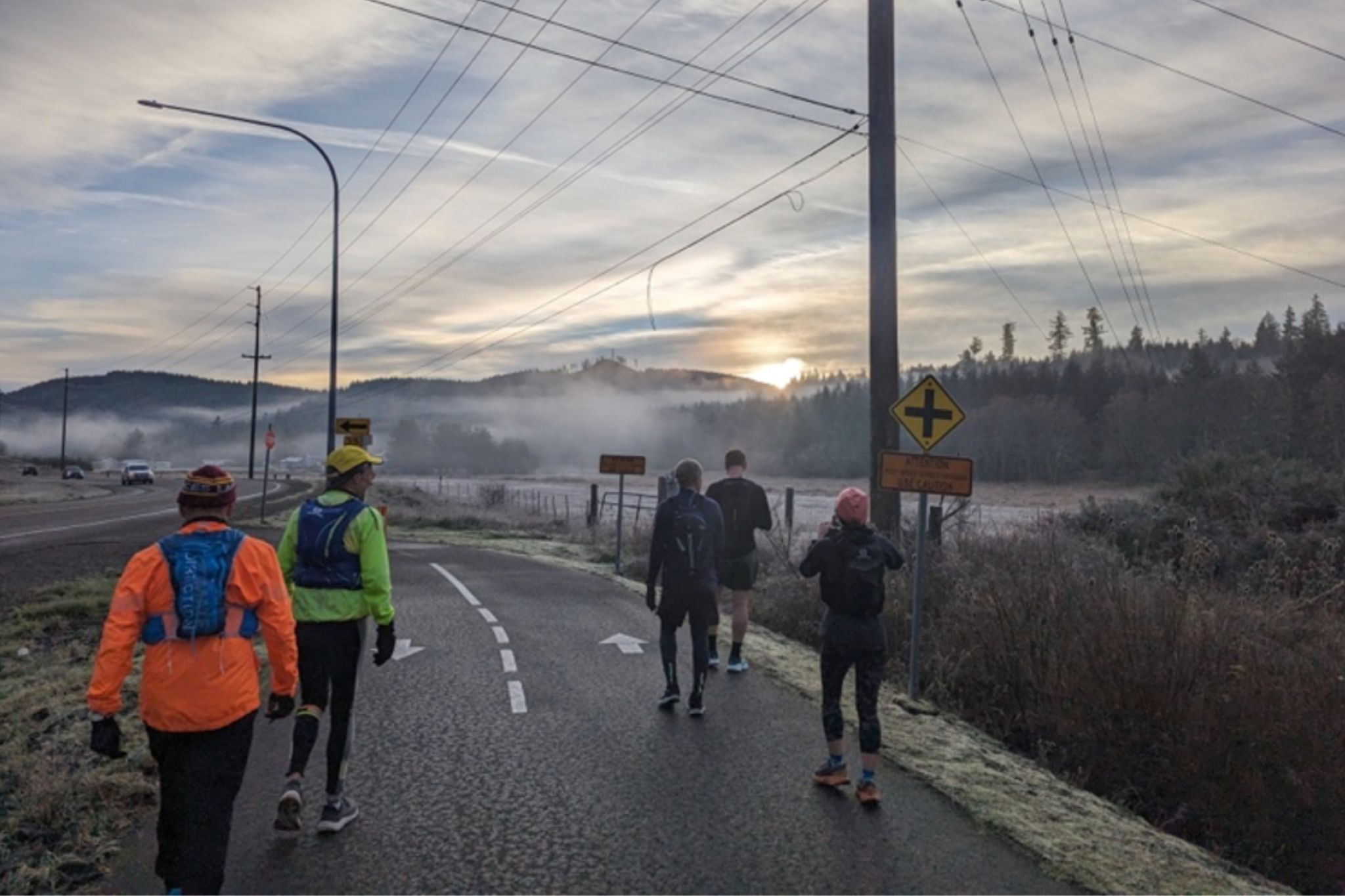
Ultrarunners all run long distances, but everyone’s tastes differ. We may prefer solo wilderness adventures, or large organized races (with sponsors, festive crowds and bling). Some blaze their own trails, while others run ultra distances on roads, tracks or treadmills. We can choose among fixed-distance events, fixed-time events, multi-day stage races, backyard ultras, fastest known times or conceptual performance art like Kilian Jornet’s 2025 bike-run-climb “States of Elevation” project. Some prefer to run Taco Bell ultras. Each type of run has its own quirky attractions and difficulties.
“Run All Night, Run All Day” (RAN-RAD or RAD-RAN) is another easy option that is adaptable to any community, during any time of the year. In Olympia, Washington, the inaugural RAD took place in December 2017, and events have been held twice each year ever since. The 18th event in June 2026 was an all-night, 37-mile trail run ending on the Pacific Coast. RAN-RAD has evolved into an informal community group run, including runners of diverse levels of experience. For some, it’s a low-key introduction to running at night, or on trails, for ultra distances. Others work it into their training for upcoming races.
RAN-RAD follows a simple pattern: the “day” or “night” start and finish times are defined by the local sunset and sunrise. But that simple proposition allows for mind-boggling variation. We usually start slightly before and finish after the nominal times reported for our location, because that’s the spirit of running all night or all day. Once you choose the date and location, you’ve established the minimum duration of the event: be running when the sun sets (or rises) and still be running when the sun rises (or sets).
Here’s how it works in Olympia, Washington. We’re fairly far north – comparable to Missoula, Montana; Duluth, Minnesota; or Presque Isle, Maine – and we hold runs near the solstices in June and December. So, we get just over 8 hours of run time on the shortest night (or day) of the year. Of course, runners in Tucson, Anchorage or Honolulu will face different conditions. Runners at the poles, at the equator or on in the International Space Station will have to deal with their own concepts of “all night” and “all day.”
Our RAN-RAD distances typically range from 35-45 miles, but we’re not fixated on miles or elevation. (OK, deep down, maybe some of us are.) We commonly overshoot the minimum time, even by hours, if the course demands. These aren’t races – they’re just excuses to spend extended time on feet, get to know other runners, test gear or fueling strategies or see new territory. For safety and companionship, we tend to stick together or regroup at landmarks along the route. It’s more about the joy of breaking out of a routine to gain a new perspective on the local area as the earth slowly turns beneath your feet.
RAN-RAD in our area is informal, with no registration and no fee. That doesn’t mean it’s disorganized. As the originator of the series, I pick a date months in advance and develop a route concept so people can train for the expected distance and terrain. We send out a general email and runners invite their friends, or people just hear about it by word-of-mouth. I try to learn who is expecting to show up so I can arrange carpools if needed, or communicate any late changes. As the date approaches, runners receive more detailed information about the course, safety, gear suggestions and other logistics.
Originally the route was totally made up during the run itself, but in recent years, the course announcement typically includes a mostly-accurate GPX file. This permits people to soothe worried partners, develop self-rescue plans, accommodate kids’ soccer games or drop in and out along the way if they can’t cover the entire distance. Runners are advised that the announced course may change, because we’ve made occasional on-course group decisions based on our progress, weather conditions or sudden inspirations. GPX files have even included spuriously direct straight-line segments to retain an element of surprise. So far, we’ve fulfilled a guarantee that every runner will run somewhere they’ve never been.
One year we started at sunrise, joined a local 5-mile charity race, finished it and just kept going until sunset to complete two overlapping events. RAD was free, and our paid registrations helped the charity. In 2019, we ran around the city limits of Olympia as our first themed route. Themes are a great way to develop a creative course. We’ve enjoyed runs featuring neighborhood pedestrian connectors, every city park in two adjacent cities, hours of towers and the 47th parallel. One run included visits to less-visited local sites highlighting Indigenous and early-European experiences, with pre-researched mini-lessons that were later sent out in written form.
Early runs were mainly on city streets, with short segments in parks and along urban trails. These days, most winter RADs remain urban-centered, but we venture further away for summer RANs. In 2020, pre-vaccine COVID pandemic restrictions required social distancing. RAN was not canceled. Minutes before sunset, a mysterious flash mob of runners assembled on the steps of our State Capitol and were gone within minutes. Deserted roads took us out of town to an obscure gate providing pedestrian access to the logging road network in Capitol State Forest. Our epic 45-mile loop that night traversed the local high point at Capital Peak and returned to the Capitol steps by another route. This first RAN-RAD multi-hour trail run was so well received that subsequent mid-summer RANs have been largely trail runs, enhancing our heat-map with big lines in the local trail network. These RANs also introduce many runners to lesser-run areas of the forest. Of course, running unfamiliar trails at night often inspires a return in daylight to see what one missed in the dark.
Local conditions will determine the distinctive character of RAD-RANs. Olympia’s short December days tend to be dark, rainy and windy. High-quality reflective and rain-proof gear, as well as lights, are needed even for so-called daylight hours. For safety, we minimize traffic risk by favoring residential streets, our local rails-to-trails or more remote suburban routes.
In town, runners can self-support using grocery stores, coffee shops, water fountains and public restrooms. Friends or family may volunteer to set up aid stations at covered outdoor park shelters. Logistics are more difficult for night-time trail RANs. We’ve pre-positioned fluid and fuel, hoping we find it before the critters do. We’ve even had some successful midnight rendezvous at pop-up aid stations along remote logging roads, with hot food, strings of lights and music, just like a “real” ultra. We leave no trace, avoid private property and when possible, end our runs with food.