
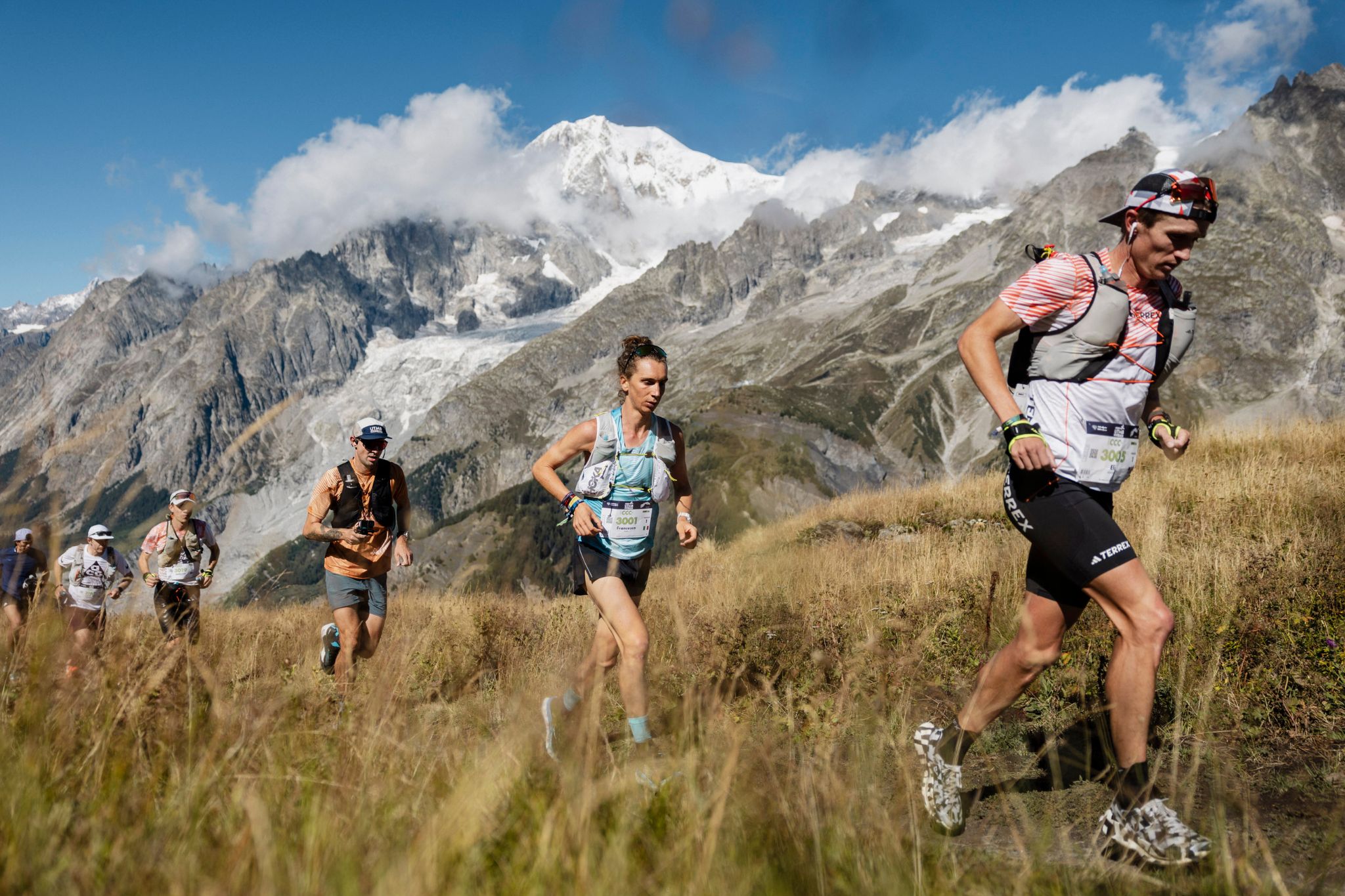
Éric Lacroix lives on Réunion Island, France, and works with elite athletes such as Matthieu Blanchard. He has firsthand knowledge of two of the sport’s most iconic races, specifically UTMB Mont-Blanc and the Diagonale des Fous. We asked him a few questions about mental preparation and motivation when running ultramarathons.
URM: What mental preparation advice would you give a runner tackling the Grand Raid de la Réunion, better known as the Diagonale des Fous, for the first time?
Eric Lacroix: On a race this long, there comes a point when your brain shifts into survival mode. The amygdala—the part of the brain responsible for detecting threats—starts to override the prefrontal cortex, which is responsible for planning, judgment, and decision-making. That’s why, sometime during the second night, your thoughts often become very basic and negative: “I can’t do this anymore.”, “I’m never going to make it.” That isn’t being weak, it’s just biology. Your brain is trying to conserve energy and focus on immediate survival. My advice to anyone tackling the Diagonale des Fous for the first time is simple: expect that moment before it happens. Don’t try to avoid it, because you can’t. Instead, learn to recognize it when it arrives and resist the temptation to believe everything your exhausted brain is telling you. A dark thought at 3 a.m. in Mafate isn’t reality. It’s fatigue talking. When that moment comes, focus on simple things: your breathing, the rhythm of your footsteps or the beam of your headlamp on the trail ahead. Those sensory cues help pull you out of panic mode and back into the present moment. And never underestimate the power of human connection. Sometimes, a brief exchange with a volunteer or another runner can do more for your race than an energy gel. At the right moment, it can remind you that you’re not alone and help you to start moving forward again. As for the final miles into La Redoute, remember this: by then, the race is no longer really about your finishing time. You arrive stripped down, exhausted, and vulnerable. But if you’ve stayed with it long enough, you often leave with a clearer understanding of who you are. That’s one of the reasons the Diagonale remains such a special race.
URM: UTMB Mont-Blanc has become a major enterprise, both literally and figuratively, and I get the sense that many runners now view it as a mandatory rite of passage, or one the few ultimate achievements in an ultrarunning career—much like the Ironman World Championship in Kona for triathletes. Yet, UTMB remains difficult to access, difficult to finish, and generates its share of frustration and DNFs every year (the average dropout rate is 35%). Before committing to such a demanding goal, it seems important to examine one’s deeper motivations. In your view, which motivations are most likely to lead to a positive UTMB experience, and which ones can make a runner more vulnerable?
Eric Lacroix: The comparison to Kona is a good one, and that’s exactly why it’s so revealing. A race can become the ultimate symbol for an entire community while remaining brutally difficult for runners who show up without first asking themselves an important question: Why am I really doing this? When I work with athletes preparing for a goal like UTMB Mont-Blanc, the first thing I want to understand isn’t their training plan. It’s their reason for being there. There is a huge psychological difference between running toward something meaningful and running to fill a void. When the motivation comes from within—from curiosity, from a desire to discover what you’re capable of, from a genuine attraction to the mountains and the journey itself—even a DNF can become a valuable experience. The runner comes home having gained something, even without a finisher’s vest. But when the motivation is mostly external—proving something to friends and family, seeking validation on social media or trying to earn a sense of legitimacy in the sport—this UTMB, like any major ultra, can become a trial. And UTMB is a harsh judge. Cold weather, technical terrain, sleep deprivation and exhaustion don’t care about anyone’s ego. This brings us to another concept we work with extensively: the mental load athletes carry before they even arrive at the starting line. Many runners show up in Chamonix already running a deficit. Work stress, poor sleep, jetlag, emotional strain and the pressure they’ve attached to the event itself have already drained part of their mental reserves. That invisible fatigue can weigh more heavily than any climb on the course. An athlete who arrives mentally fresh is far better equipped to handle the inevitable chaos of UTMB than someone who arrives already depleted, even if both are equally fit. The paradox is that the runners who seem to get the most out of UTMB Mont-Blanc—whether they finish under 30 hours or drop at refuge Bonatti in the middle of the night, approximately 49.7 miles from the start—are often those who came to experience the mountain rather than conquer it. They don’t come home feeling that they have to rebuild their identity. And that 35% DNF rate? It doesn’t surprise me at all. In fact, I see it as proof that the mountain and the race organizers are both still doing their job. The day UTMB boasts a 95% finish rate, it may become a showcase. For now, it’s still a true test, and that’s part of what gives it full meaning. So, before looking at a training plan, I would ask a simple question: if someone told you today that you would not finish UTMB, what would still remain of the adventure? If the honest answer is “nothing” or “not much” then there is work to be done before race day. And that work matters every bit as much as any long run in the mountains.
URM: In ultrarunning, at what point does social media become a hindrance to performance, well-being or mental health? And conversely, under what circumstances can they become a source of motivation and growth?
Eric Lacroix: I don’t believe social media is a problem in itself. The problem begins when the natural order of things gets reversed. At first, we run and then we share the experience—for the pleasure of telling the story, preserving the memory or connecting with other runners. But at some point, often without realizing it, the balance can shift. We stop running and then eventually talk about it. Instead, we start running so that we can absolutely talk about it. Consequently, the run no longer holds value on its own. It only seems to matter if it becomes a photo or a video, a statistic, a post or a form of validation. One of the areas I work on extensively is emotional regulation, and this is exactly the kind of pattern I teach athletes to recognize. The brain quickly learns to associate effort with its social reward: a like, a comment or a Strava ranking. Gradually, attention shifts away from the body and toward the screen. The question is no longer, “How do I feel?” but rather, “Will this give me something worth posting?” One of the clearest warning signs is the frustration many runners feel after a great run that wasn’t recorded because they forgot their watch or their GPS failed. The experience happened. The memory is still there. Yet part of them feels as though it somehow doesn’t count because nobody else will see it. That’s when social media becomes a genuine mental health issue: when the satisfaction comes less from the effort itself than from the reaction it generates. And the problem with reactions is that we don’t control them. That creates a quiet dependence on something external and unstable—the exact opposite of what endurance sports are supposed to teach us, which is how to trust our own internal compass. At the same time, social media can be incredibly valuable. It can help isolated runners feel connected to a community, provide inspiration and create a sense of accountability that encourages consistency. The difference isn’t the tool itself. The difference is who is in control. One simple exercise I often recommend is to occasionally go for a run that you don’t share with anyone—not even with an app. Not because technology is bad, but as a test and a reminder: this experience belongs to me before it belongs to anyone else. The day you no longer need to prove a run happened for it to matter, you’ve gained something far more valuable than a Strava segment record: the ability to simply be present, for yourself.