
Training zones are a tool. Like any tool, they’re only useful if you understand what they’re built on. When you understand the physiology underneath, a lot of the zone arguments that fill coaching forums start to look like noise.
A zone chart usually consists of five, color-coded columns, with ranges that feel precise and authoritative: Zone 2 for fat oxidation, Zone 4 for threshold and Zone 5 for VO2max. Follow the chart, hit the numbers and get faster.
The problem isn’t the zones. The problem is what gets lost in the translation from science to workout prescription and the fact that every coach, platform and system has their own names for essentially the same things.
Let’s go back to the source.
Why Zones Exist
The purpose of training zones is to describe meaningfully different physiological states, and ranges of intensity that produce distinct adaptations and place specific demands on the body’s energy systems.
Zones matter not because they give athletes numbers to obsess over, but because they ensure hard days are hard enough to drive adaptation, easy days are easy enough to permit recovery and the distribution of stress across a training block is intentional rather than accidental.
Without zones, athletes can drift. Easy runs get too hard, hard sessions don’t get hard enough and you end up spending most of your time in a metabolic no-man’s-land. A workout is too intense for maximal aerobic development and not intense enough to drive meaningful high-end adaptation. Athletes who drift toward moderate intensity accumulate fatigue without the full adaptation return of either high-volume easy work or properly executed quality sessions – a pattern that’s well-documented in endurance training literature.
The Three-Zone Model: Where the Science Lives
Before you had five zones or seven zones, you had three. And at the level of physiology, three is still the right number.
The three-zone model is anchored by two physiological inflection points. The first is where your body begins producing lactate faster than it can easily clear it, measurable as either the first lactate threshold (LT1) or its ventilatory equivalent (VT1). The second is where lactate accumulation outpaces clearance entirely, considered as the second lactate threshold (LT2) or ventilatory threshold (VT2). Ventilatory thresholds are used when lab gas analysis is available; lactate thresholds are when blood sampling is used. They describe the same underlying transitions and are often used interchangeably. These inflection points are not arbitrary – they reflect measurable, reproducible shifts in how the body fuels and tolerates work.
Zone 1 — Below VT1/LT1
At these intensities, oxygen supply meets demand, lactate production is minimal and the body clears what little accumulates without effort. Fat is the primary fuel source, with carbohydrate contribution increasing as intensity rises. Breathing is comfortable and conversational, and rate of perceived exertion (RPE) is roughly 3 to 5 on a 10-point scale. Adaptations include mitochondrial biogenesis and density, improvements in fat oxidation and metabolic efficiency and increases in cardiac stroke volume. Most of your training should live here, not because it’s easy (it isn’t, over long durations and high cumulative volume) but because you can accumulate it without meaningful recovery debt.
Zone 2 — Between VT1 and VT2
This zone spans the territory between your first and second lactate thresholds, from where lactate begins to accumulate faster than it can be easily cleared up to maximal lactate steady state (MLSS), the highest intensity you can sustain in a metabolic equilibrium. Breathing becomes effortful, conversation requires short sentences and RPE spans approximately 6 to 8. This is where structured tempo and threshold work lives, and where a significant portion of endurance performance gains are made, particularly in the upper range. Adaptations include improvements in lactate clearance capacity and mitochondrial enzyme activity.
Zone 3 — Above VT2
Above the second threshold, oxygen demand begins to exceed what aerobic metabolism can fully supply, and the anaerobic glycolytic system takes on a meaningful share of the workload. VO2 is at or approaching maximum, breathing is maximal, conversation is not possible and time to exhaustion is measured in minutes rather than hours. RPE is 9 to 10.
Adaptations here include improvements in VO2max – the ceiling of your aerobic engine – and the ability to buffer and tolerate the metabolic byproducts of high-intensity work. This zone carries the highest recovery cost and the highest injury risk – it is used strategically, not liberally.
Seiler and Intensity Distribution
The three-zone model has strong empirical support, and much of it stems from the work of Stephen Seiler at the University of Agder in Norway. In a foundational 2006 study with Kjerland, published in the Scandinavian Journal of Medicine & Science in Sports, and further developed in a 2010 paper in the International Journal of Sports Physiology and Performance, Seiler documented a consistent pattern: elite endurance athletes tend to complete roughly 80% of their sessions at low intensity and 20% at high intensity, with very little time in the moderate Zone 2 range. Zone 1 builds the aerobic foundation without meaningful recovery debt, Zone 3 drives adaptation at the upper end of the spectrum and Zone 2 is demanding enough to compromise recovery without producing a sufficiently distinct adaptation signal.
Before we apply that math, we need to understand what it actually describes. Seiler made an observation about how elite athletes self-organize their training – a documented pattern, not a prescription. The 80/20 split is also session-based, not volume-based. Coaches and athletes who apply it to total training minutes end up with far more time at intensity than the model reflects. In practice, session-based 80/20 looks like this: six sessions per week means five easy Zone 1 days and one hard day. Training prescriptions should be built around the physiological adaptations you’re trying to drive and the specific demands of your event, not around hitting a ratio.
How Three Zones Become Five (and Seven)
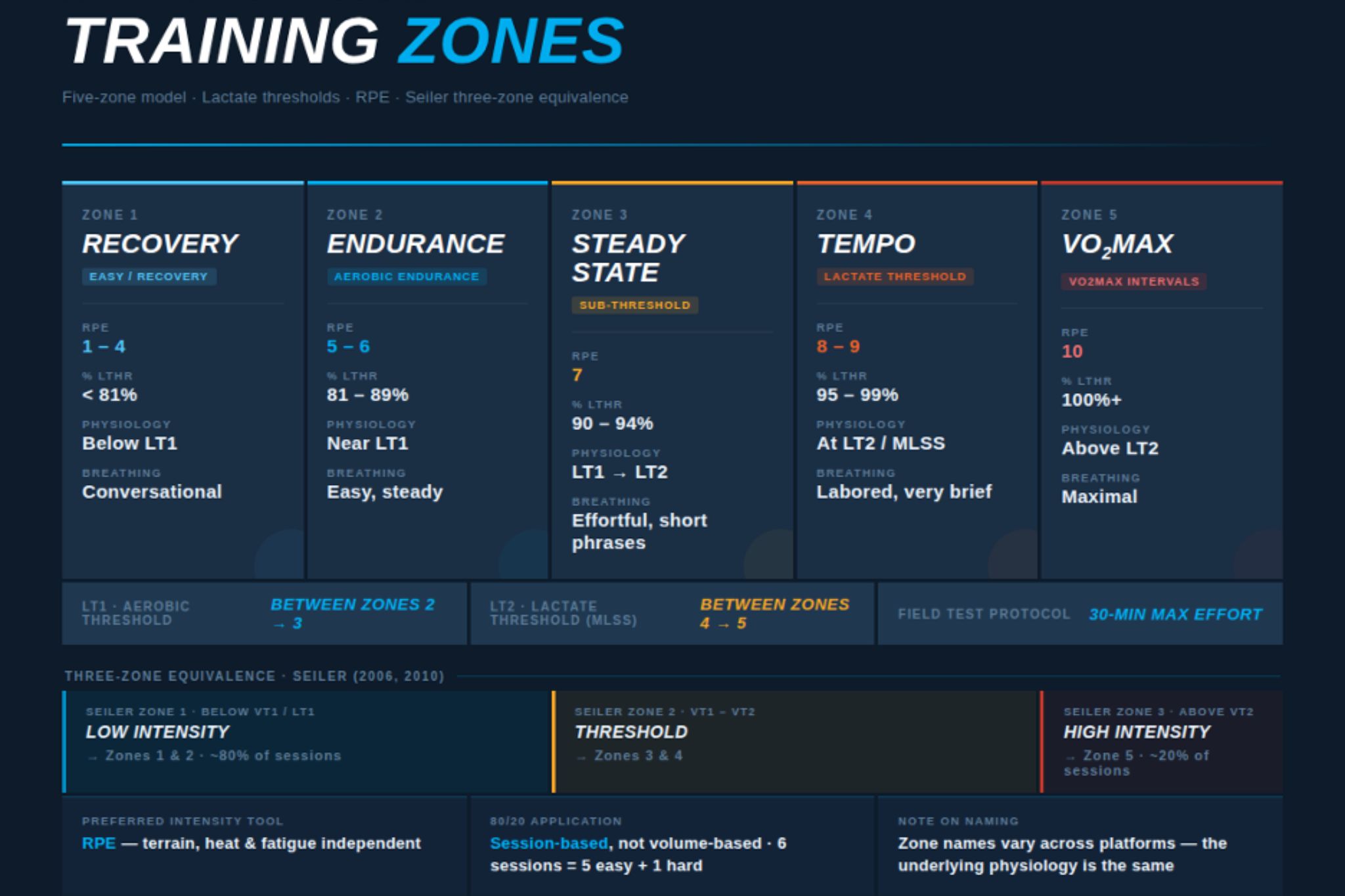
If three zones capture the underlying physiology, why do coaches use five? Because practical application requires finer resolution. The three-zone model tells you which physiological system you’re targeting. Five zones add enough precision to distinguish between a long endurance run, a sub-threshold steady state effort and a threshold session, intensities that perform differently in training even though the underlying physiology maps back to the same three categories. The above graphic lays out the full five-zone breakdown with RPE ranges, lactate threshold heart rate (LTHR) percentages and three-zone equivalence.
Seven zones, most commonly associated with Andrew Coggan’s work in cycling, subdivide the upper end further into anaerobic capacity and neuromuscular power. Those distinctions have genuine value in cycling, where power meters support that level of precision and the sport’s demands justify it. In ultrarunning, they exceed both the measurement tools available and the physiological demands the sport places on athletes.
Why Five Zones for Ultrarunning
Seven zones exist because cycling has a measurement instrument – power – that makes that level of resolution operationally viable, and because the sport’s demands actually require it. Sprinting, attacking and anaerobic accelerations are real competitive requirements in cycling that benefit from Zone 6 and Zone 7 distinction. Running has no direct equivalent. Pace is terrain and grade-dependent, heart rate is confounded by heat, fatigue, altitude and hydration status, and GPS pace on technical trail is an approximation at best.
More importantly, ultrarunning doesn’t select for Zone 6 and 7 adaptations. The sport is won and lost in the aerobic and sub-threshold domain. The additional zones in a seven-zone model are tools for specificity, not capacity-building, and for ultrarunners whose sport demands sustained aerobic output over many hours, that specificity argument simply doesn’t hold. Five zones capture the relevant physiological territory without demanding a precision that trail running cannot support.
Practical Tools: Finding Your Zones
Knowing the model is half the work. Knowing your own numbers is the other half.
The most accessible field test for runners is a maximal 30-minute effort on a flat, controlled surface. Warm up for 10 to 15 minutes, then run as hard as you can sustain for 30 minutes. Your average heart rate over the final 20 minutes is a reliable estimate of your lactate threshold heart rate (LTHR), and your average pace over the full effort approximates threshold pace. From there, zone percentages can be calculated, and the graphic above lays those out. Lab-based lactate testing provides more precision, but the 30-minute field test is accessible, repeatable and well-validated for most athletes. A trained and experienced coach can also derive these markers from existing training data, with no formal field test required.
RPE as Your Field-Portable Intensity Tool
Heart rate is a lagging indicator that reflects what already happened rather than what is happening in the moment, and pace is terrain-dependent, but neither is sufficient on its own for trail and ultrarunning where conditions are always changing and hours of effort decouple physiological response from simple metrics. RPE is available in every condition, on any terrain, at any elevation and at any hour of a race. When calibrated well, it is the most reliable intensity tool ultrarunners have, accounting for all the environmental and physiological variables you’ll encounter on a course in a way that no single metric can.
One honest caveat: every coaching system has its own RPE scale. CTS uses a 1 to 10 scale with specific zone language, the Borg CR10 scale is common in research and the original Borg 6 to 20 scale appears in older literature. They all describe the same underlying continuum, but the labels differ. What matters is that your scale is internally consistent and calibrated against real physiological markers through training and testing.
The Simple Message Under All of This
The three-zone model is the physiological truth. Zone 1 builds the aerobic foundation, Zone 2 raises the lactate threshold and Zone 3 develops VO2max. The five-zone and seven-zone frameworks are precision layered on top of those three realities, useful for coaching application and session design, but they don’t change what’s happening underneath. The physiology doesn’t care how many columns are on your zone chart.
If you can execute a structured five-zone plan with accuracy and consistency, that’s the right tool. If the terrain is too variable, conditions too unpredictable, or the numbers simply don’t hold up, the three-zone model with RPE is not a fallback – it’s a legitimate and well-supported approach. Get the proportions right across easy, moderate and hard efforts and sustain that discipline week after week. That’s the most important variable in ultrarunning training, and no zone chart changes it. How you apply the science depends on your terrain, your tools and your own physiology.
References
Seiler, K.S. & Kjerland, G.Ø. (2006). Quantifying training intensity distribution in elite endurance athletes: Is there evidence for an “optimal” distribution? Scandinavian Journal of Medicine & Science in Sports, 16(1), 49–56. https://pubmed.ncbi.nlm.nih.gov/16430681/
Seiler, S. (2010). What is best practice for training intensity and duration distribution in endurance athletes? International Journal of Sports Physiology and Performance, 5(3), 276–291. https://pubmed.ncbi.nlm.nih.gov/20861519/
Koop, J. & Rutberg, J. (2021). Training Essentials for Ultrarunning, 2nd Ed. VeloPress. https://trainright.com/ultrarunning/