

Vincent Bouillard broke 14 hours at Western States, running 13:46 to become the first person ever to do so and shattering the course record by 23 minutes. A few hours later, Jenn Lichter crossed the same finish line in 15:28, dipping just under the course record in her 100-mile debut. Two course records were broken on the same day, on the sport’s biggest stage. I spoke with both of their coaches to see how they contributed to these athlete success stories.
Bouillard is coached by Mario Fraioli, an independent coach and longtime running journalist, who produces the popular podcast The Morning Shakeout. Mario coaches a variety of ability levels across multiple distances, including road, track and trail. Lichter is coached by John Fitzgerald, one of my fellow coaches at CTS. What makes this story interesting is their connection – Mario also happens to be part of John’s early development as a coach.
A Line That Runs Through Both
From 2010 to 2012, Mario coached John as an athlete, helping him drop his marathon best from 2:56 to 2:42. That relationship did more than build fitness, it planted the coaching philosophy John would eventually build his own career upon. “I was really lucky to have that connection,” John told me. “He would take the time to jump on phone calls, and I would meet with him at races. With that connection came trust. I trusted the program. I trusted what he was giving me.”
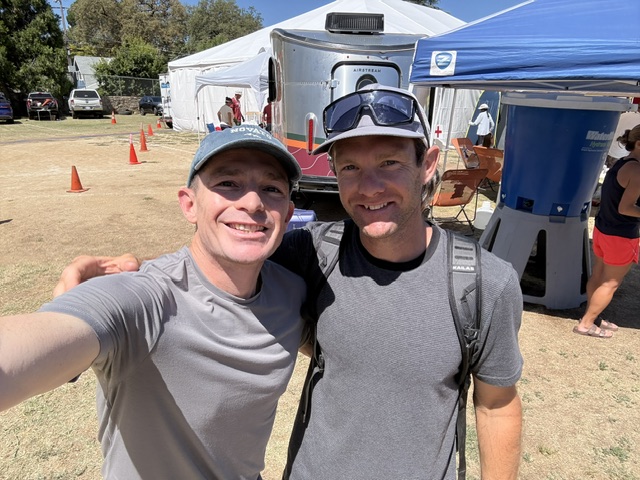
Fraioli (left) and Fitzgerald use their coaching strategies for both elite ultrarunners and age-group runners training for multiple distances. Photo courtesy author
John went on to become the first person Jason Koop hired as he was building the CTS ultrarunning coaching program, which is where the second half of his development was cultivated. Koop brought the data and the science up a level, but he also gave John language for what Mario had already taught him by example. “Coaches can see but can’t feel, and athletes can feel but can’t see,” John said, citing a mentor’s line he’s carried with him. “We can program extremely well, we can have all the evidence and the data to back it up, but if there’s no buy-in, if the athlete isn’t engaging with us, it’s just not going to work.”
So, John didn’t inherit one coaching style, he inherited two, and the blend of both is largely what makes him effective as a coach. Mario gave him the relational foundation, and Koop gave him the science to build on top of it. This June, both lineages met on the same course, on the same day, with both of their athletes standing at the very top of the podium.
From my conversations with Mario and John, it’s evident that they live out three coaching pillars that make them elite. Some elite coaches lean toward one of the following pillars more than others, but they are competent in applying all three in practice.
Pillar One: Personal Connection
If there’s a single non-negotiable in this framework, it’s this one, and both Mario and John are world-class examples. You can be strong in applied science and understanding data, but if the relationship isn’t solid, nothing else holds weight.
Mario put it plainly: “Like any solid relationship, establishing and maintaining a good connection mostly comes down to two things: trust and communication. If even one of those elements is missing or underdeveloped, it’s just not going to work. The foundation will crumble. It’s not a top-down approach. Yes, I write the training and provide various forms of guidance, but their input, feedback and ideas are essential to helping me understand where they’re at.”
John operates the same way, though the shape of it looks different because of how he has built his roster. Several of his elite athletes, including Lichter, live and train together in Missoula, which means he’s coaching a group of runners who are also racing directly against each other. That’s a delicate thing to manage, and he’s found that the key isn’t by dividing his attention evenly, it’s making sure no one reads extra time with one athlete as the neglect of another. “When athletes see me connecting, putting in a little bit more time with one athlete, it almost gets them more excited,” he said. “They know that if one of them can get better, that’s going to make all of them better.”
That sentiment really stands out, as it reflects the level of maturity and confidence that his athletes possess.
Neither coach treats connection with their athletes as something you establish once and move past. It’s ongoing work and both of them return to it constantly, whether the athlete in front of them is racing for a course record at Western States or training for their first 50k.
Pillar Two: Evidence-Based Training
Evidence-based training is built on a small set of universal training principles: overload and recovery, progression, periodization, specificity and individuality. These aren’t unique to running. They govern adaptation in every sport, from swimming to powerlifting to alpine skiing. What changes from sport to sport and athlete to athlete, is how those principles get applied given the specific demands. The principles are fixed, but the application is not.
At CTS, every coaching decision that’s made gets run through this same framework. If a method or approach doesn’t have direct evidence behind it, it won’t be automatically disqualifying, but it earns a higher level of scrutiny before it goes anywhere near an athlete’s program. Sometimes a coach’s instinct is genuinely ahead of the published research. That happens, and it’s part of how the field moves forward. But there’s a difference between being ahead of the evidence and being in defiance of it. If an approach violates one of the universal principles like overloading without recovery, ignoring individual response, skipping progression or manufacturing fatigue through artificial loading, rather than training the actual demands of the sport, it isn’t a bold new idea. It’s just wrong, regardless of how it’s marketed or who’s selling it.
The reason all of this matters, beyond intellectual honesty, is trust. When training is built on these principles, an athlete can have confidence that what they’re being asked to do is going to work, not because a coach said so, but because it’s grounded in something more durable than one person’s opinion.
That’s the lens to hold up against Mario and John. Neither of them talks about training in terms of overload, progression or periodization explicitly, because that’s not how they naturally communicate, but everything in their answers maps directly onto this framework.
Mario’s principles are deliberately few: “In terms of exercise science principles, it really comes down to three things: one, developing and maintaining a solid aerobic foundation; two, establishing a consistent training structure that works for the athlete, their goals and their lifestyle; and three, dialing in the specificity when appropriate. I’ve found those to hold up no matter if someone is training for a mile or 100 miles.”
Applied to Vincent Bouillard, that meant a high-volume, mostly aerobic 13-week block that never changed shape, built around the reality that he also works part-time at Hoka and is a new father. Evidence-based training, in Mario’s hands, is less about rigid application of exercise science and more about pointing well-established principles at the actual life of the athlete in front of him. “I think rigidity is a trap,” he said. “It’s important to be firm in your principles but flexible with how you apply them.”
John’s version of evidence-based training shows up as a willingness to unwind an athlete’s existing habits when they’ve hit a ceiling. Jennifer Lichter came into her Western States buildup with a 50k background built on higher intensity and interval work. That approach had served her well at shorter distances, but John recognized it wouldn’t hold up at 100 miles. “I knew that if we stuck to her current program going up in distance, we weren’t going to have any room to progress into more specific training for the longer distances,” he said. The fix wasn’t complicated. Dial the easy days down to genuinely easy, which created room to add volume without adding fatigue.
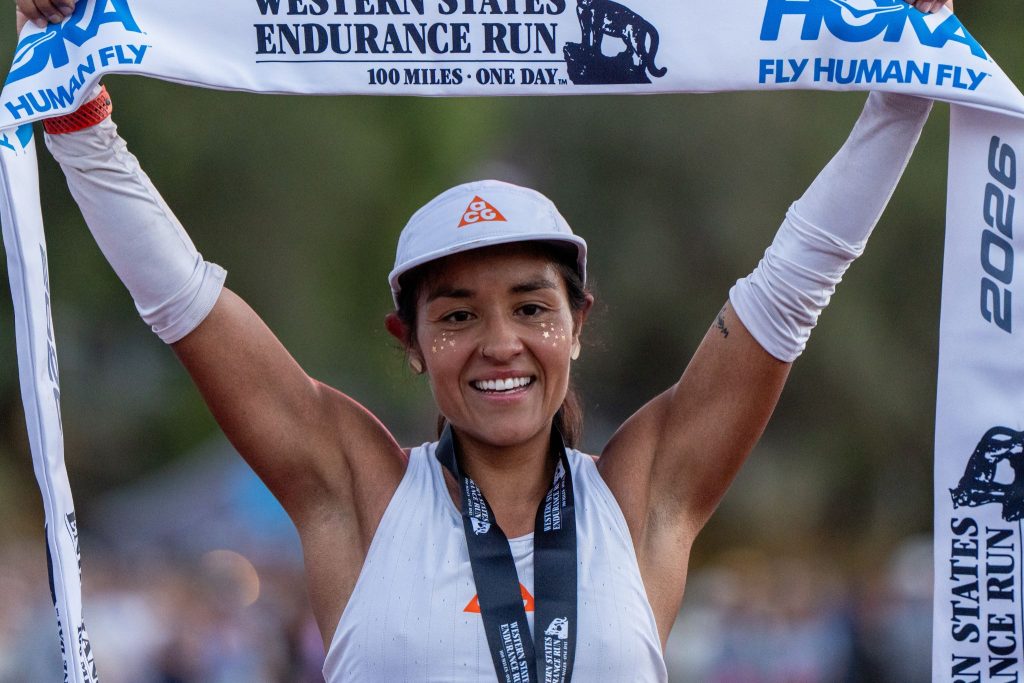
Jennifer Lichter crosses the finish line at Western States, winning the women’s race and setting a new course record. Photo: Paul Nelson
“It’s incredibly simple,” he said, and then immediately pushed back on his own statement. “But there are some athletes, when we talk about the fundamentals, doing the simple training, the best that you can do is not necessarily an easy thing to get right. It’s simple in theory, but it’s hard to execute. I think that’s what separates a world champion from someone who can’t quite get there.”
Both coaches, in their own language, are describing the same discipline: resisting the pull toward complexity and novelty, and trusting that consistent execution of a few, well-chosen principles beats a more sophisticated plan that is unsustainable.
Pillar Three: Advanced Tools & Technology & Data-Driven Decisions
The third pillar exists because subjective feedback only tells half the story and insights often lay hidden in trends over time. An athlete’s perceived effort and self-report are real and important, but they’re inherently limited by the athlete’s own day-to-day awareness, whether from inexperience, denial or simply lacking the training background to interpret their own signals accurately. A coach who relies only on what the athlete says they’re feeling is missing context that exists independently of the athlete’s perception. Data fills that gap. It’s the other half of the picture, not a replacement for connection, but a second, more objective source of information a coach uses to make an informed decision.
This is why I say a coach who isn’t analyzing data is just an accountability partner or cheerleader. Coaching requires analysis and an understanding of how to leverage that data for further athlete development.
But data cuts both ways. Kept in context, it sharpens decision-making. Taken out of context, or chased for its own sake, it does the opposite. Some data points are genuinely meaningful, while others are noise that pulls attention away from what matters. Part of the skill in coaching at this level is knowing the difference.
Both Mario and John operate well inside this definition. They just keep the application simple and resist letting it outrun its usefulness. John pulls straight from TrainingPeaks and is deliberate about which numbers earn a permanent place in his process. “What is something that I can gather daily from an athlete that I can use on a daily basis?” he said. “It’s pretty simple data that I actually just pull straight from TrainingPeaks.”
He’s also wary of metrics becoming ends in themselves, citing Goodhart’s Law: “A measure that becomes a target ceases to become a good measure.” His baseline check on any athlete is still foundational load data, “How many hours did an athlete do this week?” before zooming into intensity distribution within that volume.
Mario works through Final Surge and describes being handed “more data than I know what to do with or could possibly be useful.” His filter is sequence: athlete feedback first, then the numbers. “I’m mostly interested in how the athlete’s perceived effort lines up with what I assigned for a given workout or run, and if there’s a discrepancy there, going about the business of peeling back the layers to figure out why.”
Beyond that, he tracks total time at a given intensity, elevation relative to the session’s objective, heart rate and pace. With Bouillard specifically, the one new data source this cycle was a Core body temperature sensor, used to build heat adaptation without overreaching into it, a clear example of data adding real information a coach can’t get from feel or feedback alone.
They’re both filtering data hard, using it to confirm or challenge what connection and training principle already suggest, and that filtering, not the volume of data collected, is the actual skill on display.
What Actually Separates Good from Great
Asked to name the one thing that separates good coaches from great ones at the elite level, both coaches landed in the same place but from different directions.
Mario refused to isolate a single pillar. “You can’t separate the three, at any level of the sport, but the foundation of the relationship is built on connection and that work is ongoing. Applying evidence-based training and using data appropriately are important, of course, but they’re only as useful as your ability to tailor them to the person you’re working with, and I don’t think you can do that well if the connection isn’t solid.”
John arrived at the same conclusion. “You can have all the data, you can have the best programming in the world, but if that connection isn’t there, if that trust and communication and that partnership isn’t there, everything kind of crumbles.”
Asked whether that changes once you’re not coaching someone chasing a podium, his answer came without hesitation. “That’d be really strange if I just completely ignored that connection with my age-group athletes. I’ve had some of my longest-standing relationships with age-group athletes. I would say it’s just as much of an importance.”
Mario and John are, by their own description, weighted differently across these three pillars. One leans harder into feel, the other into a more even split of feel and data, but neither of them are willing to let any of the three go entirely. Both of them insist that the framework holds regardless of who’s standing in front of them. A cheerleader can build connection without evidence or data behind it, and it will feel good for a while, but it won’t produce results. A technician, or even AI, can build a program without any relationship underneath it, and it may work for a season, but it won’t hold up under real stress.
What separates elite coaches isn’t that they’ve found some higher tier of expertise unavailable to the rest of us, it’s that they never stopped treating the athlete in front of them as a person first. Someone with a job, family, fears about their own limits and a busy life needs training to fit into it rather than override it, and evidence-based training is the tool. The data is the information. But the coaching itself, the actual thing that separates good from great, is the same whether the athlete is racing for a Western States title or trying to survive their first 50k: pay attention, build trust and have a deep level of emotional engagement with the athlete’s goals and development.