
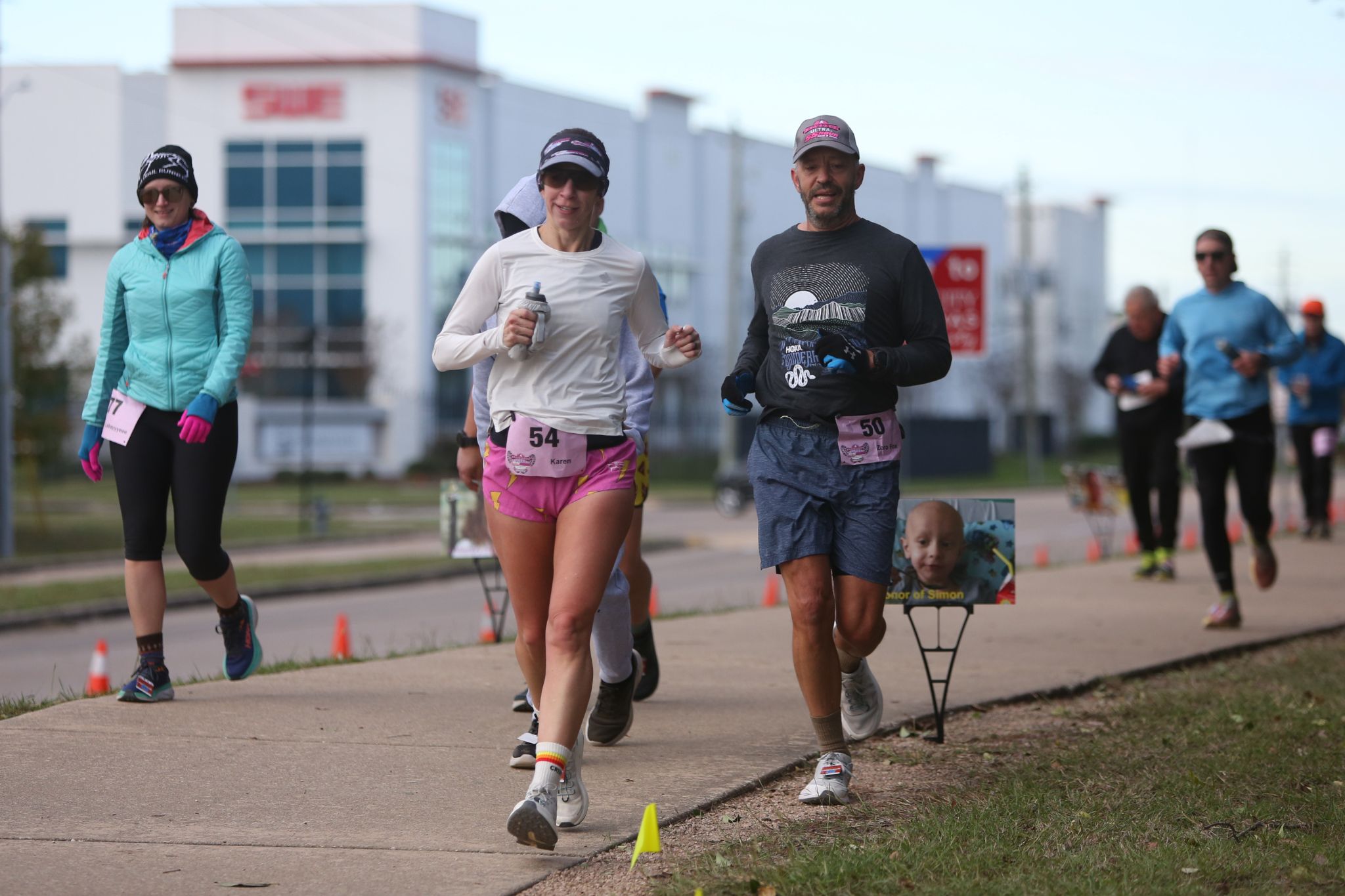
The New Year’s holiday is always popular for racing. We all want to finish the year strong and get the New Year started on the right foot. Some of us even like running from one year straight into the next.
Snowdrop 55 Hour Ultra Race and Relay in Missouri City, Texas, gives runners (and walkers) 55 hours to reach 100 miles or more. It attracts both those that might not otherwise reach 100 miles in a standard cutoff and those trying to set records and go as far as they can in 55 hours. Buckles are awarded 100, 150, 200 and even 250 miles. Meanwhile, relay teams keep the energy high and constant throughout the 55 hours.
But why 55 hours? Snowdrop Foundation encourages all participants to fundraise to give pediatric cancer survivors scholarships for college (but it’s not required). The inspiration for this event and founder of the Snowdrop Foundation was Chelsey Campbell who, in 2006 at age 15, underwent a record-breaking 27-hour surgery for a rare cancer. One primary surgeon and one assistant surgeon completed the full 27 hours equaling 54 hours of surgeon time. An hour was added to represent Chelsey, and that’s how the 55 hours was established for the event. Every year, bib #55, assigned to Chelsey, gets carried throughout the race by different runners to keep her memory going after she passed away from stage four undifferentiated sarcoma in December 2006.
The course is a USATF-certified loop of 0.69045 miles on crushed granite and paved sidewalk. Runners and crew set up tents around the gravel portion of the loop and can access aid throughout the race at their set-up and at the race-supplied aid station. Runners are supported with catered meals and regular aid station fare. Medical support is on site to assist with foot and body care. The course is lined with pictures in honor and in memory of children with cancer.
After four years of running this event as part of a relay team, this was my first time running solo. One thing that hooked me to race it solo is that every person reaching a milestone (100, 150, 200+ miles) gets to ring the bell and do a victory lap with a baton that flashes at night. As that person makes their way around the loop, people cheer and congratulate the runners. Sometimes people join in for the finish. Then that person gets to “win” their personal journey by running through the finisher tape. During the race, you will see people tap some of the honor/memorial signs on the course as they pass by, and one of those is for co-race director Jared Mansell who is a survivor of pediatric cancer. There are inspirational people like Meg Eckert who has the female record for the course in 2023 and Juan Acevedo who has run 200+ miles the last consecutive five years, making him the fastest to reach the 1,000-mile milestone. This year, Pamela Chapman Markle set American age group records for 70-74 at 12 hours, 100k, 100 miles and 24 hours. Also, she was the second female to reach 100 miles.
I didn’t quite know what my goals for this race would be, but I had several options. With great weather on day one and a cool start with mild temperatures, I just let the day decide. By mid-afternoon, I had climbed to first female and then also first overall. A girl from a high school cross-country team doing the relay gave me a fist bump and shouted, “You are in first!” Well, I can’t let the ladies down now, can I? Goal solidified. Being the first to finish 100 miles was my target. The day was fun with various groups and friends around the loop for cheers and smiles. Shortly before 3 a.m., I finished 100.11 miles in 19:38:09 as first overall to 100 miles. After that, I took a break and then elected to walk the next day due to some foot tendonitis. Since I was still on track for lead female for most miles, I walked 35 miles on day two, got some sleep overnight and walked another 20 miles the final morning to reach the next buckle milestone for 150 (plus 5 more miles because 155 felt right).
I asked Kevin Kline, President of Snowdrop Foundation (who is also behind the microphone much of the event), what his key moments were this year. Two runners, Susan Bell and Deborah Sexton, completed 100 miles (14 years in a row). Juan Acevedo hit another 200+ miles and reached 1,000 cumulative race miles just before the 2 p.m. finish time on New Year’s Day. It was the largest solo and relay field to date. Three high school cross-country teams participated. Two coming from Watonga, Oklahoma, because their coach, Greg Adams, had run the race before and they wanted to run it based on his stories about the race.
The final day is always inspiring. Many runners have completed their 100 miles and have already left. Then there are those still going for that milestone or something greater. Maybe they just want to see how far they can go or they are trying to reach the next buckle. Early on that day, I walked a bell lap along with Lisa Decker and Wayne Gross, friends I often see at races. Wayne could have finished 100 miles overnight but saved his final lap for daylight so he could carry his sign for Anne Marie across the finish among friends since the nighttime is always quieter. With emotional hugs at the finish from all of us and the RDs, we are reminded why we do this. We do it for those who no longer can. We do it again and again, because we can.
See you next year, Snowdrop Family.
Full results here.