
Fitness is your foundation. If you show up to Western States undertrained, no amount of heat adaptation or cooling strategies will save you. But if you’re fit enough to complete the race, heat adaptation matters enormously. Weeks of deliberate heat acclimation give you a larger plasma volume, a lower exercising heart rate and a body that starts sweating earlier and more efficiently. That’s meaningful, but it’s still incomplete without execution on race day.
The canyons at Western States don’t care how fit you are or how much time you spend in the sauna. By the time you hit Foresthill at mile 62, your core temperature has been climbing for hours, the air is still hot and the trail offers no shade.
Heat acclimation prepares your physiology for heat stress. Cooling strategies manage it in real time. Both matter of these matter, and they’re not interchangeable. This piece is about the third part of that equation.
Why Heat Kills Performance
To understand why cooling works, you need to understand what heat is actually doing to your body.
When you run, your muscles generate heat as a byproduct of energy production. At race pace, only about 25% of the energy you burn goes toward moving you forward. The other 75% becomes heat. Your body’s job is to get rid of it fast enough that core temperature stays within a range where physiology can function normally.
It does this primarily through two mechanisms: sweating and redirecting blood flow to the skin. Both of these heat reduction mechanisms have costs.
Every liter of blood in your body has a destination. At race intensity, your muscles are demanding an enormous share of cardiac output. But as core temperature climbs, your body also needs to route blood toward the skin to facilitate heat exchange with the environment. Those two demands compete with one another. The heart compensates by beating faster – known as cardiac drift – which means at the same pace, your heart rate climbs even as your effort feels identical. You’re working harder to go the same speed.
Meanwhile, perceived effort decouples from reality. Rate of perceived exertion (RPE) climbs independent of pace, and decisions degrade. The executive function you need to manage nutrition, pacing and crew logistics starts to erode at core temperatures that don’t feel dramatic.
Add in the demands of Western States, specifically the exposed canyons where temperatures regularly exceed 100 degrees, and you have a race where thermal management isn’t just a footnote.
What Works and Why
Lindsey Hunt, PhD, senior sport scientist at Precision Fuel & Hydration, presented a cooling framework to the CTS team that cuts through a lot of the noise on this topic. The evidence points to a clear hierarchy of methods, and the reasoning behind that hierarchy matters as much as the list itself.
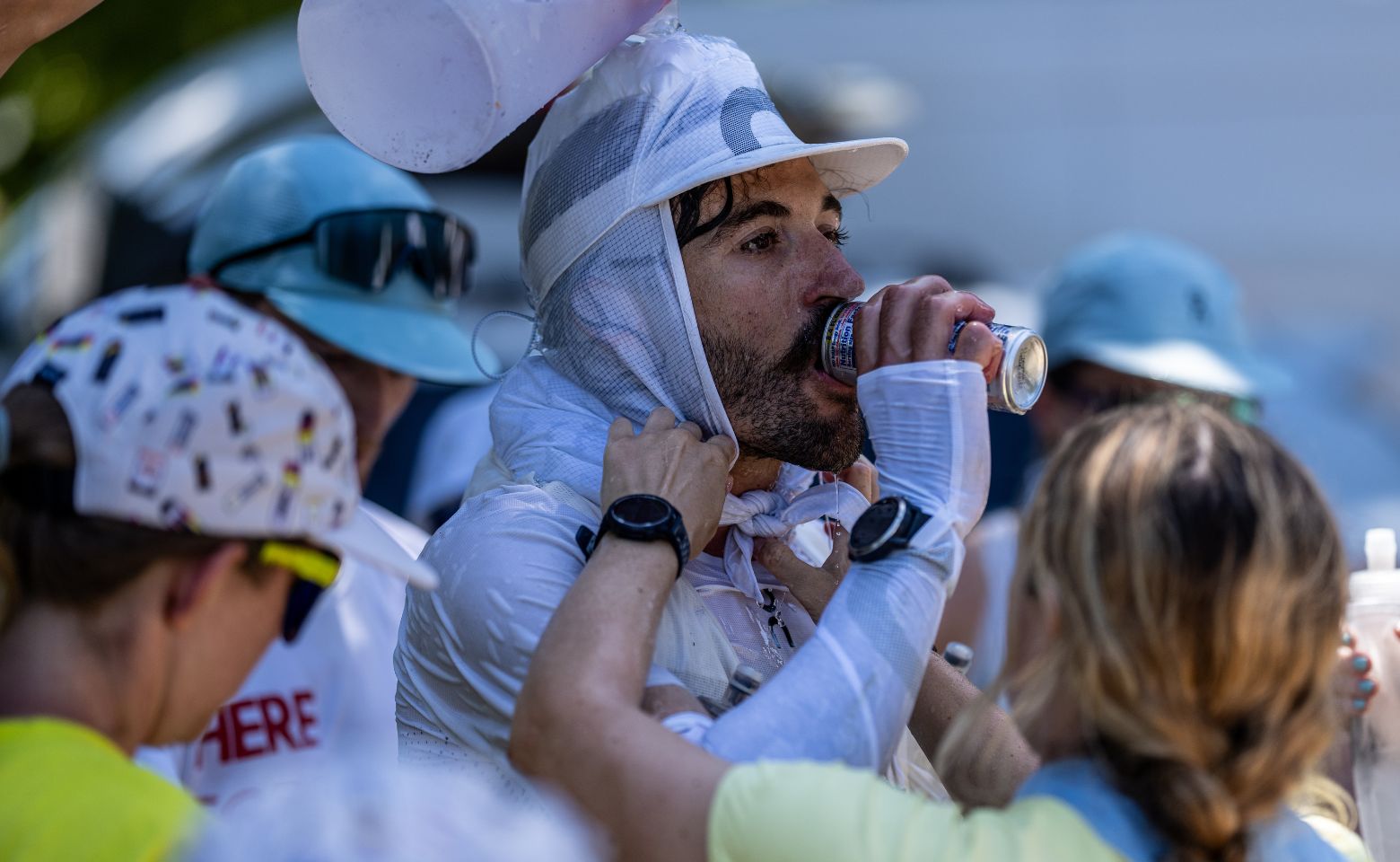
The most effective in-race cooling methods available at Western States are water dousing, ice in a hydration pack, ice bandanas, ice in arm sleeves and cold water immersion at aid stations when available. Across the research, these methods collectively show roughly a 4-6% performance improvement in controlled heat stress studies of 2-4-hour duration – a figure that likely represents a conservative floor at Western States, where the thermal load is sustained far longer (Bongers et al., 2015; Stevens et al., 2017).
Water dousing is the most underrated tool on that list. The mechanism is evaporative cooling – water applied to the skin surface absorbs heat as it transitions from liquid to vapor, pulling thermal energy away from the body in the process. In the exposed canyon sections of Western States, where airflow and direct sun are both present, dousing is highly effective precisely because the conditions that make the race hard also maximize evaporative return.
Ice in a hydration pack works through sustained conductive cooling against the torso. The detail that matters most in execution is ice chunk size. Bigger pieces have less surface area relative to their volume, which means slower melt and longer duration of effect. Small, crushed ice is gone in 20 minutes. Large chunks are still working an hour and a half later.
There’s a recent trend of athletes skipping ice contact methods entirely, based on the argument that ice on skin causes local vasoconstriction that works against heat dissipation. The mechanism is real, however, the conclusion is overcorrected. Vasoconstriction is local and temporary, and the net thermal effect is still a reduction in core temperature load.
Ice bandanas and arm sleeves target high-flow areas like the neck, wrists and forearms, where blood vessels run close to the skin surface. The logic is straightforward: cool the blood near the surface and you’re cooling the blood returning to the core. These methods are crew-friendly, the gear is easy to reload at aid stations and they require no modifications to your pack setup.
Cold water immersion is the most potent single intervention on this list. Full immersion drives the most rapid reduction in core temperature of any practical field method. The limitation at Western States is access – aid stations have not historically offered immersion, so this one falls on your crew. The time cost is real, but the benefit justifies it for most athletes, and for those targeting competitive finishes, it’s a calculus worth making before race day rather than in the moment. Last year, our CTS crew brought kiddie pools to the aid stations accessible to crew, and the impact on our athletes through the canyons section was significant. We’re doing it again this year. Who doesn’t want to jump in a kiddie pool full of ice water when it’s 100 degrees?
The through-line across all of these methods is the same: you are trying to reduce the thermal load your cardiovascular system is managing so that blood flow can be directed toward working muscles rather than toward heat dissipation. Every degree you keep off your core temperature is cardiac output that stays where you need it.
Ice Slurries?
The research on ice slurries shows real benefit—pre-cooling reduces core temperature, and mid-race ingestion extends time to exhaustion in heat stress conditions (Bongers et al., 2015; Jay & Morris, 2018). There’s also evidence that cold fluid ingestion blunts the thirst signal through thermoreceptors in the stomach, potentially reducing total intake (Morris et al., 2016). For athletes drinking to thirst, that’s a liability. But drinking to thirst at a 100-mile race in triple-digit heat isn’t a strategy – it’s a gap in your plan. The athletes who execute well at Western States drink to a schedule based on temperature-dependent sweat rate estimates. For them, the blunted thirst signal is irrelevant. Within a disciplined intake framework, cold drinks and ice slurries are a useful tool, not a liability.
The Hierarchy
Pull it together into a race-day framework and it looks like this.
Your primary cooling tools are water dousing and ice in the pack. These are the methods with the broadest evidence base, the most practical accessibility at Western States and the lowest downside risk. Douse at every aid station exit, so evaporation is working for you on the trail. Use large ice chunks in your pack and reload aggressively. If you’re running with a crew, this is their most important job in the canyons section.
Your secondary tools are ice bandanas, arm sleeves and cold water immersion. Reload bandanas and sleeves at every crewed aid station. If an aid station has a pool, use it – the time cost is real but so is the benefit. Make this decision in advance based on your goal and your position in the race, not in the moment when you’re already overheated and your judgment is compromised.
Your fluid and nutrition strategy runs alongside all of this, not downstream of it. Drink to a schedule based on your sweat rate and the temperature. Use ice slurries if you have access to them – cold drinks are a complement to your cooling plan, not a substitute for it. The athletes who fall apart in the canyons are rarely the ones who made one catastrophic mistake – they’re the ones who let their fluid intake slide because they felt okay, and then stopped feeling okay 20 miles later with no good options left.
Finally, rehearse this. The worst time to figure out your cooling protocol is mile 38 in the canyons when your core temperature is already elevated and your crew is improvising. Brief your crew on the reload sequence before the race starts. Practice dousing in training runs on hot days so the habit is automatic. Cooling execution is a skill, and like every other skill in ultrarunning, it degrades under fatigue if it hasn’t been practiced under normal conditions first.
Lindsey Hunt shared that Norwegian professional triathlete and Ironman World Champion Solveig Løvseth said it best: “Heat training is my most powerful cooling strategy.” That’s the right starting point. Adaptation reduces the thermal burden your body carries into race day. But adaptation is the foundation, not the full structure. The athletes who perform deepest into the Western States heat combine that physiological preparation with deliberate, rehearsed execution on race day – managing their thermal load in real time, aid station by aid station, with tools they’ve thought about long before the gun goes off.
References
Bongers CCWG, et al. (2015) — Precooling and percooling both improve performance in the heat
Jay O & Morris NB. (2018) — Does cold water or ice slurry ingestion during exercise elicit a net body cooling effect in the heat?
Morris NB, Coombs G & Jay O. (2016) — On the maintenance of human heat balance during cold and warm fluid ingestion
Stevens CJ, Taylor L & Dascombe BJ. (2017) — Cooling during exercise: an overlooked strategy for enhancing endurance performance in the heat