
Gary Cantrell (better known to the ultrarunning world as “Lazarus Lake”) once imagined a race with no finish line, and the idea came from his days in high school track when running 4 miles an hour was the only way he could outlast the fastest runner on the team. Decades later, that concept found its purpose. Tennessee’s Greenbelt tax program required him to keep his own 150 acres as an open‑space or conservation forest to maintain affordable property taxes. Rather than log or develop the land, he created a recurring event on his property: a simple looped race named after his dog, Big. That race, Big Dog’s Backyard Ultra, fulfilled the Greenbelt use requirement, preserved the land exactly as he intended, paid the taxes and ultimately grew into one of the most iconic endurance events in the world.
From Cantrell’s humble backyard in Tennessee, the format has exploded into one of the most influential movements in modern ultrarunning. Backyard Ultras now appear in small towns and major cities all over the world and are designated as national championships and international team competitions. Cantrell recently recalled that participation doubled in 2020, and today, there are roughly 700 affiliated Backyard Ultras and another 700 unaffiliated events across more than 85 countries.
But the questions remain: why has this format captured the imagination of runners everywhere? And what makes a Backyard Ultra so different from the traditional ultras that built the sport?
Part of the appeal lies in its simplicity: run 4.167 miles every hour, on the hour, until only one runner is standing. It’s a format that gives average runners a legitimate shot at running a sub‑24‑hour 100‑miler, and one where the fastest athletes can’t simply outrun the field. Everyone starts together every hour. Everyone resets. Everyone depends on each other to keep the race alive. It’s a format that brings runners together and, eventually, tears them apart. In a Backyard Ultra, you are never behind – you are only one loop away from being right back in the race.
As the race director of St. Louis’s only Backyard‑style event, the Queeny Backyard Ultra, I’ve seen firsthand how this format becomes the great equalizer. In my 12 years of directing ultramarathons, nowhere have I seen a more diverse field of runners, each arriving with a personal goal or a distance PR in mind, all with the same chance to continue or to quit. The Backyard format gives every runner the same hour, the same loop and the same opportunity to surprise themselves.
Traditional ultras and Backyard Ultras test runners in fundamentally different ways with ultramarathons being a journey including fixed distances, defined finish lines and a narrative arc with a beginning, middle and end. Backyard Ultras, by contrast, are psychological chess matches. There is no known distance, no finish line and no continuous rhythm – only micro‑recovery, the relentless toll of the hourly bell and the question that grows heavier with each loop: can I do one more?
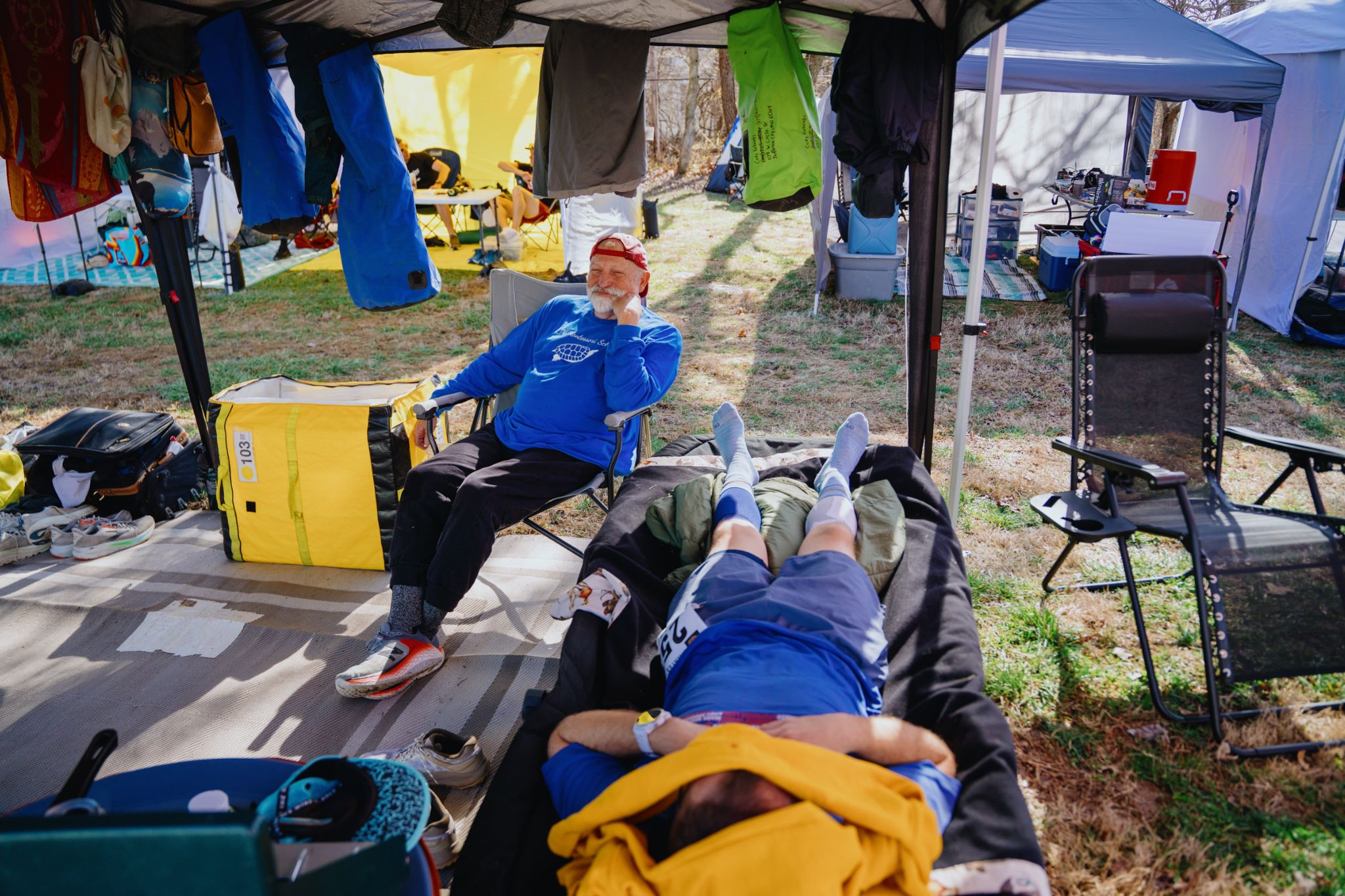
Cantrell often says the format reveals something deeper than fitness, exposing patience, stubbornness and the ability to negotiate with your own mind. The Backyard Ultra isn’t about who’s fastest – it’s about those who can endure the longest conversation with their own doubt. Four miles in an hour feels wildly accessible, yet the challenge becomes endlessly daring. Between loops, runners gather to eat, laugh, swap stories and quickly push each other back to the corral, forming a tight‑knit crew of co‑survivors. And unlike traditional ultras with a fixed endpoint, the Backyard offers the thrilling unknown of how far you can go if you simply refuse to stop. For spectators, it’s pure adrenaline – every hour resets the race, every loop is a fresh twist and the suspense builds until only one runner is left standing.
Cantrell has always had a knack for designing races that test the edges of human capability. The Barkley Marathons is infamous for its near‑impossible finish rate, but the Backyard Ultra is different. It isn’t designed to break runners – it’s designed to reveal them. The rise of the format reflects a cultural shift in ultrarunning: athletes aren’t just chasing distances anymore; they’re chasing experiences that challenge identity, ego and resilience. As Cantrell puts it, “The Backyard is fair. Everyone gets the same chance, the same loop and the same hour. What you do with it is up to you.”
From Big Dog’s Backyard Ultra to local grassroots events, the format has become a global phenomenon. National championships, world team competitions and record‑setting performances have cemented the Backyard Ultra as a legitimate and uniquely compelling discipline within the sport. Traditional ultras remain the backbone of the community, but this format has carved out a new space, offering something both familiar and radically different.
In a sport built on pushing limits runners are being asked to push a different one: the limit of showing up, over and over, long after the finish line has disappeared. In a world obsessed with finish lines, the Backyard Ultra offers something radical: a race where the finish is unknown, the challenge is internal and the victory belongs to the last person willing to answer the bell.