
This article was originally published in the June/July 2025 issue of UltraRunning Magazine. Subscribe today for similar features on ultra training, racing and more.
From a soggy bank behind Brushy Mountain Penitentiary, I watched Lazarus Lake tape a paperback book titled, Last Will and Testament to the sun-blackened wall of “the yard.” His hands moved precisely—neither hurried nor worried—carrying out what had become a well-oiled Barkley Marathons ritual. Each pull of the duct tape screeched over the click of cameras surrounding us, as this was the last book being placed prior to the start, and the media had been invited to join in.
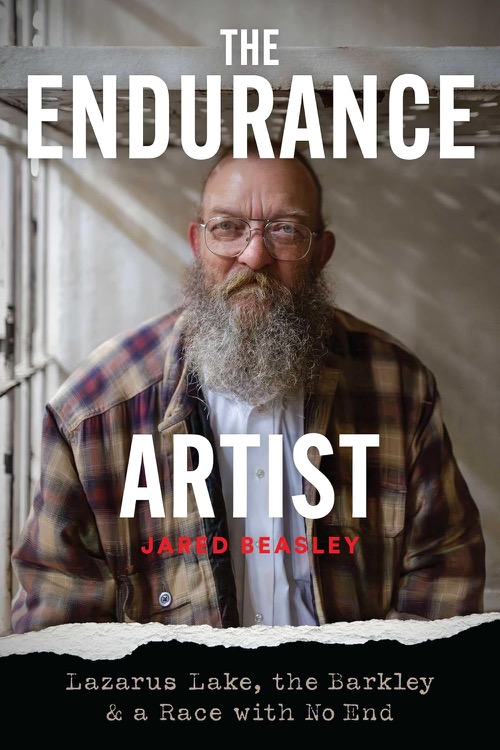 It was 2023, and I’d just begun writing a book on Laz’s life—an idea he and I both met with some skepticism. “Nobody’ll publish it,” he said with a faint laugh, smoke curling around him. “I’m not that interesting.”
I nodded. It felt impossible—like the Barkley Marathons.
The next two years slid by, feeling slow, sudden and strange. I logged hundreds of hours of interviews, slept in Laz’s house, broke bread with his family and holed up with him in a motel room smaller than a dorm on his 2024 Transcon that began on the edge of the East Coast.
I learned to expect the upside down from Laz. His story, as I dug through it, was rife with adversity, adaptation and absurdity—always with a wink, never straightforward. And never predictable.
Back at Frozen Head State Park this year, everything had changed. Laz had given his magnum opus away. Carl Laniak, his longtime collaborator, taped the book to the prison. And my own improbable book, The Endurance Artist, was set to come out in September.
Craning my neck up a gnarly slope called “The Bad Thing,” I was reminded that I didn’t write it as much as endure it—my own private Barkley—to uncover Gary Cantrell from Lazarus Lake.
“He was always there early. Always looking at things analytically. Very smart, psychologically, with the kids,” said Coach Mike. At Cascade High School, Gary Cantrell, the volunteer coach, was known as “the Godfather.” “He’d been around so long, the kids assumed he came with the school.”
Many of them had known him since they were eight years old and remembered being driven around in his large white van. There was a hole where the backseat used to be and an Oklahoma tire cover over the spare. “He just took time out of his day,” said Danny Rucker, a member of the traveling basketball team. “But he always challenged us.” Gary had formed the group for the local elementary school kids. He organized the practices, taught fundamentals and lined up games with teams from other towns.
“Players loved Gary,” Coach Mike remembered. “He would write things for the players for each game—what they’d learned, how they could improve—and would read it to them before practice. One talked about learning from defeat.”
Laz and I began with phone calls—bi-weekly, then daily—often hours-long. But asking him anything about his life was like setting in motion the hands of a clock. The first 5 minutes, he’d stay on topic, then wander the rest of the hour on various tangents of his curiosity: the death of small schools, predictive coding and why women’s high school basketball is the last bastion of organized sports.
To understand him, I would need to live in his element and that meant passes to cover his races. He wasn’t going to open that door for free. Instead, he laid out a series of trials: years-long waits, math problems and eventually a challenge to take on a Backyard.
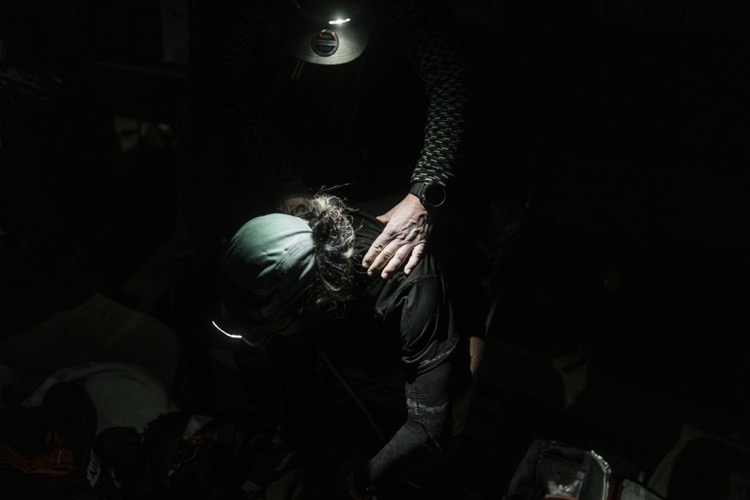
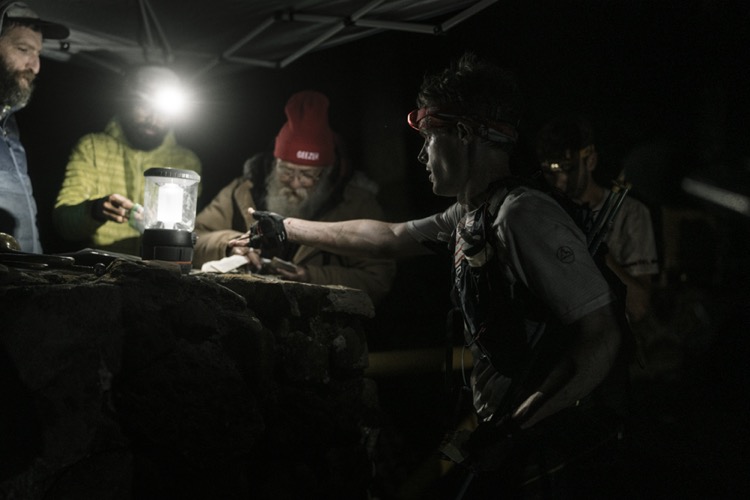
Tomokazu Ihara gets a helping hand in camp from his support after coming in from loop one before going out on loop two. Ihara would later be only one of four runners to start loop three. Photo: Jacob Zochermann
Instead of gleaning insights into him, I found he was holding a mirror back at me—highlighting something I hadn’t wanted to see: my impatience, my instinct to quit and my tendency to sell myself short. Only then did I realize the particular language he was speaking: what makes us quit?
After his mother passed away in December of 2022, and then his beloved pitbull, Big, the following January, Laz became a different person to interview. He opened up about living under his father’s shadow, working at a laundromat and feeling like a creep with no friends. “No one knew me as a kid,” he said, and described years of being dropped into new schools only to be ripped out before the semester ended.
But it was after moving to Tennessee at age 12 that his world was cleaved in two. A mass found behind his nose was inching its way toward his brain. Option one was the safest: the doctors would cut away his nose, his cheek and his right eye. Option two was not much better: yearly surgeries to trim back the tumor as it grew, in hopes that one day it would go dormant. For Gary, there was no choice. He might die, but at least he’d die with a face.
“That’s what made him,” said his first wife, Mary. “He was scarred from that.”
Pain versus discomfort. The possible versus the impossible. Adapting to change. These concepts would form a new filter for the burgeoning race creator: when the finish line could be tomorrow, how do you respond? He’d start with a novel idea—that what’s fair may not be what’s best for us—and turn it into an art form.
This year, runners gathered by the white tarp for the latest impossible version of the Barkley Marathons. But they find Carl, not Laz, sitting at the picnic table in its center. He checks in the virgins and veterans by jabbing them in true Barkley fashion. That evening, he tests the conch, and it squeaks like a dying animal. Heads turn. We all laugh. The next morning, he has even more trouble with it when officially signaling an hour until the start of the 2025 Barkley Marathons.
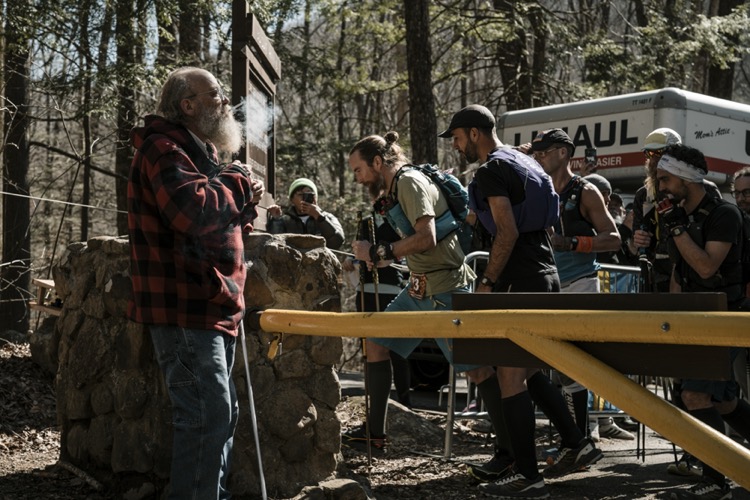
Laz starts the 2025 Barkley Marathons by lighting a cigarette. Photo: Jacob Zocherman
It’s easy to spot flaws in a new face and overlook the highlights. When he stands behind the gate, tall and somewhat lanky, it’s obvious that Laz is stepping aside with theatrical precision—literally opening the trap door to his own legend. Carl gives the speech and does everything but light the cigarette. It’s his race now. But it’s hard not to feel for him. His Barkley will be more public than private.
Taps plays throughout the first night as runners succumb to the course. Bleary-eyed and cold, I amble over to the firepit. One by one, the headlamps come bobbing down Quitter’s Road or from the bottom of the hill. “It’s a massacre,” Laz says. It’s the revenge year many expected in 2024. A new addition to book one now sends the runners rocketing down an 1,800-foot ridge (after first climbing 1,500 feet).
Less than 24 hours into the race, Barkley is chewing through the field. Ten make it onto loop two. Four to loop three. When the human whirlwind, Sebastien Raichon, crumples into a chair, hand over his pained face, the price that’s being paid is obvious. The only one left with a chance is John Kelly. But not really. The three-time Barkley finisher sprints to the flaking pole in a rain shower. He’s beaten the 40-hour cutoff for a “Fun Run” finish (three loops) with 10 minutes to spare.
Carl calls out his time as Laz looks on from the dark side of the gate.
John takes the bugle and plays Taps for himself. He mentions “perfection.” As a runner, I can’t relate. I never could. I do my miles for different reasons.
John Kelly hands over his pages to be counted at the 2025 Barkley Marathons. Kelly was the only runner with a “fun run” finish (three loops). Photo: Jacob Zocherman
But as a writer, it’s a familiar gut punch. Too many times, I came to an impasse with the book—no way forward and no easy answer. I’d work my way into a gully too steep to bushwhack out of. I’d have to adapt. When finally, a solution came, I shook my head, surprised how a story was never hindered by problems but made better by them.
Still, there were times when the towel was in my hand, begging to be thrown. Getting at Laz’s “lost years” proved formidable: the gap between him leaving home with nothing but a backpack and a thumb in the wind to his return to Shelbyville—no longer just a runner but a race creator.
I’d ask him about it and the hands of the clock would move and somehow, we’d never get there. Then, on a late night by the fire in 2023, at his Backyard World Championship, he just went there.
He married Mary Cawthorne at age 19 in a Catholic church, and the couple soon left for Memphis. She went to school to be an X-ray technician. He got on at Baptist Memorial Hospital.
In no time, he was the best on the orthopedic floor with catheters—cracking jokes while inserting them and eating lunch with elderly patients who had no one else. He loved them the most. They reminded him of his grandmother. No pretense. But what struck him most was the vast difference between those who wanted to recover and those who wanted an excuse. He watched both kinds die, wrapped them in sheets and wheeled them down to the morgue.
Winning and losing at the hospital were not so clearly defined. It was about personal limits. Where do you set yours? And how much are you willing to endure to get what you want? Danger lurks on the plateau, where making it to decent can block you from getting to great. Those who thrived shared a mindset: there is no finish line.
“I’ve always seen myself as a coach,” Laz told me as we sat there, listening to the fire pop and sizzle. I couldn’t help but think that in some ways he’d been coaching me, too. Whatever my limits were in writing the book, they were self-imposed. Reminders were everywhere, even a Facebook post of a quote from philosopher Heinrich Zimmer: “The best things cannot be told; the second best are misunderstood; the third best are what we talk about.”
With that in mind, I stuck a lavender-colored note to my bedroom window, directly above my writing desk. On it, I wrote two words: “How Good?” It was less a question than a dare—a daily challenge to confront those stubborn ideas beyond the reach of words. The battle would be in the attempt.
The book is now done, but the note is still there. I think I’ll leave it.