
In Sweden, it’s much easier to sign up for a backyard ultra than a marathon. Why? There are simply more of them.
This race format with “no finish line” has even reached the northern coast of Borneo, to the country of Brunei, a nation so small, you could fit it inside Yellowstone National Park—twice. Backyards are now in over 80 countries around the globe, with team championships, golden tickets and at-large lists all leading to a biannual showdown in Bell Buckle, Tennessee: last runner standing.
This year, it began on October 18.
But doesn’t a race that lasts days, where everyone is tied for the lead, make for boring viewing? If you tuned into the livestream at the end of October, you would have seen a Shakespearean drama played out before your eyes in real time.
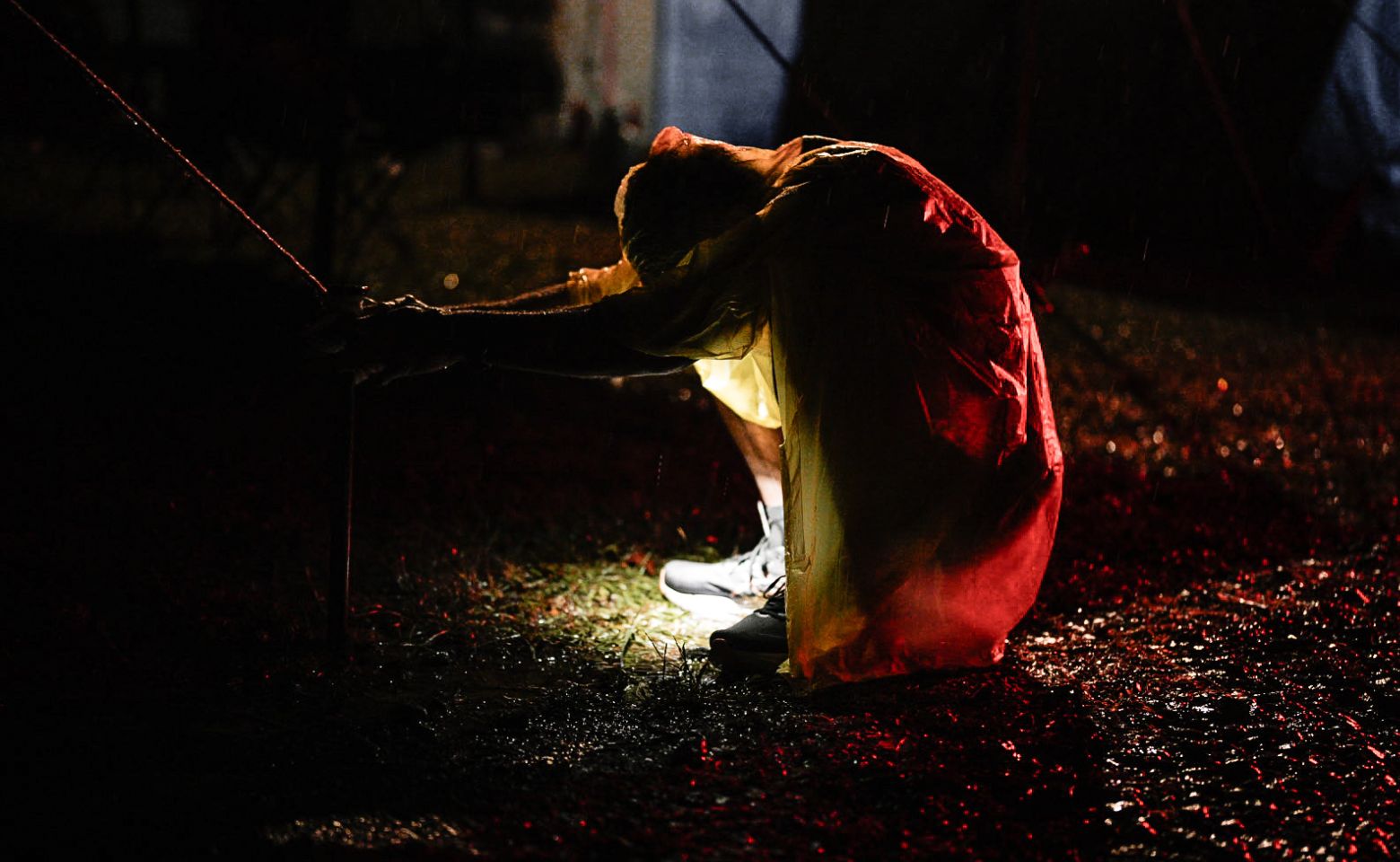
Records were smashed. Ribs were broken. A 7-hour storm struck the first night, sending tents flying into the trees. A disqualified runner lay face down in a heap of tears. A math teacher soared far beyond her calculations. And a runner carrying what appeared to be a grocery bag upstaged the whole lot.
“It’s sudden death overtime every hour,” says Lazarus Lake. “You don’t have to have a great hour any hour. But you have to have a good hour every hour.” For Laz, there were his own moments. Like the hour when he rang the personal-best bell—for himself.
It was the start of the 109th yard (loop). The Tennessee night looked like wet ash, dense and low, and Laz, age 71, stood by the corral in a ring of snuffed-out cigarette butts. He’d just reached a new PB: ringing the bell on the hour, every hour, 109 times.
It was now Wednesday. What had started with 72 hopefuls on a Saturday morning had been reduced to four. The sun had set hours ago, the last whistle had blown, and Phil Gore was the only runner in. Crews wandered out onto the road to find their runners but only darkness hovered.
The Backyard format is both simple and cruel: 4.167 miles every hour until just one remains. For those in camp or watching from afar, it became ritual—three whistles, then two, then one. Laz would ring a cowbell, yell “Happy Time,” and another hour would start.
Each yard finished brought the same choices: sit or eat, change socks or lie flat, close your eyes for 2 minutes or get back up and pretend you’d slept. The tired brain built a private maze of calculations and bets: drink now, caffeine later, fast this hour, slow the next.
Sarah Perry of the UK knew the arithmetic by heart. Back in Cumbria, she taught math and moved with calculation: evenly—no wasted steps, no complaints—just the steady maintenance of form as the days folded over. Early Wednesday morning, she and Meg Eckert of the U.S. had reached 88 yards.
The two pushed on. Ninety-one, ninety-two. Then Meg dropped. Sarah, though leaning forward from a bad back, did not. Finally, she stopped the clock on a new British overall record and a women’s world record at 95 hours and 395 miles. She eased herself down with the cautious care of someone placing a glass on a table. “I had it in my legs and my head for a hundred,” she said, “but my back quit before I did.”
“To see a woman beat everybody makes me happy,” Laz said after. “She could have won it all.”
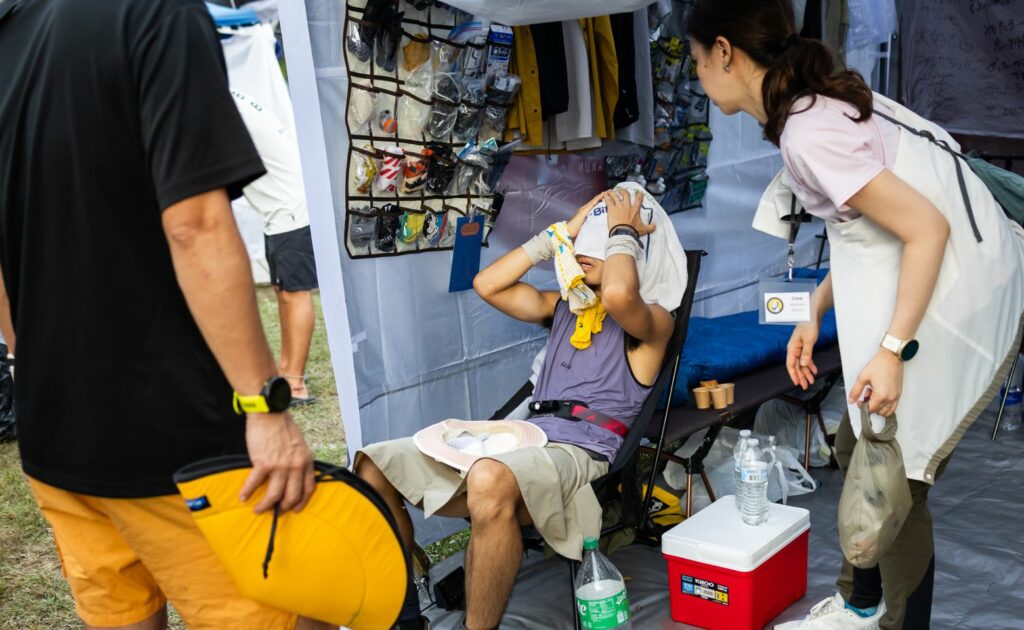
Michitaro Mizuno of Japan rests in his tent while his crew helps him manage pain between yards. Photo Big’s Backyard Ultra
But if you were watching, you got the sense that none of this was about winning.
Take Rodolfo Ramírez of Mexico. For an entire day, he’d been the caboose. Each hour he arrived after the whistles—less than a minute to spare. His end seemed imminent. But even after eclipsing the Mexican record, he pushed on.
Near midnight on Tuesday, he came in 20 seconds before the bell and lugged a cooler over his head to pour himself awake. His long black hair, carefully tied back for days, now hung wild across his cheekbones. “I’ll die on the course,” he said as water streamed down his cheeks.
The next hour, the last whistle came and went with no sign of him. Then—a light. Rodolfo was in with 10 seconds left. He staggered like a fighter in the 15th round—one that had just stood up from a standing eight count—his body wasted, his eyes burning.
On the 89th yard, his light returned—but 10 minutes too late. A quiet reverence filled camp. Now, it seemed, the limits one could reach with pure heart had been met. But even that was premature.
After the 109th yard and Laz’s personal-best bell, Phil Gore zipped himself in his tent—in from the road faster and faster. It was his race to lose. Ivo Steyaert of Belgium had been leaning to the right for two days. Jon Noll of the US had slowed to the point it seemed he jogged in place. And Harvey Lewis had never looked worse. For the last 12 hours, he’d been running on broken ribs.
The whistles cut the crisp air; crews checked their timers; some filtered onto the road and stared out into the black, waiting for the faint glow of a headtorch.
Only one appeared: Ivo. He ran like a man pulling an invisible chain attached to his right hip. But he was in. Gone were Harvey Lewis and Jon Noll. Two left.
Laz watched them carefully, the way he does everyone, with an odd mix of detachment and awe. He rang the bell, marked the hour and fired up a Camel. Hour 112.
Ivo came in hunched sideways, grinning like he couldn’t help it, and camp made room for him to pass. Gore met him under the arch, hugged him and asked—quietly, not as a dare—if he had one more. Ivo nodded. He put a hand on Phil’s shoulder, and whatever he said was for the two of them.
Ivo made it in again but retired.
Phil ran the 114th alone in 37 minutes and change, a pace that felt almost rude that late in the week. He set a new course record, 6 hours better than the previous best.
In total, 30 national records were broken. But at Big’s, the race is not the story. Like the young runner from Japan carrying a bag—a man not yet 30, who’d quit his job three months earlier to run.
The first-time commentator Dawn Stone caught sight of him, she did a double take. “What’s in the bag?” she asked. Others wanted to know, too. At first glance, it looked like a gray plastic grocery bag.
“I started using grocery bags in my first backyard,” Michitaro Mizuno told me. Now he carries a cloth one from an outfitter in Japan. Inside he keeps small answers to predictable questions: water, Japanese rice balls, fruit, gloves for the cold hours before dawn, caffeine pills, chewing gum to stay awake and candy for a dry throat.
“People are really nailing down exactly how they train for it,” Laz said of the backyarders. “My recommendation is always the same to prepare for a hard race. You should sleep in the briars.”
It’s those kinds of witticisms that often leave him branded a sadist. Yet, that would imply that the runners must be masochists.
Michitaro Mizuno disagrees. His bag, which he carried in his right hand, was as much for the other runners as for himself. “Helping others gives us more energy,” he said, almost apologetically. “We are not alone. We are family.”
He was disappointed when he came in late from the 64th yard. His race was over. There to greet him was his wife, Ao. She kissed him and laughed, and he laughed too, and the hurt didn’t go away, but it was put in its place. Behind them, the sign lingered: “There is No Finish.”
Full results here. Watch more about Big’s 2025.