

Abby Hall’s victory at the 2025 Western States 100 didn’t surprise those who knew her talent and work ethic, but few had picked her to win. Jason Koop, however, wasn’t surprised. He watched an athlete he has been working with for eight years execute a deliberate, data-driven plan to perfection. Backed by a high-performance team and eight years of consistent collaboration with Koop, she executed a training build and race that looked more clinical than miraculous.
“This was absolutely a case of nailing the fundamentals,” Koop said. “Training architecture, fueling, hydration and heat mitigation—those were the focus. No gimmicks. 98% of the work was boring.”
In an era obsessed with shortcuts, extreme heat interventions and trendy and overhyped supplements, Abby Hall showed that what actually works isn’t flashy or gimmicky—it’s precise and patient.
Hall wasn’t even guaranteed a spot at the race until weeks before, inheriting a Golden Ticket after EmKay Sullivan deferred her entry. Just two years removed from a broken leg that required surgery at the renowned Steadman Clinic, Hall had every reason to doubt whether this was the year—but she didn’t. Her win wasn’t the result of one race—it was the product of years of smart, progressive training.
Long-Term Athletic Development
Long before Abby Hall broke the tape in Auburn, she was logging “boring” training weeks and embracing a multi-year developmental arc. When she first teamed up with Koop nearly eight years ago, the focus wasn’t on peaking quickly—it was on building a sustainable foundation.
“When we first started working together in 2017, I had a head full of dreams and was hungry to grow and become the best athlete I could be,” Hall said. “That same sentiment rings true today—we prioritize the long game, and I think we communicate really well.”
“She finished Leadville in 28 hours in 2019,” Koop recalled. “We spent the first two years on foundational work before thinking about competing at the highest level.” Progress came gradually: physiological improvements, growing durability and an increasing ability to handle high-yet-appropriate volume. Her return from surgery wasn’t rushed either. “The return to run was slow and deliberate,” Koop said. “She stayed engaged with the community, crewing Tom Evans during his Western States win, but she wasn’t in a hurry to get back to racing.”
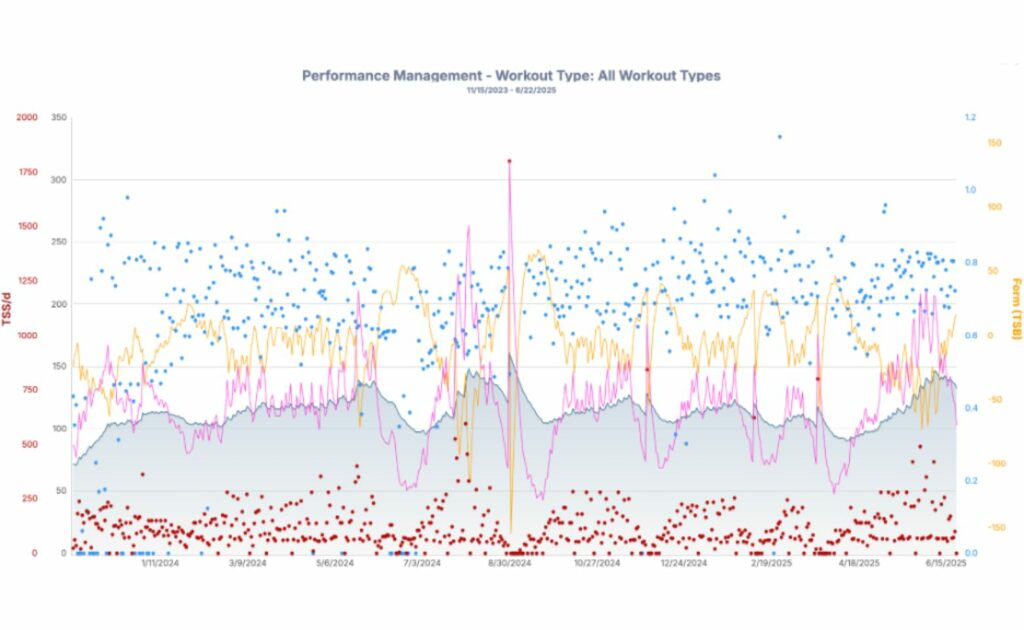
Image: TrainingPeaks Performance Management Chart post-surgery through Western States
Boring Training: Architecture Over Hype
Abby Hall’s training wasn’t flashy. From week to week, her calendar was structured, repeatable and anchored in principles that prioritized durability over drama. “Not every workout was a ‘breakthrough’ or ‘best ever’ or performative in any way,” Koop said.
Her build for Western States followed a structure Koop has used successfully with other elites: three consecutive big training days within the week, typically broken into 3-hour, 6-hour and 4-hour runs. These weren’t casual back-to-backs, they were intentionally structured around race-specific effort, with intensity strategically placed—not at the beginning, but toward the end of key sessions when fatigue was already present.
“We kept the training process familiar,” Koop said. “We knew we had a winning strategy based on her CCC performance in 2022—we just used that structure and made small adjustments for travel and heat.”
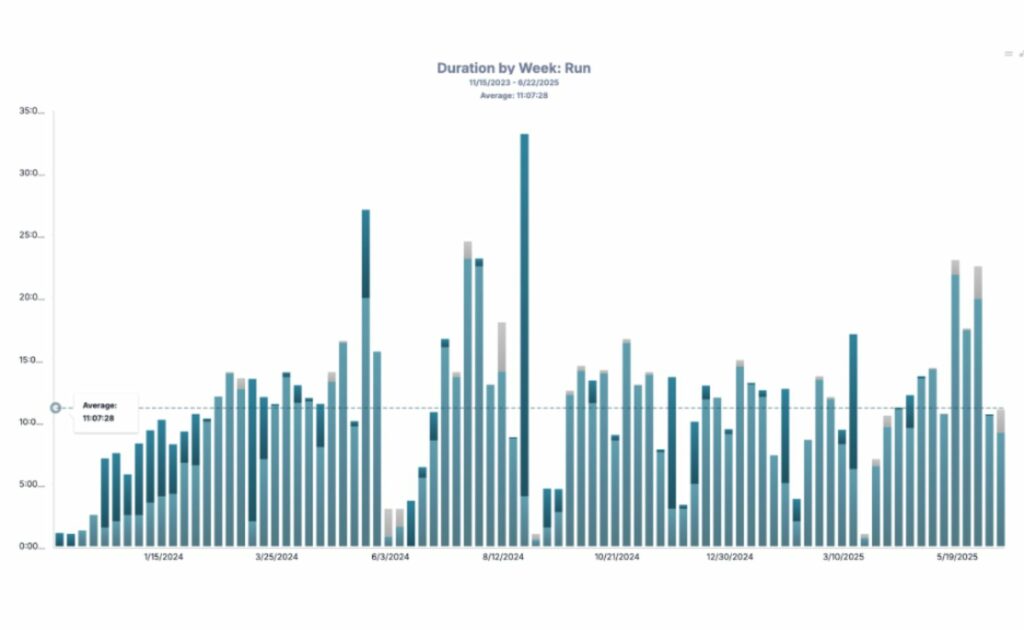
Image: Duration by week graph, reflecting an average of 11 hours of running per week post- surgery, with significant peak weeks for UTMB 2024 and the Western States 2025 build.
While placing intensity early in a session is ideal for building capacity, when the athlete is fresh and able to produce high-quality work, Koop instead emphasized specificity and durability by inserting efforts late in long runs, when fatigue had already accumulated. For Abby, who has years of training history and a high aerobic fitness level, building additional capacity is difficult and often inefficient. Instead, the goal became to utilize the fitness she already had and refine her ability to perform under fatigue, which is exactly the demand of racing 100 miles.
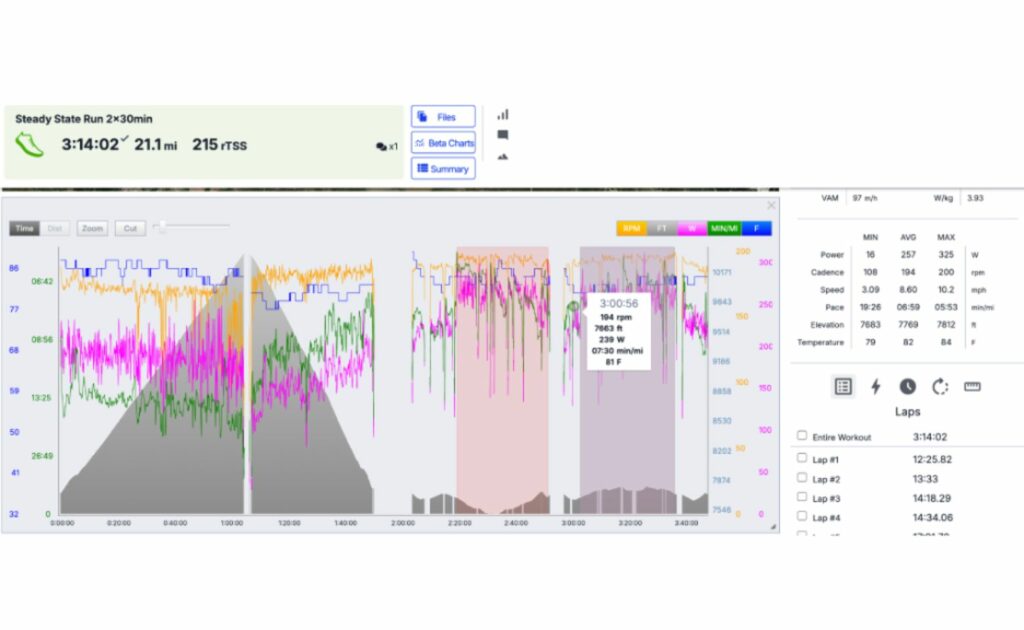
Image: TrainingPeaks workout file reflecting a 2 x 30 min at steady state at the end of a 3-hour run, which Abby did weekly in the final months leading up to race day. A very specific and intentional effort that Abby would need to access in her victory.
The early phase of her build included a short block of tempo work—roughly 60 to 90 minutes per week at threshold—layered onto 15 hours of weekly volume. But as Western States approached, the focus narrowed. They transitioned to steady-state work, typically just one key session per week, with peak training volume reaching 22-23 hours per week. The bulk of her training in those final weeks was centered around race effort—moderate intensity on rolling terrain, with just enough higher-end aerobic work (note the steady state workout above) to simulate key climbs or race-day surges.
Strides, VO2max intervals, track sessions or treadmill work simply didn’t have a place during this phase. “Anything that’s not specific to the race is largely a waste of time and energy,” Koop emphasized. Those modalities might serve a purpose early in the season when developing general fitness, but in the final two months before race day, Abby was fully dialed in on the demands of 100-mile trail racing, specific to Western States. Every decision in her training reflected that clarity of purpose.
Rather than travel to train on the Western States course, Abby stayed local, logging the bulk of her miles in Flagstaff, Fountain Hills and the Grand Canyon, where the terrain and conditions closely mirrored what she’d face on race day.
“First of all, it’s home,” she said. “I’m a big believer that the best training environment is the one where you feel most like yourself. And I’m lucky that the place I love also happens to be an incredible training environment.”
The decision wasn’t just about convenience—it was strategic. Training at home allowed her to recover better, eliminate travel-related stress, and stay comfortable in a familiar environment. That consistency, both physically and psychologically, became a major advantage in maintaining training quality through the final weeks of her build.
Her intensity factor (IF) during long runs consistently ranged from 0.70 to 0.78, mirroring the demands of race day. IF is a metric that compares an athlete’s effort to their lactate threshold (LT2), with 1.0 representing 100% of LT2. So, an IF of 0.70 means Abby was running at roughly 70% of her maximum sustainable intensity. These weren’t just big weekends, they were structured rehearsals that were dialed to match the effort she would need to sustain over 100 miles. “Basically, all of her long runs were at that IF,” Koop noted. “You need to be able to hold that kind of effort for a long time if you want to be competitive.”
If that sounds calculated, it’s because it was. The data wasn’t used for tracking progress alone—it helped dictate pace, progression and recovery. Combined with subjective feedback and tools like HRV4Training and NGP analysis, Koop had a holistic window into how Abby was absorbing load.
Hall didn’t thrive because her training was maximal—she thrived because it was right for her. Her years of consistent development, careful planning, and deliberate structure allowed her to train at a high level—without chasing numbers or trends.
Measured Heat: Science Over Suffering
With temperatures at Western States often soaring above 90 degrees, heat adaptation is essential. But how it’s done makes all the difference. Abby Hall didn’t wear a heat suit in training. She didn’t grind out treadmill sessions in a garage with the heater cranked. Instead, her heat strategy was grounded in physiology, precision and restraint without detracting from the quality of her training.
“Running around in heat suits is dumb, even for hot weather races,” Koop said. “All of the focus for Abby’s training was on her training, nutrition, hydration and heat mitigation/management.”
Rather than rely on hype-driven approaches, Abby used eCelsius core temperature pills—provided by her sponsor—to evaluate how different cooling strategies actually influenced her internal temperature during heat training. It was a direct measurement, not an approximation based on algorithms. The goal wasn’t to suffer—it was to understand. “All that I did was educate Abby on how the cooling interventions work,” Koop explained. “They do, unsurprisingly.”
“Serious heat can feel kind of scary and demands respect,” Hall admitted. “But the data showed I wasn’t hitting core temperatures typically associated with performance decline. That gave me the confidence to push more than my brain was telling me to.”
Her heat adaptation protocol included passive sauna exposure, where she’d sit for 20-30 minutes post-run, allowing her body to continue elevating core temperature in a controlled, low-strain environment. This method is preferred over extended active heat sessions, which can be unnecessarily taxing and compromise recovery and training quality. “Less strain on the body for the same adaptation,” Koop noted. “That’s the main driving factor behind that decision.”
Popular methods like heat suits, hot treadmills or high-volume double-sweat sessions might look impressive—and are certainly popular on Instagram—but they come at a cost, especially for highly trained athletes like Abby. The team’s focus was on minimum effective dose: enough to drive adaptation, not so much that it risked fatigue or undermining key workouts. As Koop often emphasizes that if you go all in on heat, you’re likely taking away from something else that matters more—like actual training.
Cooling strategies were equally targeted. While headbands and cold drinks may offer temporary relief, they don’t move the needle much on core temperature. Koop and Abby tested real interventions: pacing, ice application, cold showers and surface-area cooling. Trials revealed that keeping core temperature below 101.3 degrees was critical, and exceeding 102.2 degrees became both physiologically risky and performance-limiting.
When race day arrived, Abby wasn’t guessing how her body would respond to heat—she had already done the work to find out. Her success was less about enduring the heat and more about knowing how to manage it.
Nutrition Reset: From Under-Fueled to Unleashed
For years, Abby Hall relied exclusively on Spring Energy products, believing she was taking in adequate carbohydrates for ultramarathon performance. In reality, she was significantly under-fueling. “Abby switched off of Spring near the time of the debacle,” Koop said, referencing the revelation that some Spring products contained far fewer carbohydrates than labeled. The discrepancy wasn’t minor—it meant Abby was racing and training for hours at intensities that required far more fuel than she was giving her body.
Nutritionist Meredith Terranova joined the team to help recalibrate Abby’s entire fueling strategy.
“I had a readjustment period of getting used to taking in the amount of carbs I previously thought I was taking in,” Hall said. “I’m blown away by how much better I recover in training—and racing—actually hitting my fueling targets.”
The goal wasn’t to chase extremes but to rebuild the foundation. “It was honestly just moving over to Neversecond Performance Nutrition products and getting used to them,” Koop explained. Over the next year, Abby gradually trained her gut to tolerate appropriate fueling levels for elite performance. “I actually took in 120 grams of carbs per hour during the race,” she said. “We aimed a little lower than my high-end from Black Canyon, but I ended up drinking more Coke than expected and it added up.”
It wasn’t a flashy nutrition pivot. There were no super powders, pills, ketones or secret formulas—just good food, reliable products, careful planning and deliberate practice. As with every other element of her build, Abby’s fueling strategy was grounded in evidence, not trend.
Race Day: Precision in Motion
Hall’s win at Western States wasn’t the result of a patient surge or a lucky late-race collapse up front—it was a commanding performance from the start. She ran with heart, confidence and control, setting the tone early and dictating the rhythm of the women’s race from the high country through the canyons and into Auburn.
“My goal in the first 50k was to position myself early to be part of the action,” Hall said. “Even if 10 women were in front of me, I knew I was running the right effort for me.”
The precision behind Abby’s execution wasn’t just visible to those watching—it was confirmed in the data. Her TrainingPeaks workout file from Western States shows a race-long Intensity Factor (IF) of 0.71, aligning perfectly with the demands of elite-level performance at this event.
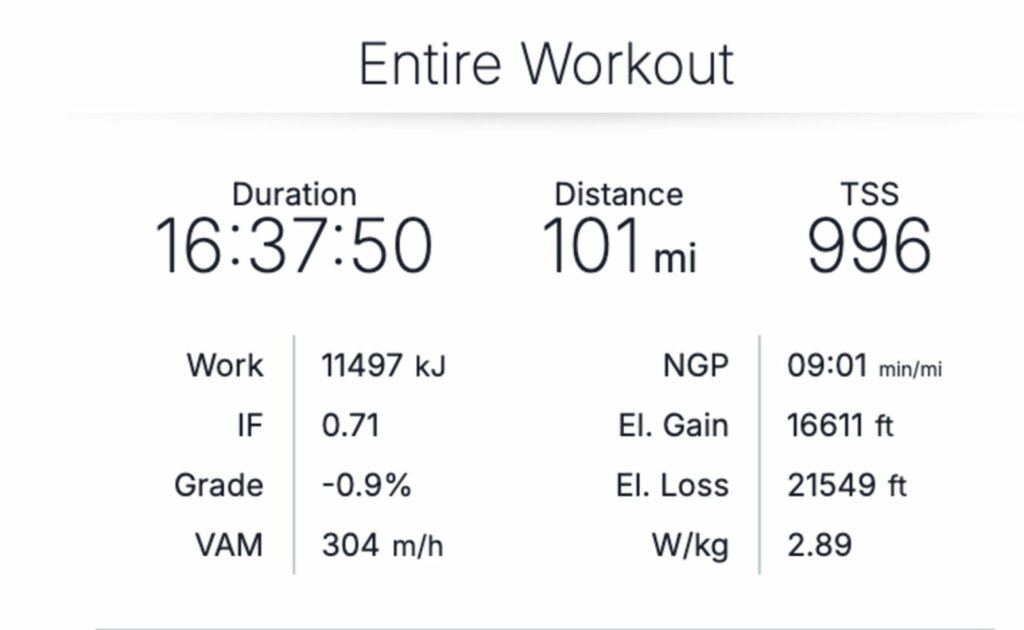
Image: Western States file reflecting her IF of 0.71
Her pacing wasn’t just aggressive—it was calibrated. “For the women’s race, you need to sustain an IF of 0.7 for 16 hours to win Western States,” Koop said. And that’s exactly what Abby did. Her race-day Intensity Factor matched Katie Schide’s 2024 performance at 0.71 on the dot—proof that she wasn’t just fit enough to win, but that she executed it with precision. Holding that effort for 100 miles demands more than fitness alone; it requires confidence, discipline and a deep understanding of how to race your own plan.
That specificity wasn’t accidental—it was trained. Abby had rehearsed this exact intensity and speed across long runs in training. The file below shows the fastest 10 miles of the race where she ran 7:35 min / per mile at an IF of .78. Unironically, this mirrors some of the steady state run work she did leading to the race, mimicking the kind of sustained output she had practiced repeatedly in training.
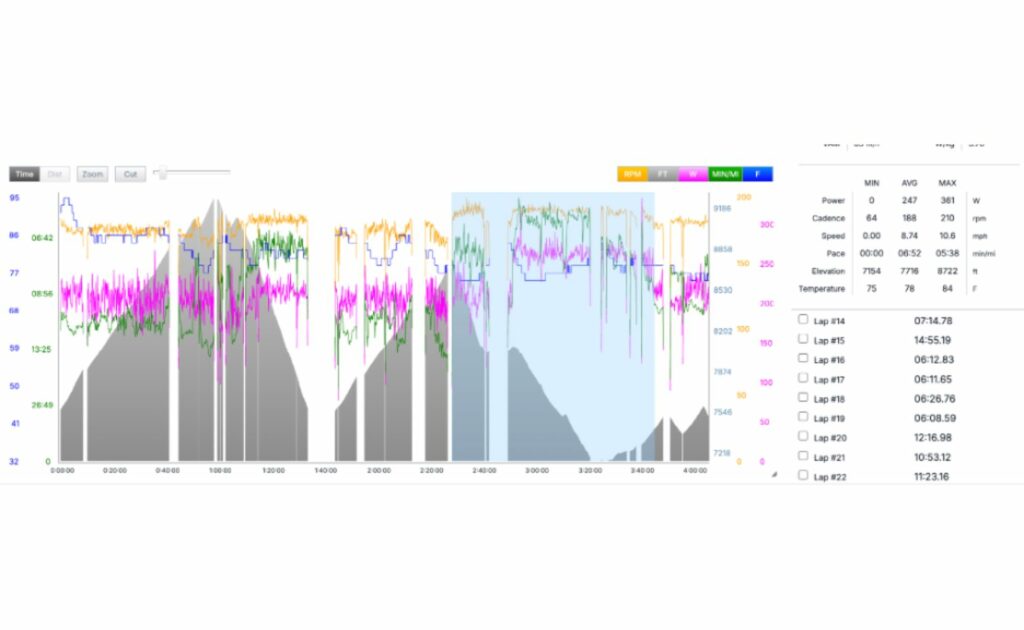
Image: Steady state run in training with 60 minutes at the end
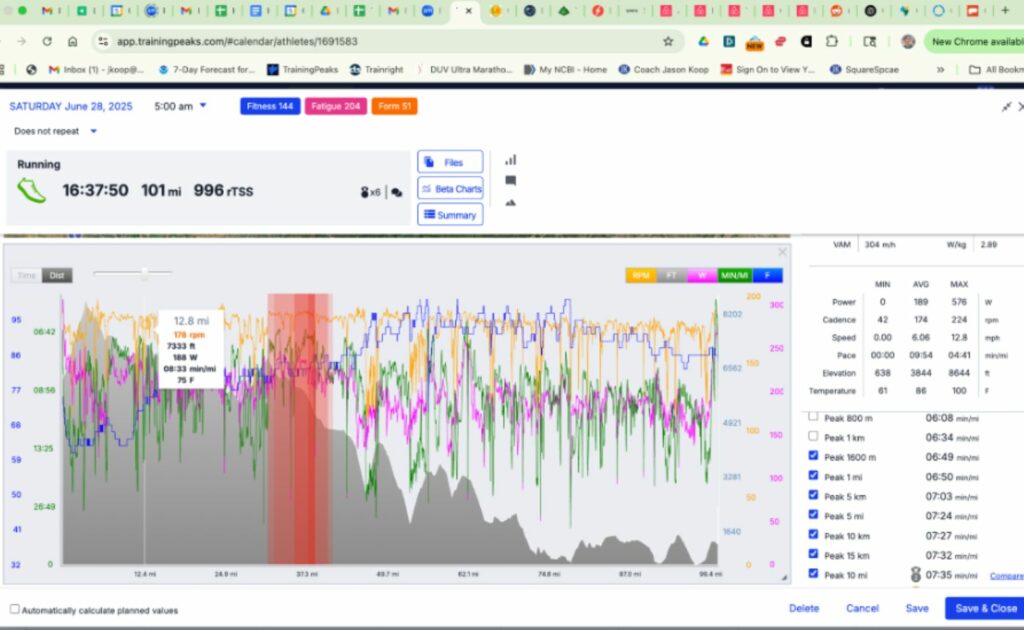
Image: A section of the course where Abby executed the steady state effort mid-race, an aspect of specificity she dialed in during training, and is reflected in the images above.
While the data shows a perfectly measured effort, Abby wasn’t chasing numbers during the race. Her focus was on feel—staying in tune with her body and letting effort guide her decision. “The most important race-day metric for me was RPE,” Hall said. “I think a well-calibrated sense of effort is one of the most important tools a trail runner can have.”
Her fueling plan—100-120g of carbohydrate per hour—held steady, her core temperature stayed within safe thresholds thanks to practiced cooling interventions, and her confidence never wavered. She didn’t just withstand the pressure of front-running—she thrived in it.
Built Around the Athlete: A High-Performance Program That Works
Hall’s performance benefited from years of collaboration within a high-performance system built around her—one that prioritized communication, clarity and athlete-centered decision-making. “All of the focus for Abby’s training was on her training architecture, nutrition, hydration and heat mitigation/management,” Koop said. “Strength training was managed by a professional with the goal of managing any issues post-surgery.”
That strength professional was Sarah Scozzaro, a CTS coach and strength specialist who played a key role in helping Abby return from injury and build the structural resilience required to handle her training load. Sarah’s targeted programming didn’t just support performance, it helped protect it.
“Our approach centered on restoring foundational stability, layering durable strength, and tailoring load progression to meet the demands of both the training and the volume she underwent during her Western States build,” said Scozzaro.
“Having such incredible professionals in my corner day-in, day-out, truly makes me feel like I can’t lose,” Hall said. “They support me as an athlete and a person, and that’s everything.”
This program also enabled her to train at a level that raised eyebrows. Some observers were critical—or at least concerned—about the volume she was logging. Similar skepticism was voiced about Katie Schide’s training the year prior. But Abby’s volume wasn’t arbitrary or excessive. It was monitored daily with HRV, subjective wellness tracking and post-workout metrics like NGP and fatigue feedback. “Basically, 90% of the training went exactly to plan,” Koop said. “But 10% was adjusted based on how she was feeling and what the data showed.”
Her volume wasn’t maximized—it was optimized. It was appropriate for her physiology, her durability and the level of guidance and oversight she had in place. What made the program elite wasn’t gadgets or gimmicks—it was alignment. Abby had access to accurate data, experienced specialists and a coach who knew how to weave it all together into a cohesive and sustainable plan. “Just as important, she’s an excellent communicator: clear, consistent and honest,” Koop said. “That made the entire system more effective.”
Abby says, “Koop’s always quick to respond when we need to make pivots or swaps. But he also knows when to push back and tell me to press on. My job is to always be providing feedback so we can keep tabs on what’s working and what’s not.”
Nothing Flashy, Just Everything Right
Abby Hall’s Western States win was built on years of consistent, intelligent training; patient recovery and rebuilding; and the support of a high-performance team that understood how to elevate an elite athlete.
She didn’t fall for the noise. Instead, she trained with precision, adapted her fueling, managed her heat response and showed up on race day with the confidence to lead from the front—and the strength to hold it.
In a sport that often celebrates extremes, Abby Hall just made the case for something different: that the most powerful performance enhancer is consistency, precision and resilience, and the best strategy is to focus on what actually matters, even if it is boring.
“I’m proud that no matter what curveballs came my way, or if the odds felt stacked against me, I kept believing in myself,” Hall said.
1 comment
Terrific article: well-written and very interesting. Thank you for sharing.
I am interested in determining my IF (or something close) but do not have a heart rate monitor and don’t know my LT2. Is there another way I can approximate this effort level? Does it match up with RPE, as in, an RPE of 7 (scale of 1-10) approximates an IF of 0.7? Marathon pace plus 50%? 12 hour pace plus 20%? Anything?
Thank you.
Comments are closed.