
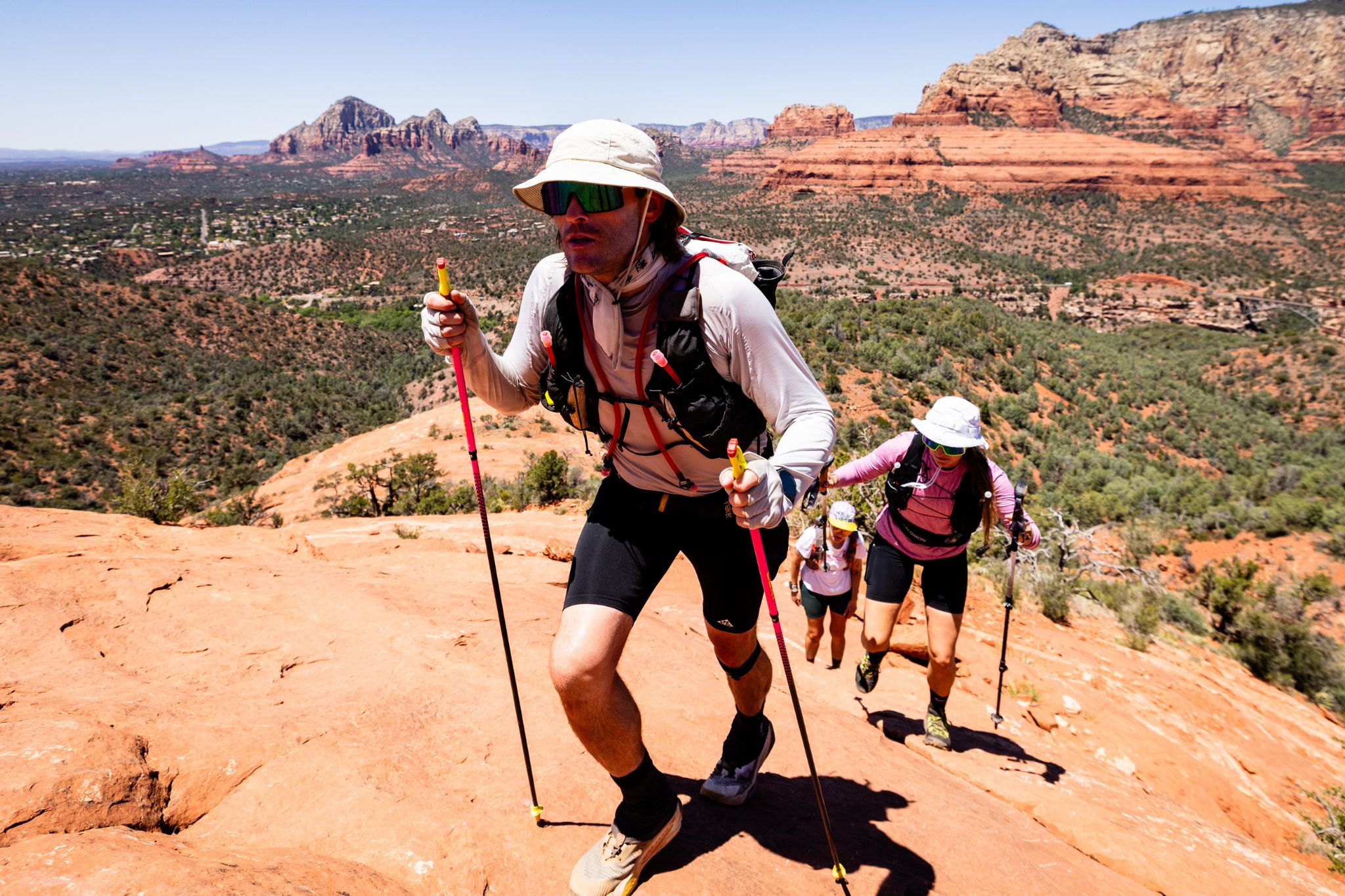
The 200-mile distance is no longer a niche anomaly—it’s on a meteoric rise. In 2025, Aravaipa’s Cocodona 250 livestream captured a level of engagement that even rivaled the iconic Western States 100. Whether it’s a feat of promotional excellence or a collective desire to push past the once unthinkable, the ultrarunning world is moving the finish line another 100 miles out (and beyond.)
Watching the Cocodona 250 livestream this past year, it was easy to feel a spark of inspiration, thinking, I want to do that, followed immediately by a wave of, there’s no way I can. You might assume these runnersare all elite professionals with endless time to train, but the reality is much more encouraging: the 200-mile finish line is far more attainable for the everyday athlete than it appears from behind the screen.
I want to pull back the curtain on three athletes I’ve coached whose stories are proof of what’s actuallypossible: the daily schedules they balance, the specific training that got them to the finish line and the deeply personal “why” that drove them to tackle double the century mark. My hope is that by seeing their real-life examples, you’ll realize that you can do it, too.
George Coogan: The “Life-Change” Warrior

George Coogan, Photo: Anastasia Wilde
George Coogan, 31, is from Salida, Colorado. He isn’t a sponsored professional athlete, he’s a runner who decided to see if his 200-mile dream could become a reality. Hedidn’t pick an easy year to do it either. George signed up for his first 200 during a year that brought his first child, first house and a transition into a new career.
In October 2025, he lined up for the Moab 240, but the desert wasn’t the dry, scorched earth people expect. Instead, George was met with a brutal mixed bag of weather – sideways rain, hail and sticky mud that destroyed goal times and turned the course into a test of pure willpower. Finishing in 111 hours during one ofthe most brutal weather years in Moab history isn’t just luck – it’s the result of a solid foundation and the ability to stay calm when life (and the elements) gets chaotic.
When I asked George what he believed led to his success in those brutal conditions at Moab 240, he credited the two pillars that any athlete can build: “An incredibly strong and generous support system and a well thought out training plan.”
While his daily schedule was often in flux, George treated his training as a constant. “Whether it was a morning uphill ski on a snowy day or running trails in town in the middle of the night, a flexible training plan that emphasized ‘time on feet’ allowed for me to keep training as a priority while accommodating for allthat a constantly changing day-to-day demanded. As for the support system, I think the 200+ mile distanceis very much a team sport – I am fortunate to have an incredibly patient and supportive wife as well as an awesome group of pacers and crew who were absolutely essential to me finishing that race.”
During the busy weekdays, when his new job and family took priority, George focused on shorter runs and some higher-intensity workouts. These maintained his engine without requiring 4-hour blocks of time. On the weekends, however, he utilized back-to-back long runs or full days of ski touring in the Coloradobackcountry to simulate ‘relentless forward progress’ required for a 200. These workouts weren’t about speed, they were about spending time on his feet.
One of the biggest hurdles in a 200-miler is the transition from sports nutrition products such as gels and chews to real aid station food, which often consists of soup, chips, fruit, small sandwiches/wraps, etc. You’lleven find foods as substantial as burgers and burritos at 200-mile aid stations. George practiced his nutrition plan by incorporating solid foods (ramen noodles, PB&Js, etc.) during these long weekend efforts, ensuring his stomach could handle the many calories he would need to consume during the race.
When George’s baby arrived a couple months before race day, he took a different approach to training, and this is how he did it: “Beyond the prerequisite of having an incredibly supportive partner, I think flexibility in the training plan was key to the wheels not falling off in the final two months that involved having a little human to care for 24/7. When my son arrived, my training plan changed with workouts separated into ‘nice-to-haves’ and ‘non-negotiables.’ Specifically, two longer days in the mountains were deemed non-negotiable with a host of other workouts that were available should parenthood permit. This flexibility, paired with the eight months of consistent training with Moab as the singular focus earlier in theyear, allowed for me to show up to the start line with as much fitness as possible without being a totalburnt-out, spit-up-covered zombie.”
By the time he reached the 2025 start line, George’s schedule had been fluid, but his training was anabsolute priority. He was prepared not just for the miles, but also for the long nights ahead. It came as no surprise to me that George succeeded on his first try. He proved that when you respect the distance with a solid plan and a strong support system, even the most demanding year becomes winnable.
Sean Kolowich: The “Prerequisite-Breaking” ER Doc
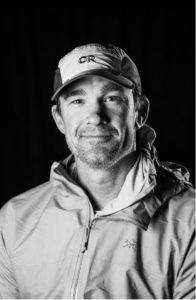
Sean Kolowich, Photo: Howie Stern
Sean Kolowich, 44, is from Flowery Branch, Georgia. As an ER physician, Sean manages achaotic calendar of swinging day and night shifts, all while prioritizing his role as a husband and father of two.
Most runners treat a 100-mile finish as a mandatory prerequisite for anything longer, but Sean decided to skip that step entirely. His longest effort before tackling the 2023 Moab 240 was the Georgia Death Race – a 74-mile brute that ‘runs like a hundred’ thanks to its relentless technical terrain and massive elevation gain. Remarkably, Sean, to this day, hasn’t clocked an official 100-mile finish, but is now a multi-time 200-mile finisher. His secret isn’t a complex physiological hack; it’s the fact that he elevated training from an’extra’ to a non-negotiable priority by mastering the logistics of his schedule.
“Working the night shift in the Emergency Department made it really tough. Then throw in parenting, family obligations and seemingly endless other tasks, and it’s easy to say I don’t have the time. You just have to make training a priority. Planning ahead really helps. Don’t plan runs when you know you’re unlikely to complete them – for instance, with me, anything post-shift is likely to be low quality if it happens at all, so if Ihave to, I’d rather wake up early to get a workout in than to plan one post shift.”
Night shifts are notoriously difficult for recovery and consistent training, yet they offered a unique silver lining that prepared Sean for the darkest hours on the trail. The brutal reality of a multi-day race involves some serious sleep deprivation—a challenge Sean was already quite familiar with tackling. His job didn’t just acclimate him to the grind; it served as a proving ground for the raw grit needed to navigate the mentalhaze of sleep deprivation. While consistently working the night shift isn’t ideal for recovery, training with a few sleepless nights is vital for race day(s) success. Overnight runs, pacing a friend or running a prep 100-miler are all smart tactics. Sean’s story, however, proves that there are other ways to conquer the same sleep-deprived training stimulus you need for a 200-miler.
Living over an hour away from any significant vertical gain meant that Sean’s access to the mountains was extremely limited. Sean leaned into a different kind of creativity, proving that you don’t need abackyard full of trails to conquer 200 miles. His solution? The incline treadmill grind. Sean would crank the machine to a 20% grade or higher, don a weighted vest or his fully loaded race pack and lock into a relentless power-hiking pace. It was a simulation of the steepest climbs he would eventually face at the Moab 240.
When Sean finally reaches the starting line with 240 to 250 miles of desert ahead, he discovers aprofound sense of peace in the simplicity of the journey. In the desert, the chaos of the hospital fades, replaced by a singular mission: just keep moving.
In Sean’s words: “The beautiful thing about these 200+ milers is you don’t have to wind up on the podium or in the top 50, or whatever, to get something incredibly meaningful from them. Simply pushing yourself beyond your comfort zone and living there for a few days somehow makes you appreciate the things that are important, and let go of things that don’t really matter.”
Sean is a powerful testament to what is possible when creativity and dedication are paired with a genuinelove for the trail. He crossed the finish line of the Moab in 98 hours, followed just seven months later by a 111-hour finish at the Cocodona 250—all without ever having run a single 100-miler.
Justin Davis: The “Daily-Grit” Physician

Justin Davis, Photo: Scott Rokis
Justin Davis, 37, is from Bradenton, Florida. Like Sean, Justin is a trauma surgery nursepractitioner who navigates the chaos of 12-hour shifts that constantly flip between day and night. Outsidethe hospital, he’s a dedicated father to two young girls, balancing the intensity of frontline medicine with the demands of a busy household.
For years, Justin was drawn to the 200-mile distance but told himself that grueling 12-hour shifts—sometimes five to seven in a row—meant he simply didn’t have time for the necessary training. In 2023, partnering with a coach forced him to confront that excuse. He discovered he had the time; he just neededa creative training strategy. Bringing on a coach immediately removed the stress of logistics, making theimpossible suddenly attainable. In Justin’s words, “You don’t have to run 20 miles every day. Many of my workdays consisted of a 30-minute walk, a 3-mile run or walking the stairs at work in my downtime. You have time every day to do something, and every little bit counts.”
After conquering the Cocodona 250 in 2023, he decided 250 miles simply wasn’t enough. He immediately set his sights on an even more formidable challenge: the inaugural Arizona Monster 300 by Destination Trail Races, a relentless point-to-point journey through the Sonoran Desert.
Justin’s training strategy incorporated several crucial “dress rehearsals” which involved extended power-hikes/walks, experimenting with his race-day nutrition (eating real food on the move) and dialing in his gear. He even overpacked his race vest on purpose to simulate the maximum weight he might carry. The mandatory gear list for a 200 is massive – often weighing double a standard 100-mile kit. Justin loggedmiles with a weighted pack to build the specific core and shoulder resilience needed for the long haul. This prevented the common fatigue and overuse injuries that strike runners who aren’t conditioned to carry a fully loaded vest over technical terrain. This crucial period of trial-and-error allowed him to fine-tune his strategy before race day.
When I asked Justin what drew him to these 200 – and now 300-mile – distances, it became clear that there is a profound purpose behind what might look like madness from the outside. “At first it was just to see what Iwas physically capable of. To push my body to its limit. But I quickly learned that these distances aren’t about pushing my body as much as they’re about pushing my mind. These distances force you to dig deep. You learn a lot about yourself, whether you want to or not. The things I’ve learned have translated to everyday life.”
Justin’s mental fortitude and unwavering consistency are his true superpowers. That combination didn’t just get him through the grueling training blocks sprinkled with 12-hour night shifts; it’s exactly what carried him across the finish line of a 300-mile race. While the physical training was incredibly demanding to fit into his schedule, it ended up preparing Justin for the mental side of ultrarunning more thananything. In a race that long, the mental game becomes far more important than the physical.
Justin paints a clear picture of the struggle: “Nothing can fully prepare someone for the mental strength it takeswhen you’re sitting at the campfire on night four, having slept maybe 4 hours so far, and deciding it’s time to get out of the chair, leave the aid station and head out into the cold darkness. But… this is where having a busy schedule with long workdays (or nights) has helped. Because getting up at 2 a.m. for a long run beforework would give me a tiny taste of what kind of mental and emotional challenges I would face out on the trails.”
Justin offers a masterclass in no-nonsense wisdom, perfectly balanced with the grace required for a busy life. His advice for those on the fence is simple: “Just commit. Decide that you’re going to do it and then do it. If you want, you will always be able to convince yourself that you’re too busy, you don’t have the time to train andnow’s not a good time. But most likely, you’re not, you do and yes, it is. You just have to decide you want to do it and you’ll find the time.”
However, he is the first to admit that consistency doesn’t mean perfection: “Cut yourself some slack. You’re gonna miss some training days because you’re too exhausted from life. Don’t beat yourself up. Just take the rest day and jump back in tomorrow. Missing an occasional training day isn’t going to change anything. Justdon’t make a habit out of it.”
Justin’s story shows that a demanding career isn’t a barrier to a 300-mile finish. Ultimately, his grueling work schedule was the very thing that forged an unbreakable mental toughness, making him unstoppablewhen the race got dark. The result? Justin conquered the inaugural Arizona Monster 300, clocking in just under 134 hours. He proved that even with an ER doctor’s schedule, a 300-mile finish is well within reach.
The thread connecting these three athletes is simple: the power of a non-negotiable commitment. Their journeys prove that you don’t need a perfect life or a flawless scheduleto achieve the impossible. The creativity to adapt and the consistency to show up is all that is needed to succeed. Stepping into the world of 200-plus mile racing isn’t just about a finish line—it’s about a life-altering experience that will redefine the meaning of human capability.