
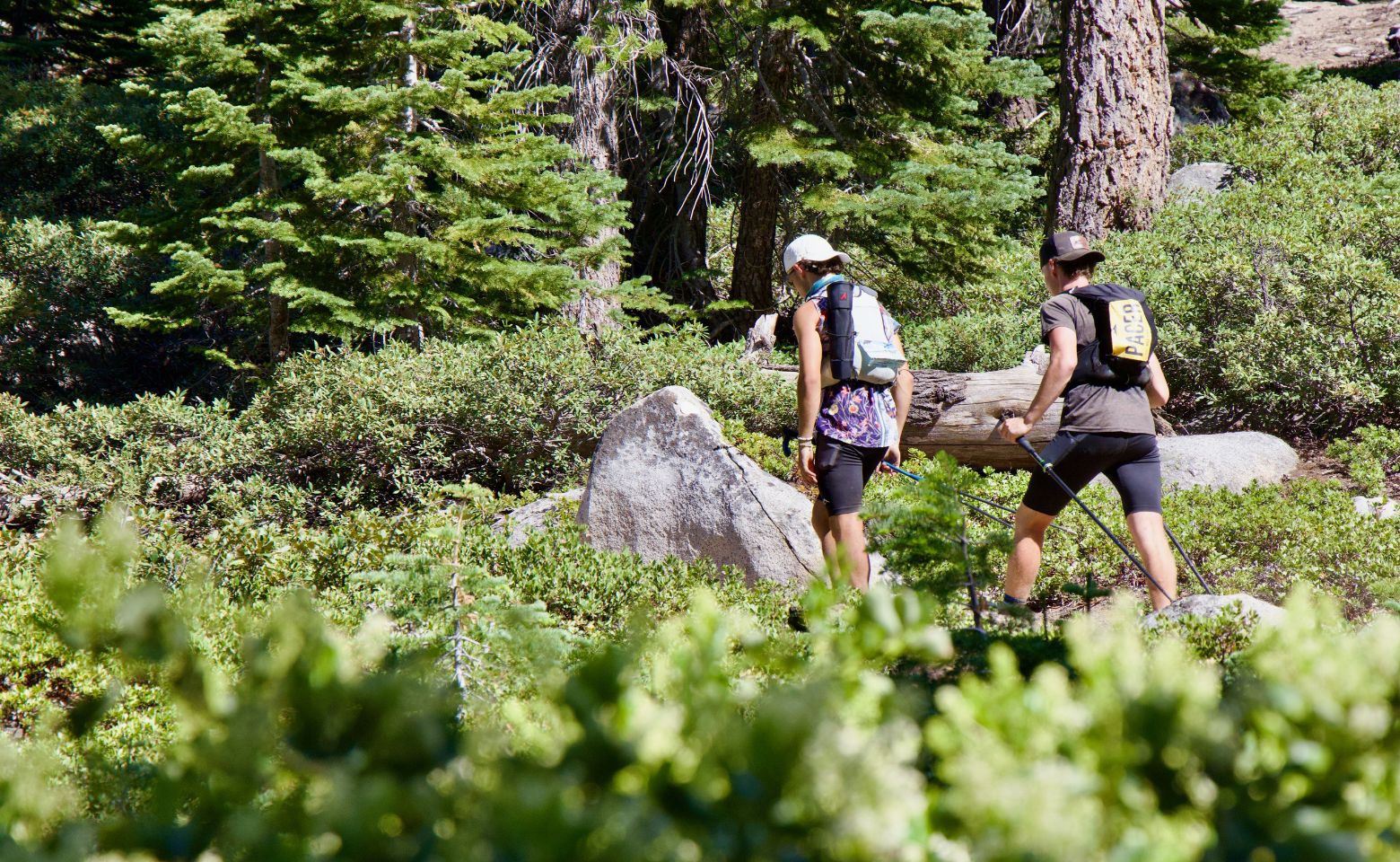
Dennis Boic lumbered down the dusty single track at mile 199.3 of the Tahoe 200. He was confused and had been moving on foot for nearly 59 hours. Looking right through me, he asked, “Am I close?” His voice was husky, and his eyes were unfocused, but somehow his feet shuffled smoothly. “I don’t know where I am.”
I replied, “You’re close, just keep rolling.”
The 2026 edition of the Tahoe 200 trail races saw course records being smashed and a late approval by the Forest Service which allowed for the original loop to be run. It was also a record year for the most finishers at 182 since the race’s inception in 2014. And finally, the 100k distance returned this year.
Aaron Kubala won the 200 overall in a ridiculous 48:09:30, beating the previous course record by over an hour. Women’s winner, Mika Thewes, destroyed her own PR by just under 6 hours, and finished second overall in an impressive 51:10:26.
Ashley Paulson has been on a tear through the first half of 2026. She set the 100-mile world record at the Jackpot Ultras and then proceeded to set the treadmill 100-mile world record. She also signed up for the Triple Crown of 200s and began that journey at Tahoe. I asked her what it feels like to toe the line of a 200-miler. “It’s scary. It’s why we sign up… to test ourselves and experience the wonder.” Paulson especially enjoyed that wonder early in the race. She loved the first 50 or so miles, which are runnable and scenic. This, though, brought her to the hardest aspect of the event: the newly reapproved burn section. “It was really rugged. We had to climb over, and under logs. You couldn’t really run, plus I was there at night.” Another challenge was the problem-solving aspect of long ultras. Leading into the race Paulson had been dealing with a cold; but as the race went on, the virus seemed to merge with the dreaded Tahoe lung and her sickness turned into pneumonia. For Paulson, this was just another challenge to face. “You have to let go and focus on what you can control. I had to stay calm and lean on my team for help.” Her husband/crew chief and a few friends helped her deal with all of the challenges and kept her moving. Paulson finished the race in second place (fifth overall) in 59:04:37.
Boic works for Cal Fire. For the Tahoe 200, he didn’t have any pacers. His first GPS watch is less than a year old, and his race prep didn’t involve any spreadsheets. I asked how he avoids getting overwhelmed about remaining mileage while on course. “I never think about how much I have left, or how much I’ve done. I don’t look at my watch – I just try to listen to my body. You know going in that things won’t feel good, but you also know that things will eventually get better.” Boic wasn’t trying to race. His focus was on “enjoying it, looking around, having fun.” I asked him about doing that in the long burn section, and he shrugged, “Normally when I’m walking around the woods for work, I’m wearing logging boots and pants. Moving with tennis shoes and shorts is pretty awesome.” He mentioned that the harvest section for him was from Loon Lake to Barker Pass, a 14-mile section on the west side of the lake. “It’s rocks, boulders and a loose road.” He described off-road vehicles ascending in front of him, raising dust and kicking up rocks in the heat. Back on the east side of the lake, at the finish, Boic mentioned he felt “pretty smoked. I’d run out of water.” And yet, his stoke stayed high throughout a lot of the race. “I didn’t want it to end.” His biggest worries while on course were for his family who doubled as his crew. He finished the race in third place (fourth overall) in 58:51:48.
When asked how long it takes race director Candice Burt to recover after staging a big multi-day event, she had this to say: “Well, it used to take around a month. But I’d say now it takes a week or two, usually. I’ve learned how to delegate.” When she started the race in 2014, she had only a volunteer coordinator to help, and the rest was on her. “Back in those years, I would be at the finish line for every single finisher. I’d park my truck up as close as I could to the finisher’s arch without being in the way, and I’d sleep in the bed in a sleeping bag between runners.” She went on to note that back then they didn’t have trackers for racers, so runners could show up at any time.
For Burt, this race is special, at least in part, due to the beautiful venue. She loves offering an event that can help people attain goals and dreams in such a unique place.
Challenges for the 2026 race included both the heat and the burn section. “There was quite a lot of medical stuff, which happens when you have a hot race. We’ve also had a broken ankle, a concussion and other issues with the downed trees over there.” Burt then remarked on how impressive Aaron Kubala’s CR time was in light of the blowdowns in that section. “I think that the record would have been broken by even a few more hours” without it.
When asked about the 100k distance, she had this to say: “I think it’s in the top three most beautiful sections of the 200. They do an out-and-back on that. You get a ton of views of the lake and get to run on some really nice single track, too. It’s technically runnable, but there’s a lot of climbing, and the cutoff is 24 hours.”
On the 100k side, Kristina Malzbender won the women’s race in 17:23:30, with Christopher Grove winning overall in 13:20:06.
Initially a little nervous about the technical aspects, Grove said he found flow on the course and enjoyed the fluid movement. “I took a few spills, but it was still fast and fun out there.” Grove was intrigued by the race because it’s an early summer race in a beautiful place. “My background in trails is actually backpacking, so I’m always looking for races with big climbs because I want great views. He ran his first ultra less than two years ago. “I went through a traumatic life event and was looking for a way to help me process it. I was looking for the hardest thing I could think of doing, and, at that time, it turned out to be a 50k.” He was instantly hooked on the expression and gratitude that ultras gave him. In addition, he added that he couldn’t have run the race without his “incredible support system and community. They supported me through everything. When things got tough, I thought about them and their unconditional love and support.”
His favorite part of the course was Armstrong Pass, a tough section roughly in the middle of the out-and-back course, “Things had started to go wrong and I was cramping. I got to the aid station, and the aid station volunteers revitalized me.” After some Coke, pickle juice and an impromptu karaoke session with a volunteer, Grove left with a grin, and never looked back. He’d entered the race a bit hurt, and ran ready for adventure, with no expectations.
Grove’s final thought stood out, “People like to say that it’s ‘you vs you’ out there, but it’s not. It’s you with you.”
Full results here.