
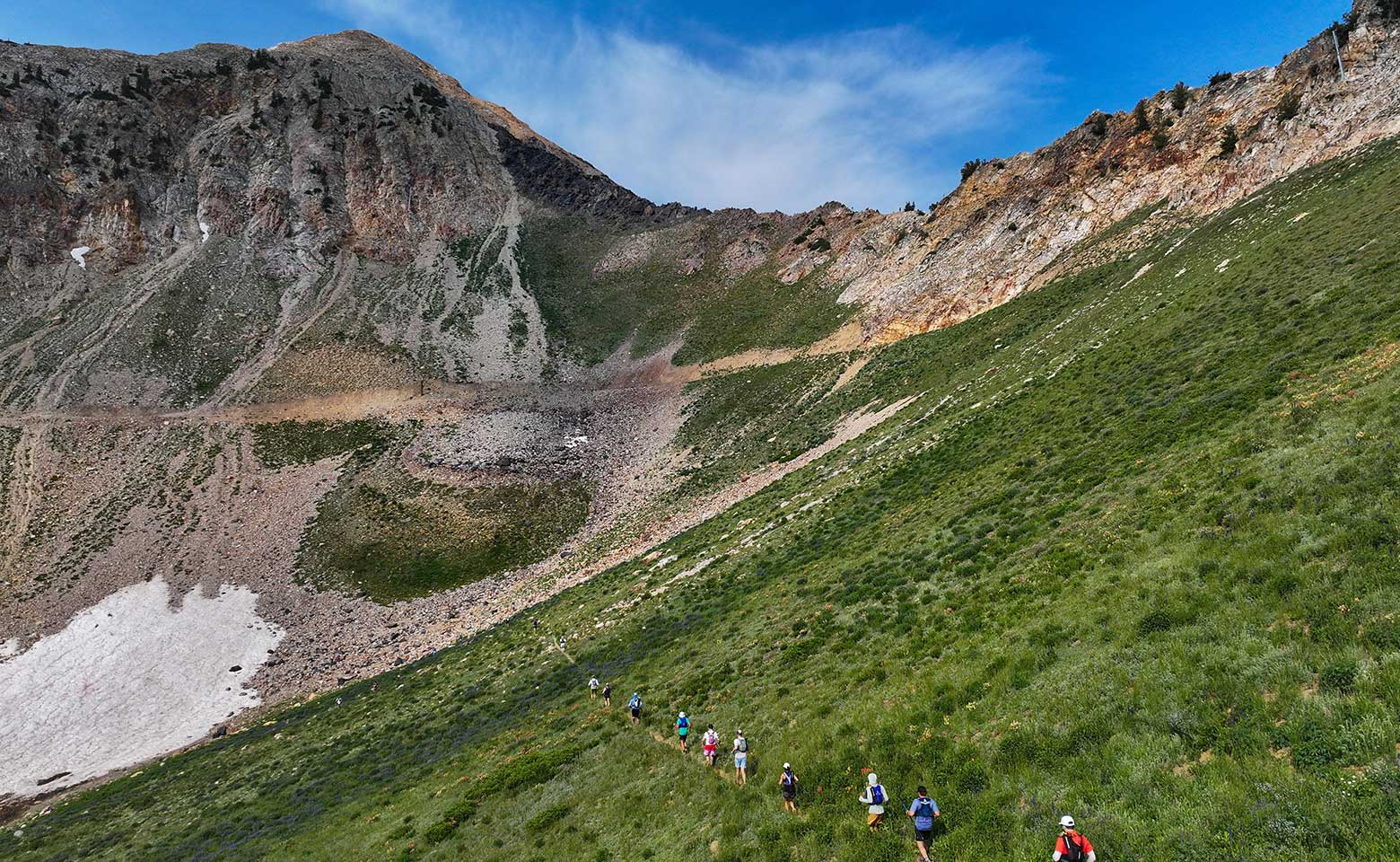
There are no official “Rules of the Trail.” No one hands you a rulebook when you take your first step onto the dirt, and there’s no pre-race briefing where someone explains that you should always pack an extra snack or jacket, that the best climbs are for hiking and soul-searching or that small clothing problems will, without exception, become very big clothing problems. These are things you learn the way most trail runners learn everything: slowly, stupidly and usually the hard way.
Spend enough time on trails – long runs, wrong turns, thunderstorms, the emotional rollercoaster of running for 10 or 20 or 30 hours – and you start to develop a set of rules. Not rules you have to follow, but rules that, if ignored, will eventually teach you why they exist.
In 2019, a dear friend of mine, Ida, made a last-minute move from New York City to live with me in Seattle. Those two places, as you might imagine, offer very different lifestyles. Her New York hobbies – fashion shows, Michelin-star restaurants, boutique fitness classes, bar-hopping until 3 a.m. – didn’t disappear, but they started to share space with camping trips, long days outside and eventually, trail runs.
She took to it immediately. Not in the sense that she was destined to win UTMB, but in the sense that she understood the assignment: you’re out there to have fun, do hard things and find the joy anyway.
Over the next six months, we started to piece together a set of simple, basic rules (half joking, half not). None of these rules will make you fast but all of them will keep you moving, relatively comfortable and occasionally remind you to look up and remember why you’re out there. In trail running, as in most long and difficult things, that’s usually enough.
Always Bring Extra
Trail running is unpredictable, and I’ve heard regularly that it can be seen as a selfish endeavor – being out there for hours at a time, leaving your responsibilities behind to frolic amidst the woodland creatures. But it’s also generous – if you choose to prepare. One of the simplest rules of the trail is also one of the most overlooked: always bring extra – extra food, extra water, extra snacks and maybe even an extra layer or headlamp. Not because you’ll always need it yourself, but because the trail inevitably puts you next to someone who does.
There will be a runner 5 miles behind you, whose bottle is empty, whose stomach is growling or whose morale is low. There will be a hiker whose map blew away or a wailing kid who dropped their snack on the trail. Having something extra transforms a small moment into a big one: you offer a handful of nuts, a spare battery, a quick word of encouragement and suddenly, their day gets a little easier.
In the winter of 2024, a local trail running group formed near Los Angeles. Named after the canyon we ran every Sunday, the Sisar Canyon Run Club would mob uphill for 3–7 miles, stopping to recite poetry, daisy-chain across raging creeks or marvel at the vistas. Once we reached the top, a new “club” would form for those daring enough to run deeper into the Sespe Wilderness. We jokingly called it the “All Day Run Club.” Routes lasted 5–8 hours, including off-trail scrambling up Chief Peak or cold showers under Rose Valley Falls.
Since I was training for my first whack at Cocodona, I ran with a pack loaded with anything that might be useful for a 250-mile race. Snacks ranged from Sour Patch Kids to toffee-covered cashews to full bags of bagels, extra water, extra Gatorade, headlamps, jackets – you name it. I was essentially a mobile 7-Eleven. For anyone who joined us for our all-day treks who had, that morning, expected to run far less, my extra food and water became their lifeline and often enabled them to complete their longest “unsupported” trail run ever.
Some of my most vivid memories from the trail aren’t necessarily from the tops of peaks or the thrill of a fast descent – they’re from standing on a ridge, giving a spare headlamp to someone who needed one, and seeing the relief on a tired face when I ask if anyone needs a Precision chew or some of my spare water. Trail running, sometimes more than most sports, is a shared experience. Your “extra” becomes someone else’s required gear, or even an unexpected opportunity to try something they didn’t anticipate doing that day.
So, yes, pack that extra but don’t hoard it. Bring it so you can give it away. The trail has a way of teaching that what you carry doesn’t always have to be just for yourself. Sometimes, it’s for someone you meet along the way.
Never Pass Up the Opportunity to Jump in a Lake
Trail running can sometimes be grueling. There are climbs that make you question your sanity, miles of rocky descents that rattle your joints and stretches where you feel like you might be lost forever. But the trail also has its surprises – moments that remind you why you started running those remote dirt paths in the first place.
When I first moved out west, I was very “serious” about trail running, keeping a lot of my road running principles at the forefront: run fast and minimize stoppage. After reaching the tops of grueling climbs, I’d usually turn right around, without even pausing to take in the view. I’d ignore flowers, wildlife and cool rocks, all in pursuit of how my run would appear on Strava. All that mattered was my elapsed time being something respectable and that left little time for dilly-dallying.
All of this thoroughly vexed my friend Steven. A thru-hiker-slash-trail-runner, his entire approach was about having a whole-body experience: taking in the sights, sounds and views. There was no time constraint. Trail running took as long as it took. We were not bypassing the views to save 5 minutes.
I went on several trail runs with Steven when I arrived in Washington, and at first, I found myself internally bemoaning the slower paces every time we stopped to admire a field of Indian paintbrush or a cloud formation. Over time though, I began looking forward to these moments. I started to see what I’d been missing when I kept my head down, and once you see it, the new goal becomes never bypassing it again.
Ida and I were on a trail run in California near Mount Langley, at Cottonwood Lakes. This was her first double-digit trail run, and she was a little self-conscious about being “slow.” Despite my reassurances, she remained discouraged, right until we got to the lake’s basin, where we gleefully began jumping into every lake we came across, and elapsed time suddenly became the least important aspect of the day’s activity. Steven’s once-reluctant student, it appeared, had become the master.
Jumping in a lake is more than a thrill – it’s a way to honor the trail itself. It reminds you to embrace the present moment, to stop measuring yourself by pace or distance and to let yourself experience wonder, laughter and frigid water temperatures. In ultras, as in life, the hardest moments often come with the greatest opportunities for joy. You just have to be willing to stop, look around and dive in.
No Quitting on the Uphills
If trail running teaches you one thing, it’s that you learn about who you are when things get tough. And for most of us who aren’t Kilian Jornet, those tough moments usually fall during the uphills. Trail running is absolutely ripe with hills you don’t want to climb, and there are very few moments that are lower during a race than being dog-tired and looking ahead to see the 500-foot climb lurking ahead, never mind your leaden legs and fading will to live.
When life gets hard, we give ourselves plenty of extremely valid reasons why it’s understandable to give in and quit. We’ve earned a break. It’s okay to slow down. We can always try again next time. We convince ourselves that quitting is actually the smart, reasonable decision, and sometimes, it is. I find that nearly 100% of the time I want to quit during a run, it’s on an uphill section. Our minds tell us that this hill is too steep, and too long, and we suck and can’t do it. But more often than not, the second the circumstances improve, even mildly, I realize that I actually don’t feel as bad as I thought, and my legs do still work, and I can keep going further than I anticipated. In the moment of difficulty, I’ve simply forgotten that difficult moments end.
I am proud of the fact I have DNF’d very few races. I am even more proud of the fact that I have never quit a single one of them while slogging through an uphill section. After the hill is over, and the terrain has gotten easier, if I still want to quit, then so be it. But I’m not letting difficult circumstances trick me into thinking I can’t make it through. I am very good at applying this rule to trail running but less so at applying this rule to life.
I moved from Seattle to Los Angeles in 2021. Immediately, it was difficult. I was in a new city filled with smog and traffic and trails I wasn’t used to navigating – rocky, dry, hot SoCal trails were nearly the opposite of the verdant river valley trails of the PNW. I had very few friends, and living in a place as expensive as Los Angeles meant I was working almost constantly in order to pay for the high cost of living. I felt alone and regretted everything. Ida, who had remained in Seattle, was often the only person I felt I could talk to about my dark feelings – my regret having left somewhere I loved to pursue what I thought was a “great perhaps.” But maybe it was too hard. Maybe I should just move back to Washington.
I have always loved baking, a skill I honed with Ida during the pandemic by binge-watching The Great British Bake Off. This show is brilliant because, not only do you learn how to make kouign-amanns and popovers, you also watch the contestants work together and learn surprising-yet-heartwarming lessons about life through hardships within the show. I kept this hobby up during my move to Los Angeles, but referred to it usually as “stress baking,” often crying quietly as I frantically creamed together my sugar and butter. I’d sometimes send Ida photos of the complex baked goods I’d concocted, receiving much-needed praise from someone I loved and missed from a life I felt I had left rashly and prematurely.
And then, one day, I got a package in the mail. I wasn’t expecting anything, and it was from a return address I didn’t recognize. I opened it, and inside was a spatula, gifted from Ida, with a handle that read a simple message: “No Quitting on the Uphills.”
I held that spatula in my hand for a long time. It was silly, practical and profound all at once – a simple reminder from someone who believed in me, and knew I needed to strike down my tendency to doubt myself when the climb seemed too steep. I still have that spatula, nearly five years later. It’s rendered somewhat useless now, with little snags and rips along the rubber from overuse, but I just can’t bear to throw it away.
Since then, every time I face a metaphorical – or literal – uphill, I think of that silly, ripped, teal spatula. I keep moving, one step at a time, trusting that the slope will eventually ease, that the view will be worth it and that quitting is never the first option. And it is not at all an option when things feel the toughest. It is not an option on the uphills.
It’s not the easiest moments that define you, but the ones you keep moving through. The final rule is simple, but its lesson lasts far beyond the trail.
Trail running teaches you many things, but perhaps the most important is this: the trail doesn’t always just reward speed, perfection or clever shortcuts. It rewards presence, perseverance and generosity; showing up, over and over, even when the path is steep, the sun is hot or the miles stretch ahead endlessly.
The rules I’ve learned aren’t about performance. They’re about noticing the world around you, caring for the people you meet along the way and trusting yourself to keep moving forward. They are about making the journey meaningful, even when it’s hard, and finding joy even when it’s uncomfortable.
And like that spatula, an extra handful of trail mix or a cold plunge in a mountain lake, these small lessons persist beyond the singletrack routes we are so lucky to run. They remind you that the trail isn’t just a path through the wilderness – it’s a path through life. Keep moving, keep noticing, keep giving and never, ever quit just because it’s hard.