
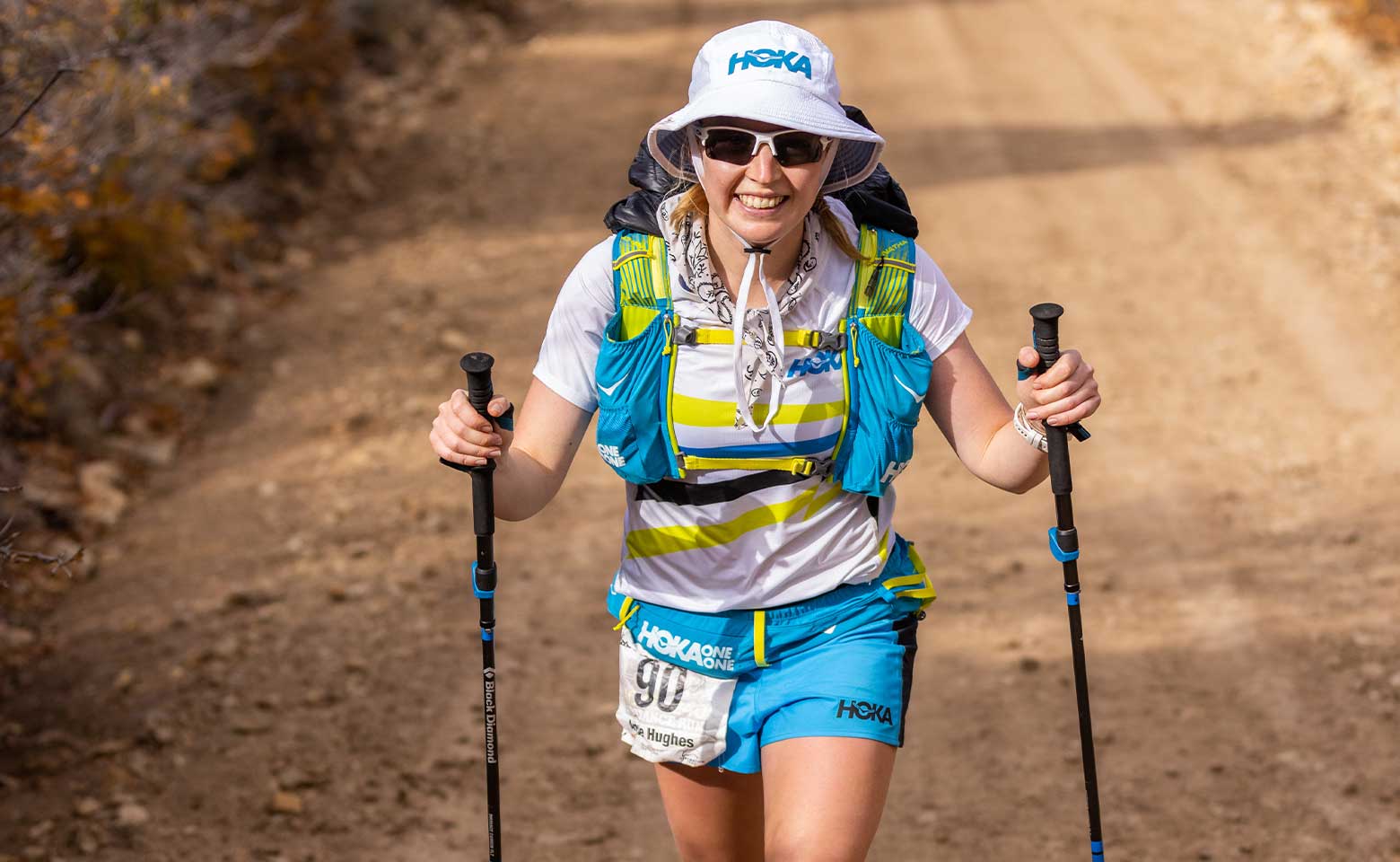
The longer a race is, the more things can go wrong. Especially when there’s at least a second night of racing. The 200-mile races have grown in popularity, and many runners are moving up from 100-milers to take on a new challenge. Annie Hughes, who has won many 200-milers and has focused on this distance for years, despite being only 27 years old, sat down with me to discuss how she deals with the remoteness, mountainous terrain and the need to survive throughout multiple days of movement. While 100-milers are great preparation, there are a lot of big differences between the two race distances.
Hughes was young when she started running extremely long races, with her first ultra at age 20, her first 100-miler at age 22 and her first 200-miler at age 23 – the Moab 240 – which she won. She built up her experience quickly, including a 160-mile FKT attempt on the Collegiate Loop in Colorado and other 200-mile races in quick succession.
So how did she skip the years of gradually accumulated knowledge to perform so well at these extremely long events? She admits she amazed herself by how well these races went but was also surprised by how much slower 200-milers are compared to shorter ultras. “Part of my ‘slowness’ was just the nature of running this long a distance, the lack of experience and all of the elevation change. I also learned the importance of pacing myself and not pushing too hard on the first day. I found myself feeling extremely sleepy on the first night and had to stop often for quick cat naps on the trail; whereas on the second night, I was energized and didn’t need to sleep for even a minute,” said Hughes.
Fitting in sleep is one of the biggest additional factors when moving up to these multi-day, non-stop events. Annie wasn’t immune to this and finds that the first night is often a hurdle she has to overcome, as she experiences a lot of exhaustion and sleepiness. At her first Moab 240, she was “feeling overwhelmed with how far I had to go – how in the world would I be able to make it through multiple days and nights? I may have let that thought get the best of me on the first night, but by the second, I felt like I was actually getting somewhere and could not help but to persevere.”
For events that take longer than a couple of nights, which happens with more rugged 100-milers and almost all 200-milers, they require a different mentality compared to shorter ultras. Hughes considers this to be the biggest difference and prepares herself for the enormity of the distance with modesty.
“I show up now to these 200-mile start lines with a deeper understanding of what it will take mentally and physically to complete the journey to the finish. There are some really important physical factors including proper training and preparation, foot care, nutrition, etc. With that said, I would argue that the mental aspect is by far the most critical piece. Having the ability to stay ‘in it,’ respect the distance and break the race up into smaller goals are all things you have to practice in a 100-miler as well, but it’s amplified by quite a big margin in a race of 200+ miles. That’s part of the draw and what makes the journey such a special and profound experience.”
As with all ultras, the appeal comes from doing something hard. In the case of even longer ultras, there’s almost no chance the race will go completely to plan because there’s more time for errors to creep in. There’s also a greater chance of failure because there’s more time for difficulties to build up to showstoppers.
Hughes improved her sleeping tactics by learning from multiple 200-mile races. She explains her initial strategy as follows:
“When I first started running these multi-day distances, I would try to go as long as possible without sleep, then only rest on the actual trail for a couple minutes when absolutely necessary. ‘Absolutely necessary’ means that I found myself stumbling, tripping over rocks and roots, and couldn’t keep my eyelids open. I got away with this strategy for the first few 200-milers, only closing my eyes for about 20 minutes total and sleeping hardly at all until the last night.”
Over the years she’s refined this technique. “I had one experience in particular that changed my view on this strategy. I was in the lead of the Swiss Peaks 360k, a race that stretches across the mountains of Switzerland and climbs 87,000 feet. It’s a monster of a challenge because the uphills were exhausting and the downhills made every bone in my body feel like it was going to crumble into pieces from the impact of each step. I made it through the first night without any sleep and was well ahead of the other [lead] women who had both taken a couple of 25 to 45-minute naps on the first night. By the time I shuffled into an aid station where I was planning to sleep on the second day, I had slowed down tremendously due to the sleep deprivation. The two women behind me waltzed into the aid as I was eating a platter of raclette (a traditional Swiss Alpine cheese dish), and then left right as I went to take a quick snooze. I never saw them again after that. This made me wonder if it would have been more beneficial to start sleeping earlier on in the race, and not only that, but to take shorter, more frequent naps,” said Hughes.
Having trained many runners for 200-mile races and spoken to a lot of winners of ultra-distance events, I’ve found there are several successful strategies for sleeping, whether it’s frequent short naps for a few minutes, longer naps for a couple of hours that are more spread out or a combination of the two. The key factor is it takes some trial and error and flexibility to work out what’s best for your race. Hughes talked about her personal method:
“It depends on the terrain of the race because anything in the 60-hour range, I think I can get away with next to no sleep, but anything in the 70 to 100+ hour range, like Swiss Peaks 360k or Tor Des Géants, I need to be sleeping much more frequently, but for short periods of time. Ten to 15 minutes seems to be the magic number… long enough to have some benefit and feel rejuvenated after, but short enough that it’s still easy to get going while my body doesn’t think it’s done.”
Hughes is a gifted athlete with a brain that quickly worked out how to train for, and race, extremely long events, but believes these events are possible for the majority of runners. There’s more margin for error due to the generous cutoffs, but runners need strong motivation to last through days of fatigue and a willingness to adjust sleep plans as the race unfolds.
A good sense of humor is also essential to help deal with the absurdity of such an extreme challenge, as Annie explains:
“On my third night of the Swiss Peaks 360k, I was hiking up one of the major climbs of the race at what I thought was a pretty good clip, when I looked down at my watch and saw that I had clocked a 40-minute mile. Yikes! When I hobbled out of the next aid station, about halfway up the climb, I noticed that I had forgotten to fill up my water bottles. I had a solid climb ahead of me, plus an unrelenting descent down to the next aid station that would take several hours. I didn’t turn around to go back to the aid station, but I did take a short, 3-minute nap on the trail. I set my timer, shut my eyes and was out like a light. When the timer started to buzz, I shined my headlamp down on the ground and pressed my hands into the dirt to stand up. This is when I realized that I had just used a giant cow pie as a comfy pillow for my nap. I definitely didn’t make the brightest decisions when I started to get sleepy, and I should have taken a nap at the last aid station instead of trying to push through it because that’s where I got into trouble. Thankfully, I made it to the next aid station in one piece, rehydrated, napped for 45 minutes and went on my merry way, but it was a good lesson to listen to my body when it was telling me to sleep because I probably could have saved a couple hours on that section alone if I had taken care of myself. Two-hundred-milers are a balance of knowing when to push and when to rest and take care of yourself.”
This article was adapted from the author’s upcoming book, The Art of Ultrarunning.