

Activity is in our DNA. From our first prenatal kicks to those early, triumphant steps captured on a smartphone, we’re drawn to movement. Later, we chase each other and skip around in the schoolyard, where the nervous system calibrates for balance, coordination and timing. That calibration has an evolutionary source. Eons ago, movement meant survival – we ran from predators, hunted prey and trekked for water, fruit and berries. And though the threats and rewards of modern life look very different from those of the Paleolithic age, our biology remains largely unchanged. We are built for life on the move.
An inevitable, seductive question follows for us ultrarunners – one that has echoed through popular science for nearly two decades: are we born to run? Christopher McDougall’s bestselling book Born to Run argued that humans evolved for endurance running, helping to popularize the idea that distance running is a natural fit for our physiology. But McDougall was hardly the first to make the case. His thesis drew on earlier anthropological arguments and was eagerly amplified in magazines like New Scientist, where writers championed humans as peerless endurance athletes. Some articles have suggested outright that humans are “better endurance runners than any other animal”(1) – the greatest endurance runners in the natural world.
If endurance really is in our DNA, then physical activity shouldn’t merely enhance performance, it should be a biological imperative.
These accounts are persuasive and narratively satisfying, but they often skate over the science and overlook the subject’s nuances. There’s a tension at the core of the question: yes, we have features that look tailor-made for running, but we’re also slow in a sprint, quick to get injured and liable to suffer when the miles accumulate. And for every trained runner, many others can’t even run after a bus. So, which is it? Are we nature’s prize endurance athletes, or have we constructed a convenient narrative to justify a sport we happen to love? Below, I’ve leaned purposely hard into each side, returning to neutral ground to sum up, with as little pageantry as possible, if we really are born to run.
For the Proposition: Yes, Humans are Born to Run
Early humans ran for survival rather than recreation. At the heart of the proposition that we are, in fact, born to run is the idea that no other animal has demonstrated a comparable aptitude for persistence hunting: that is, the ability to pursue prey over long distances.
What would persistence hunting have looked like? Small groups would have moved steadily across open country, step by step, hour after hour beneath the African sun. Their one purpose: to bring home food. The prey they tracked – often antelope-sized ungulates – were much faster over short distances; in a flat-out sprint, our ancestors would have been eating dust. But these prey animals escape danger by bolting in short, explosive bursts, redlining through their limited anaerobic reserves, shedding water and accumulating heat – just like you would if you ran a marathon by doing intervals. But, as poor thermoregulators, usually unable to sweat, they easily overheat, like a sports car without a radiator.
When the animal slows to recover, humans close the gap with a slow, methodical pursuit – a real-life tortoise-and-hare scenario. As inevitable as the setting sun, the prey succumbs to hyperthermia and exhaustion, and the hunter’s feed. Under the right conditions, humans can outrun almost any land animal – not by being faster, but by being relentless.
What makes us suited to this kind of work, and how might evolution have shaped our biology for endurance? The most consequential adaptation in our lineage is not our large brains or dexterous hands, but bipedalism. Humans are the only primates that habitually walk and run long distances on two limbs, and that shift brought at least two major advantages. First, our legs swing like pendulums, recycling momentum rather than fighting it, making walking and steady running relatively economical. Second, bipedalism severs the mechanical link between breathing and stride. Most quadrupeds, when they move, transmit locomotor forces through the trunk and ribcage, constraining their breathing patterns. But humans can vary their breathing independently of stride, freeing the respiratory muscles to do what they do best: move air in and out of the lungs. This helps sustain ventilation across varying speeds and terrains (2).
Our limb architecture also carries an endurance signature. Eons of walking upright selected for tendons that are long and compliant compared to those of other primates. The long Achilles, for example, attaches to a shorter, more pennate calf muscle – structures that allow the tendon to store and return large amounts of elastic energy at push-off. So while gorillas and chimps expend considerable energy during movement due to their short, stiff tendons, we can cover distances at a relatively lower energetic cost (3).
We move fluidly and efficiently across open terrain, but our locomotion and energy production have a cost: heat. And it’s there that humans exhibit perhaps their most distinctive adaptation: our reliance on whole-body evaporative cooling. We each have millions of tiny sweat glands secreting fluid that evaporates to remove heat. Along with sparse body hair, it’s nature’s pièce de résistance as far as heat dissipation is concerned, much more efficient than radiation or convection, especially during sustained exercise. And it’s a distinctly human feature, allowing prolonged workloads in hot environments without catastrophic overheating. Many mammals have limited whole-body sweating and instead cool themselves primarily through panting or localized heat exchange.
Put these adaptations together – upright gait, long elastic tendons, a high density of sweat glands – and you have an organism predisposed for prolonged activity. And strikingly, the raw ingredients are in place in virtually every healthy child long before it can murmur its name or support its own head. Humans are unusually well-adapted for endurance.
If endurance really is in our DNA, then physical activity shouldn’t merely enhance performance, it should be a biological imperative. In clinical physiology, disease risk and longevity, that is broadly what we see. Physical activity is among the most powerful preventive measures against non-communicable diseases. Active people – those who keep their aerobic engines revved – are less susceptible to cardiovascular disease, diabetes, some cancers, hypertension, obesity, depression, osteoporosis and premature death (4). People who meet or exceed the physical activity guidelines live longer, on average, and spend more of those years in good function.
Consider the Hadza, one of the world’s last remaining hunter-gatherer tribes living a traditional nomadic life in northern Tanzania. They accumulate roughly 135 minutes of moderate-to-vigorous physical activity every day, which is more than fourteen times that observed in large, modern industrialized societies (5). As a result, they show a strikingly low burden of several cardiometabolic risk factors across the lifespan. And it’s never too late to tap into this endurance legacy: older adults who exercise are at a lower risk of all-cause mortality and chronic disease, live on average five years longer than their counterparts, and benefit from an improved longevity as though they’d given up smoking (6). All these data point to a simple universal truth: movement is not merely beneficial; it’s foundational to normal physiological function.
Distance running isn’t an extreme pursuit so much as an evolutionary inheritance. As McDougall put it: “It doesn’t matter whether you’re the lion or a gazelle: when the sun comes up, you’d better be running.”
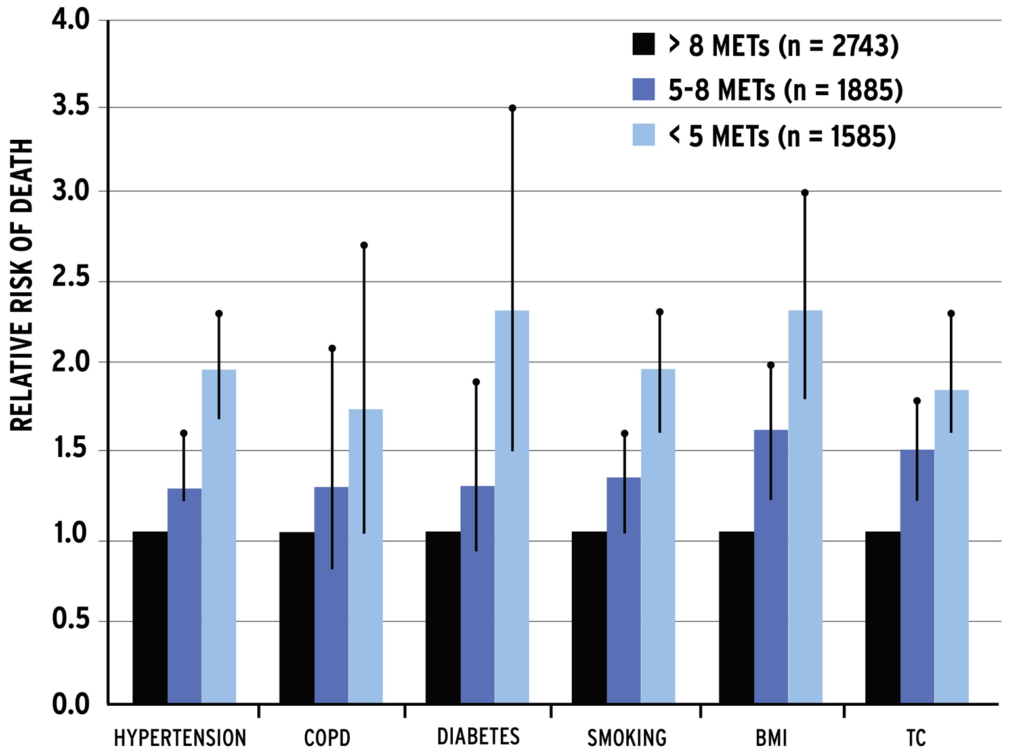
Relative risk of death in people with common health risks (high blood pressure, COPD, diabetes, smoking, obesity, or high cholesterol), who achieved an exercise capacity of less than 5 METs or 5 to 8 METs, as compared with subjects whose exercise capacity was more than 8 METs. From Myers et al. (2002) (7).
Against the Proposition: No, Humans Are Not Born to Run
We like to think we’re special because it soothes that part of us that wants answers to unanswerable questions: why are we here, and what is our purpose? Beyond easing existential anxieties, that sense of specialness once aided survival by promoting persistence, status-seeking and group cohesion. The idea that we are born to run resonates with those of us who love trail and ultrarunning. After all, if evolution shaped us for distance running, then our pastime isn’t merely recreational – it’s ancestral, and by training and racing we’re simply doing what nature intended. It’s a romantic proposition. But it doesn’t make it true.
At its core, the born to run thesis is a form of anthropocentrism: a worldview that places humans at the center of everything. But while the scientific arguments for our exceptional running abilities are compelling, they mainly comprise cherry-picked data to present an idealized narrative. Yes, humans have endurance-friendly features such as efficient bipedal walking, long elastic tendons seemingly built for running and unusually effective heat loss. But there’s no such thing as a free lunch. Those long, springy tendons are easy to overload and injure. In fact, Achilles tendinopathy – stiffness, swelling, and inflammation in the Achilles tendon – is one of the most common injuries in ultramarathon and non-ultramarathon runners alike (8). Even our celebrated party trick of sweating buckets can become a liability: in ultramarathons, fluid and electrolyte imbalances are almost guaranteed, predisposing us to dehydration and, in some cases, hyponatremia – dangerously low blood sodium concentrations (9). So, those biological advantages are, at the very least, double-edged; strengths that can turn into an Achilles’ heel.
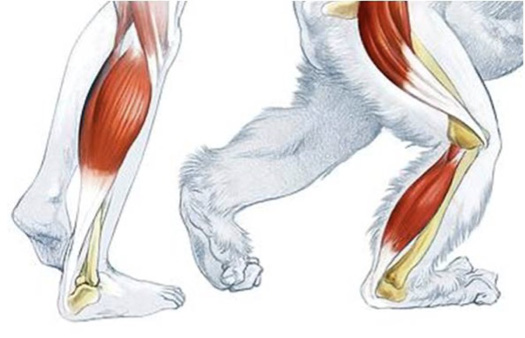
The human Achilles tendon (left) is much longer and thicker than the ape’s (right) and attaches to a shorter, more pennate calf muscle. This increases elastic return for more efficient movement.
The logic of the thesis is also shakier than it first appears. The idea that we’re born to run hinges on our persistence hunting excellence – that we’re capable of jogging prey to exhaustion. But this is a narrow ecological niche, not a universal test of endurance. It’s like declaring that your all-terrain SUV is the world’s most advanced motor vehicle because it dominates on jagged, hilly terrain that demands traction. You don’t get to define excellence based on criteria you already fulfill.
Persistence hunting, where it occurred, worked best under specific conditions: heat, open terrain and prey that overheated easily and fled in predictable patterns. Nor was it necessarily a fair head-to-head duel. Humans likely hunted cooperatively, with those at the front being replaced when fatigue set in, just as cyclists take turns at the front of the peloton to maintain pace. Change the terrain, the prey, the weather or the strategy, and the born to run fantasy begins to slip. There’s a reason we didn’t routinely hunt wolves or horses this way.
Speaking of horses, they’re a unique reality check. Whatever their limitations, they can travel farther at higher speeds than humans, cool themselves well enough to work hard for long periods and can pump roughly eight times more blood at maximal exertion than any human. Their aerobic capacity (VO2max) can be roughly double that of the fittest humans. So, what would a true endurance race between humans and horses look like?
Well, we don’t have to speculate. The Man versus Horse race is a 21-mile (34k) event held each year in Llanwrtyd Wells, Wales (similar races now exist in Scotland, New Zealand and Arizona). It began, as these things so often do, with a pub argument about whether a human could ever beat a horse across hilly, mixed terrain. The course includes road, trail and climbs, and it’s held in early summer, when warmth can become a factor.
In the 45 years since the race began, humans have beaten horses on only six occasions: in 2004, 2007, 2022, 2023 and 2025. The rare human victories tend to coincide with conditions like extreme heat or heavy mud that blunt the horse’s advantages, underscoring just how dominant horses are in true endurance contexts. And don’t get me started on sled dogs – creatures built for endurance in the cold.
Then there’s the small problem of pathophysiology. However well-adapted we may be for endurance, marathons and ultramarathons reliably cause damage and dysfunction: gastrointestinal distress, including nausea and vomiting, are as common as jellybeans at an aid station; the respiratory muscles fatigue, the airways become obstructed and inflamed, and lung function declines; there are signs of cardiovascular strain and transient myocardial (heart) injury in the hours and days after a race (10). And it’s mostly just the price of admission; normal and measurable in most race finishers. For others, the price is higher. Around 5% of ultrarunners report being hospitalized after an event (11), sometimes requiring intravenous fluids, intensive monitoring, dialysis for kidney failure or surgery for severe musculoskeletal complications. Hardly the profile of a species effortlessly doing what it was born to do.
And that’s just in the immediate post-race malaise. Over years of racing, the picture grows murkier for a susceptible subset. Evidence suggests that repeated ultra-endurance exposure may, in some athletes, have adverse consequences for cardiovascular, respiratory and musculoskeletal health. One review of 21 cardiac MRI studies (around 1,600 endurance athletes) reported that myocardial fibrosis – scarring of the heart muscle – was more common in endurance athletes than in controls, with more extensive and clinically relevant scarring in veteran athletes (12). All these data point to a simple universal truth: if we truly are born to run, then we’re also born to suffer the consequences.
The Greek legend of Pheidippides provides a final cautionary tale. The Athenian courier ran from Marathon to Athens with an urgent message of victory at the Battle of Marathon. After the 40k journey, he staggered into the city, delivered the news and then promptly died. It’s the foundational origin myth in marathon culture – the story that explains why the event exists in the first place. But Pheidippides wasn’t born to run; he died to run.
A Measured Perspective: Are We Born to Run?
It’s easy to argue both sides of this proposition. Answering the question if we are born to run depends, first, on what we mean by run. In a sprint, we get smoked by nearly every other mammal on the planet. As the distance increases and the need to dissipate heat becomes more prominent, the advantages swing back in our favor. Under the right conditions, humans can be remarkably hard to stop.
There’s little doubt we evolved traits that make us among the most dogged endurance movers on Earth. But evolution’s handiwork has limits. Run hard enough for long enough, and the body breaks down. When people say humans were born to run, what they usually mean is that we possess a suite of traits – bipedal economy, elastic tendons and robust cooling – ingrained in our DNA that, when refined through training, can make us exceptional endurance athletes. That doesn’t mean we beat every mammal in every scenario, and it certainly doesn’t mean marathons and ultramarathons come without consequence.
There’s also danger in the idiom. The notion that we were “designed” for ultra distances can turn a preference into an obligation. But pressuring people to run, and runners to run further, just to fulfill some romantic notion that we were born for it, can lead to unnecessary injury. These distances aren’t for everyone.
But the wonder of this incredible sport lies not in indulging some genetic gift to run for hours or days across trails, mountains and deserts. Rather, it’s in our capacity to do so – to dedicate ourselves fully to a single pursuit – despite it being an inherently unnatural thing to do. Most ultras aren’t glamorous affairs. Finishing one requires hard work and sacrifice, and the ability to overcome pain, injury and the inevitable lurch from excitement to despair and back again. At some point, you’ll need to draw on reserves you didn’t know you had and learn firsthand how far the mind can drag the body.
So, were we born to run? To move, to chase, to use our bodies with purpose – yes, without question. Were we born to race for days without sleep or proper food? Not so much. But if anything defines humans, it’s our capacity to meet those limits and still commit ourselves to difficult, even unreasonable goals. Not because it’s in our DNA or because we were born for it, but because it’s hard. And then, through ingenuity and sheer stubbornness, we do it anyway.
References
1. New Scientist. [cited 2025 Dec 9]. Humans are better endurance runners than any other animal. Available from: https://www.newscientist.com/article/mg23231031-300-humans-are-better-endurance-runners-than-any-other-animal/
2. Carrier DR, Kapoor AK, Kimura T, Nickels MK, Scott EC, So JK, et al. The Energetic Paradox of Human Running and Hominid Evolution [and Comments and Reply]. Curr Anthropol. 1984 Aug;25(4):483–95.
3. Blazevich AJ, Fletcher JR. More than energy cost: multiple benefits of the long Achilles tendon in human walking and running. Biol Rev. 2023;98(6):2210–25.
4. Warburton DER, Nicol CW, Bredin SSD. Health benefits of physical activity: the evidence. CMAJ Can Med Assoc J. 2006 Mar 14;174(6):801–9.
5. Raichlen DA, Pontzer H, Harris JA, Mabulla AZP, Marlowe FW, Josh Snodgrass J, et al. Physical activity patterns and biomarkers of cardiovascular disease risk in hunter-gatherers. Am J Hum Biol Off J Hum Biol Counc. 2017 Mar;29(2).
6. Holme I, Anderssen SA. Increases in physical activity is as important as smoking cessation for reduction in total mortality in elderly men: 12 years of follow-up of the Oslo II study. 2015 June 1 [cited 2025 Dec 18]; Available from: https://bjsm.bmj.com/content/49/11/743
7. Myers J, Prakash M, Froelicher V, Do D, Partington S, Atwood JE. Exercise capacity and mortality among men referred for exercise testing. N Engl J Med. 2002 Mar 14;346(11):793–801.
8. Kakouris N, Yener N, Fong DTP. A systematic review of running-related musculoskeletal injuries in runners. J Sport Health Sci. 2021 Sept;10(5):513–22.
9. Wierick SC, Perez RI, Zhao X, McDermott BP. Hydration Strategies in Ultra-Endurance Running: A Narrative Review of Programmed Versus Thirst-Driven Approaches. Nutrients. 2025 Nov 11;17(22):3526.
10. Tiller NB, Stewart GM, Illidi CR, Levine BD. Exercise Is Medicine? The Cardiorespiratory Implications of Ultra-marathon. Curr Sports Med Rep. 2020 Aug;19(8):290–7.
11. Hoffman MD, Krishnan E. Health and Exercise-Related Medical Issues among 1,212 Ultramarathon Runners: Baseline Findings from the Ultrarunners Longitudinal TRAcking (ULTRA) Study. PLOS ONE. 2014 Jan 8;9(1):e83867.
12. Allwood RP, Papadakis M, Androulakis E. Myocardial Fibrosis in Young and Veteran Athletes: Evidence from a Systematic Review of the Current Literature. J Clin Med. 2024 Aug 2;13(15):4536.
13. Allwood RP, Papadakis M, Androulakis E. Myocardial Fibrosis in Young and Veteran Athletes: Evidence from a Systematic Review of the Current Literature. J Clin Med. 2024 Aug 2;13(15):4536.