
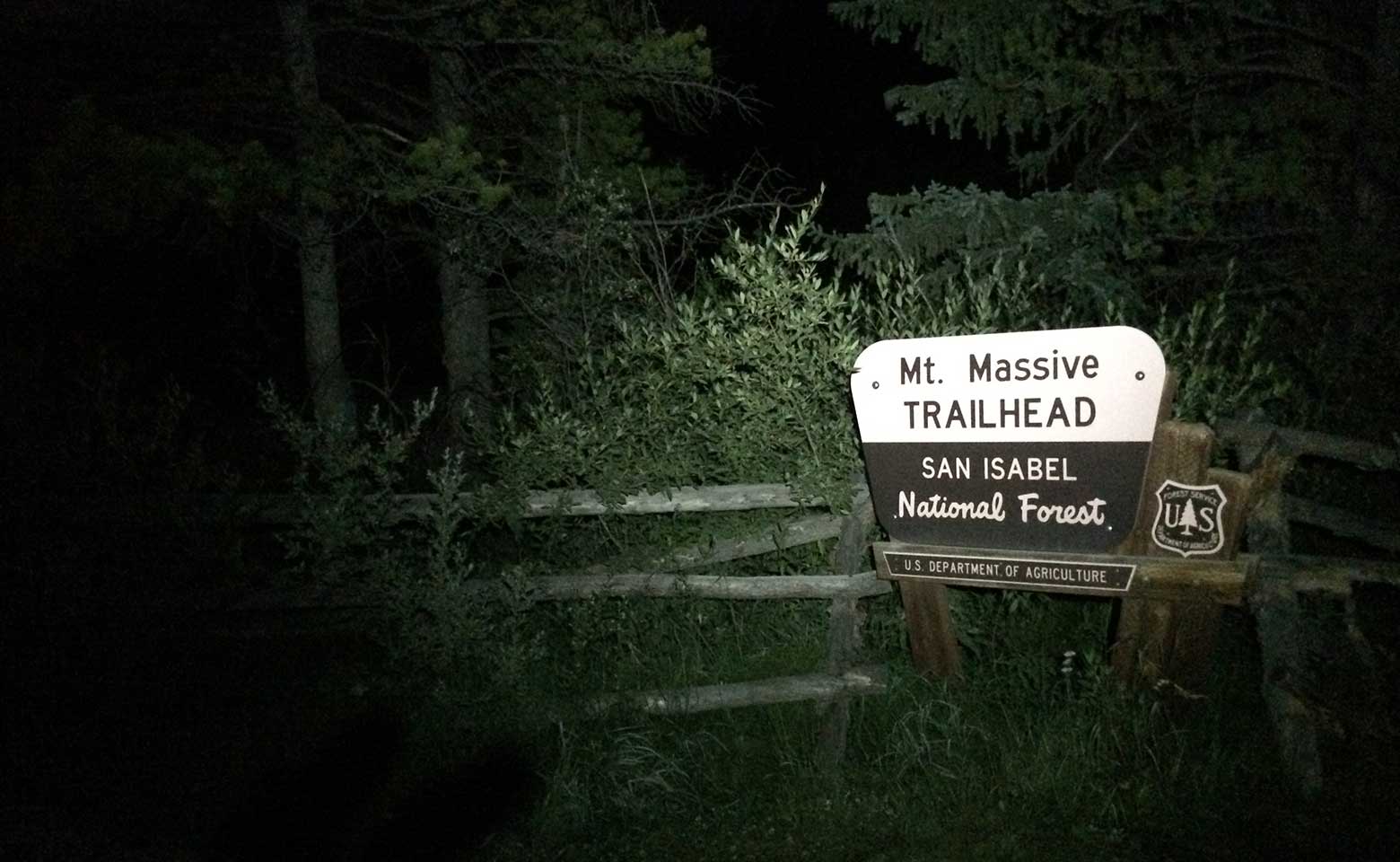
In August 2016, post-Transrockies stage race, I found myself at the base of Mount Massive in Colorado, the state’s second-highest peak situated next to Mount Elbert (the highest). The mountain is located just outside of Leadville, which sits above an elevation of 10,000 feet. I had one night between the end of the six-day race and a travel day to get back to the Front Range for work, and it was my only chance to do my first 14er during the whirlwind trip. That evening, I ate some High Mountain Pie (Leadville’s most delicious pizza) at my campsite and then headed up the trail to Mount Massive in the dark. The route from my tent and back would be close to 16 miles, and the mountain trail is considered a class 2, a system developed by the Sierra Club in the 1950s to rank terrain difficulty for hiking and mountain climbing. Generally, speaking, Mount Massive is not a difficult route and part of the trail is shared with the Colorado Trail. Eventually, close to the tree line, they diverge. I started up the trail excited about the adventure that lay ahead. As the trail began to steepen, my excitement grew. I’m an anomaly, I know. Instead of fear, these stakes give me a sense of freedom and energy, but I realize my experience isn’t the norm.
If you’ve ever struggled with finding the confidence and knowledge to embrace the nocturnal world, guided by nothing but the glow of your headlamp (and, hopefully, a well-planned GPS route), keep reading. A disproportionate number of women fears running on trails, let alone running on trails at night. The main threat to female runners in any environment is harassment from men, and that is a very valid fear. Although this threat is exponentially higher in a more populated area, it exists on roads and trails alike.
While various threats exist on the trail (including our fellow humans), most Colorado runners keep a nervous eye out for mountain lions. We share the woods with black bears too, though they tend to be more skittish than lions; in my experience, bears make plenty of noise crashing through the brush just to stay clear of us. Of course, a mama bear with cubs is always a concern, but just because you haven’t seen a cougar doesn’t mean it hasn’t seen you. To put these fears into perspective, let’s look at the stats.
Mountain Lions
Consider yourself lucky if you ever see a mountain lion in the wild. They want nothing to do with humans and usually slip away undetected or remain silent while watching you from the trees. What are your actual chances of ever being attacked by a mountain lion? The most conservative attack numbers I’ve seen claim 29 fatal mountain lion attacks since 1868 (mountainlion.org). That’s 0.18 attacks per year. To put that into perspective, the website also lists the following statistics: 777 people die from mosquito borne illnesses in North America each year, 28 are struck by lightning and 35,000-45,000 die from motor vehicle accidents. Only 15% of mountain lion attacks are actually fatal. Your chances of fatality would be worse if being attacked by a leopard (32%), African lion (62%) or tiger (78%). I think Carole Baskin (of Netflix’s Tiger King fame) would agree, tigers are probably your worst bet.
Surprisingly, most mountain lion attacks occur during the day despite cougars being most active at dusk, dawn and nighttime, which is primarily attributed to the high volume of human activity during those hours. Mountain lions do not see humans as prey. However, children, because of their size, are more susceptible to mountain lion attacks, so it’s not recommended they run on trails without adult supervision.
While our chances of being attacked by a mountain lion are fairly low, we can acknowledge they’re not zero (although based on the above, we should talk more about lightning safety). What can we do? Be sure to make a lot of noise when running alone on trails. If you are the only one out there, it’s fine to blast music from your phone or a mini speaker, but if you can’t (or don’t want to) do that, talk loudly or announce yourself often. I like to say, “Hey bear!” even if I’m in mountain lion terrain (it’s easier to say and I doubt mountain lions know the difference). And if you do see one: act big, don’t run, stand your ground and make your presence known by speaking forcefully.
Beyond just trail “etiquette,” carrying bear spray means added protection and can even ward off human threats. Just make sure you know how to use it. Manufacturers make demo cans to practice with, which I highly recommend, since you are unlikely to deploy a can of bear spray in real life. Store it somewhere that’s easily accessible while you’re running, otherwise, it’ll be totally useless and dead weight. Pro runner and adventurer Kelly Halpin is no stranger to solo nighttime wilderness efforts. She adventures in terrain among wolves, grizzlies and mountain lions and will carry bear spray when she’s alone, and clap her hands in dense forests to announce her presence. When I asked her if she’s ever afraid, she said, “I mean, I have fear, but it’s not out-of-control fear. I use good awareness, but not to panic.” The more prepared we are, the more knowledge we have and the more likely we are to allow ourselves the adventure of running on trails at night.
Bears
When it comes to a fear of bears, it’s the kind that matters most. Black bears are very afraid of humans except when habituated to human food sources. Black bears, which are the most common, have a population of about 900,000 across 40 states in the US. Each time I’ve seen one in the wilderness, they’re already running away. That being said, because of their numbers and attraction to human food, fatal black bear attacks number about 1.27 each year. These attacks are usually motivated by one of the three human-caused situations: the bear has been startled, food conditioned (not as afraid of humans because they are used to being fed) or a dog conflict occurs. Off-leash dogs can often exacerbate a bear encounter.
Grizzlies are a bit scarier. They are not as common and mostly live in Alaska, western Canada and very small, isolated populations in Montana, Wyoming, Idaho and Washington. They cause 1.58 deaths per year – mostly in Alaska and Canada. There are only 1,000 bears in the lower 48 states.
Wolves
I have never seen a wolf in the wild but figured I would touch briefly on this wildlife threat. There have only been two widely documented wolf fatalities in the last century – one in Canada and one in Alaska. There have been no wolf fatalities in the lower 48 in modern history. Wouldn’t it be cool to hear wolves howling in the distance on a trail run at night? For now, I will have to settle for the satisfyingly eerie sounds of coyotes. Which, by the way, have only caused one known adult fatal attack in Canada in 2009. Humans are much more likely to be bitten by a domestic dog.
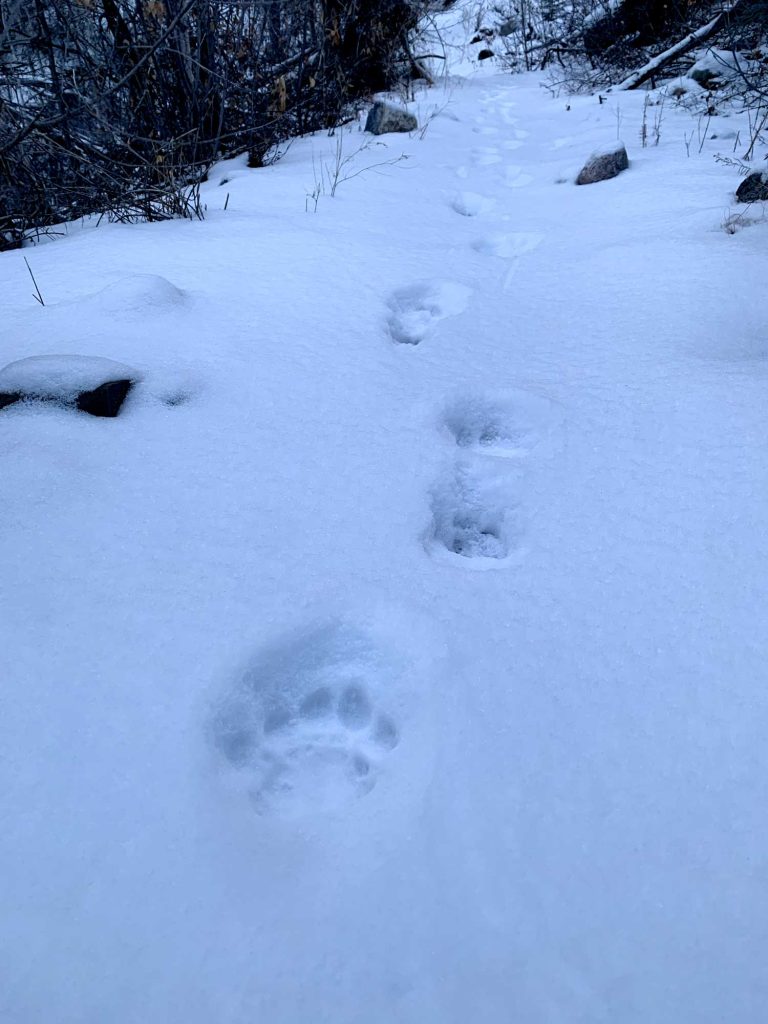
Fresh tracks (both human and animal).
Humans
So now to the real threat: humans. I won’t get into stats because I think we can all agree they are the scariest of the creatures mentioned thus far. So, for this threat, we’ll use common sense. Around my home in Durango, Colorado, I am unlikely to encounter any human on a trail run at night. Should I be aware and prepared? Yes. Carrying bear spray is a great idea. It is also wise to leave the headphones at home during your night run. Running in populated areas? Bring a friend. I definitely don’t suggest solo night runs in Philly’s Wissahickon. My husband Ryan’s strategy for “the Wiss” involved a solid crew: Gary, a 6’3” former Navy man who talks enough to warn every bear (although there are probably no bears in “the Wiss”) within a 5-mile radius, and Sophorn, who is fast enough to outrun them both. Group runs are a fantastic way to enjoy the adrenaline at night without the unnecessary risk.
The Joys
Now that we have talked about all the threats of night running (albeit statistically low), why even consider night running when we have plenty of perfectly good daylight hours? To this, I say, sometimes you never know what you are missing until you give it a shot. The countless, breathtaking sunrises and sunsets hit different when you are totally immersed in them rather than peering out a window or standing in your driveway. It feels like you are being reborn into the prospect of a long dark night or a new day. Want to see your favorite trails in a new light (or lack thereof)? Whether you’re training for a 100-miler or just looking for a new adventure, night running is the perfect way to build confidence and have some fun. If your long run is your church, your long run in the dark will be your mega church. Raccoons will be your disciples and Honeystinger waffles can be your communion.
Enough waxing poetic though. You need to see for yourself how the lack of light can open your eyes to beauty you never thought possible – it can be a truly liberating experience. And with the advancement in cell phone cameras, your Strava will be transformed into an Albert Bierstadt gallery. So, find a buddy, some bear spray and charge up that headlamp, it’s time to do some night running.
Mount Massive Trail (below the tree line): 1 a.m.
I had summited Mount Massive sometime before midnight. The far-away glow of the city lights of Leadville comforted me. I didn’t spend long on the summit though, as I quickly got chilled on that windy August night at 14,429 feet above sea level. I donned my pack and started to make my way down, and several miles later, back on the Colorado Trail, something caught my headlamp on the left: large glowing green eyes. Adrenaline rushed through me, and while I have never seen a mountain lion, there was no doubt that’s what it was. Wide set, hockey puck-sized eyes, close to the ground and they disappeared without a sound. I scanned the trees with my headlamp, but I saw nothing. No glowing green discs staring back at me. You aren’t supposed to crouch down, but I needed a stick (just in case). I squatted down to grab one while keeping my headlamp directed to where the eyes had been, and it crumbled in my hand. I grabbed another one that stayed intact. There was no more running as I walked with my head on a swivel while I clutched my stick. After 2 miles, I finally got up the nerve to break into a trot again and was relieved when I finally hit the road back to the campground. I collapsed in exhaustion in my tent around 2:30 a.m. I felt alive. I don’t regret my decision, but I do recognize that I could have been better prepared. It’s important to step out of your comfort zone, armed with the correct knowledge, in order to experience the world’s beauty, mystery and a perfect amount of fear.