
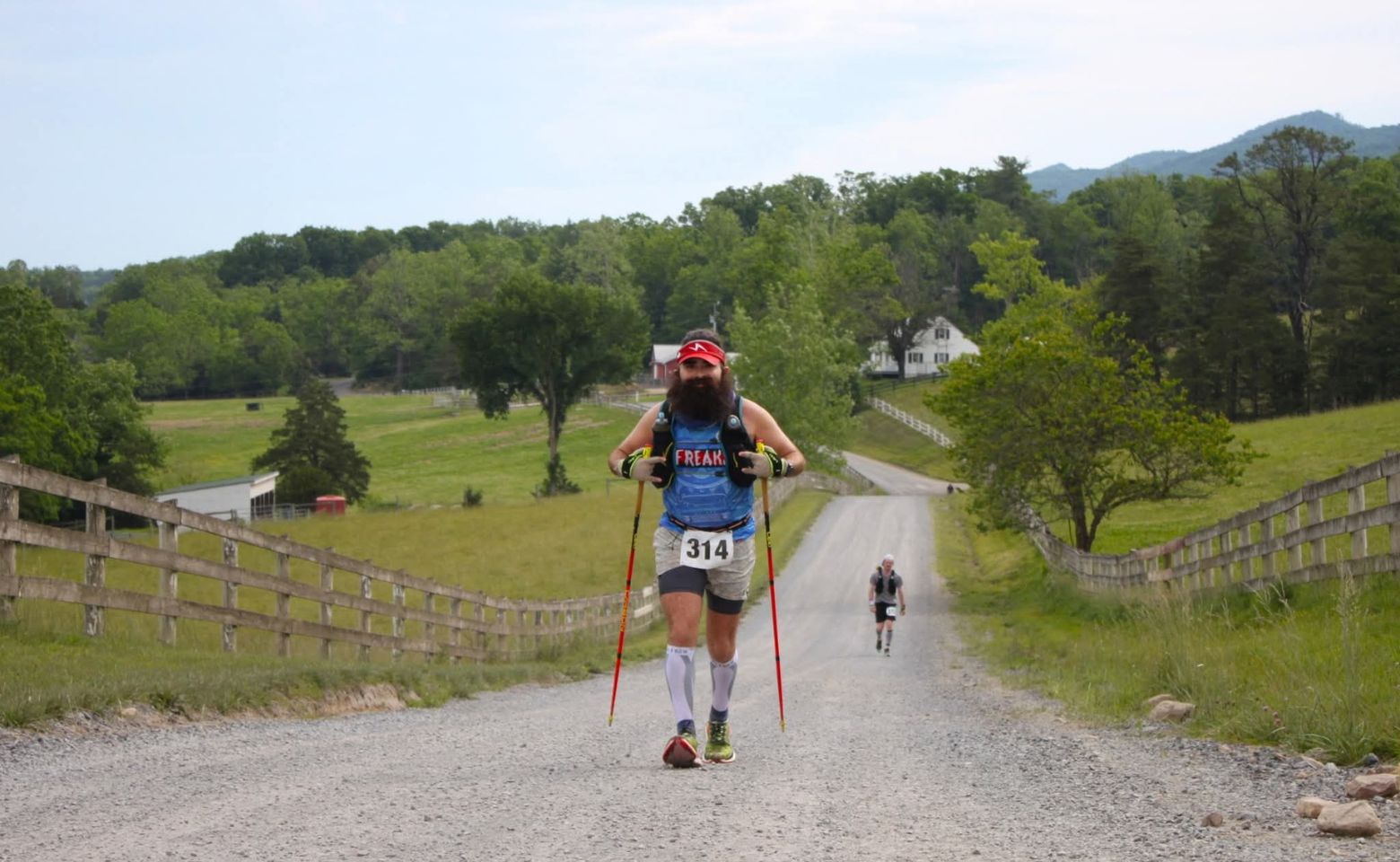
We were told to check in with Greg before starting the Old Dominion 100 in Virginia. I found that funny, as if we were all supposed to know who Greg was. I wondered why we needed to check in with him at all, not that I particularly minded. Greg was actually rather comforting, like the grandfather in a Norman Rockwell painting. When I walked over to him, I saw the start line for the first time: a red line painted across the parking lot. That was when I realized why we were all checking in with Greg. Without him and his clipboard, there would be no way of knowing we had started the Old Dominion 100 at all.
The race bibs we had been given at registration were simple white sheets with numbers printed on them – no race names or timing chips. When I gave Greg my name, he marked something down on his clipboard and wished me luck.
I then headed to the restroom before we started, mostly because of something Greg said at the pre-race briefing the night before. The talk had lasted an hour, and was incredibly thorough. It needed to be, because relatively little documentation about this race exists on paper or anywhere else. It was even difficult to find a race recap on Reddit. How else were they going to explain all the little idiosyncrasies of the race?
After detailing everything that would typically have been outlined in a race manual or on a website, the race director opened the floor to questions. Someone raised their hand and asked, “Is there any way to know which aid stations will have port-a-potties?”
Upon hearing this, about half the room immediately began to snicker, already knowing what his response would be.
“Port-a-potties? You have 20,000 acres of port-a-potties. Why would I pay for them?”
So, after using the last real restroom I was likely to see all day, I looked down at my watch and it read 3:55 a.m.
No announcements or warnings had been given, but because of the complete lack of every other creature comfort thus far, I was worried that might simply be par for the course. So, I decided to head back over to the start line. I was still fiddling with my watch when I heard the cap gun go off. We started the race with the first half mile around a horse track, where we would be returning for the finish.
As we ran through towns that looked like they could have been movie sets for black-and-white films, we were escorted by a police cruiser. Honestly, I am not sure why, because I didn’t see a single car on the road.
As we began our first big climb around 10 miles in, we made it to the first full aid station, which turned out to be a pickup truck with a box of Oreos, some tangerines and a couple of five-gallon coolers – one with water and one with Gatorade. It was Greg who took our bib numbers as we ran through the aid station.
Around mile 40, at the end of a particularly difficult climb made more difficult by the unrelenting heat of the sun, I made it to an aid station manned by two women who informed me that I was allowed to take one bottle of water, half a bottle of Gatorade and a cookie.
I asked them why.
“Rationing,” they replied. “Mules are tired.”
I looked over at the admittedly tired looking mules and realized that was how this aid station was being supplied. As I did, I saw another runner approach the aid station.
I had seen him several times already. He was a young Mennonite man, dressed in plain clothes: a button-up collared shirt that looked more suited to hard farm work than running, full-length pants held up by suspenders and a straw hat.
It was then, while looking at this young man and the mules together against the ancient mountains of Appalachia, that I began to think I was the one who stood out, not the other way around.
At around 11 p.m., I got to mile 76. It was later than I had originally told my pacer, as I predicted I’d be there around 10. I felt bad for keeping him waiting, so I ran over to meet to him and my wife as soon as I saw them.
This was the only hard cutoff of the race, and runners needed to leave before midnight. I forced down some pizza down, put on fresh socks and got back at it.
My pacer, who was originally from the area, told me all about the history of Sherman Gap as we climbed. Two miles in, I thought everyone had been overstating the difficulty.
It was about then when I realized that the moving stars I thought I saw were actually the headlamps of other runners, and that was where we were headed. It took us over 4 hours to cover that 11-mile stretch.
I had to say goodbye to my pacer at mile 87, because that’s the only section where pacers are allowed. I overheard an aid station volunteer say, “No, we really don’t need to kick anyone out until 4. These runners are slower, but they could still finish if they leave by then.”
I looked down at my watch, and it was 3:30 a.m.
A few miles later, my wife met me at a crew stop at mile 91. It was officially after 4 a.m., and I had missed getting one of the race’s iconic silver buckles, reserved for sub-24-hour finishers. But I had missed it by less than 10 miles.
I knew the next section was going to be tough because it had become difficult to run downhill, and down was exactly where I was headed.
“27:00:19,” the RD said as I crossed the finish line and went to sit down. “The awards ceremony is at 9. We’ll have breakfast.”
Great, I thought. Two hours to shower, pack up my shit and get right back here.
If not a buckle, what would my finisher award be?
They called 15 names before they got to someone who was actually present at the ceremony, and it was a guy who I had passed on the track at the finish. I tried to stand up and walk toward the stage as quickly as I could, knowing I would be next.
I didn’t know what I would say when they handed me the mic. What came out was, “I’d like to thank the RDs, the volunteers and most of all, my wife, for crewing for way longer than she had originally signed up for.”
I took my finisher towel as the crowd laughed, and returned to my seat.
As we left the post-race ceremony and drove away, I couldn’t shake the feeling that I wasn’t just leaving Virginia. I was leaving the year 1980, and a race that had not changed much since a simpler and bygone era of the sport. Maybe it was the sleep exhaustion, but something about that made me emotional. Fortunately, I can go back to 1980 next year.