
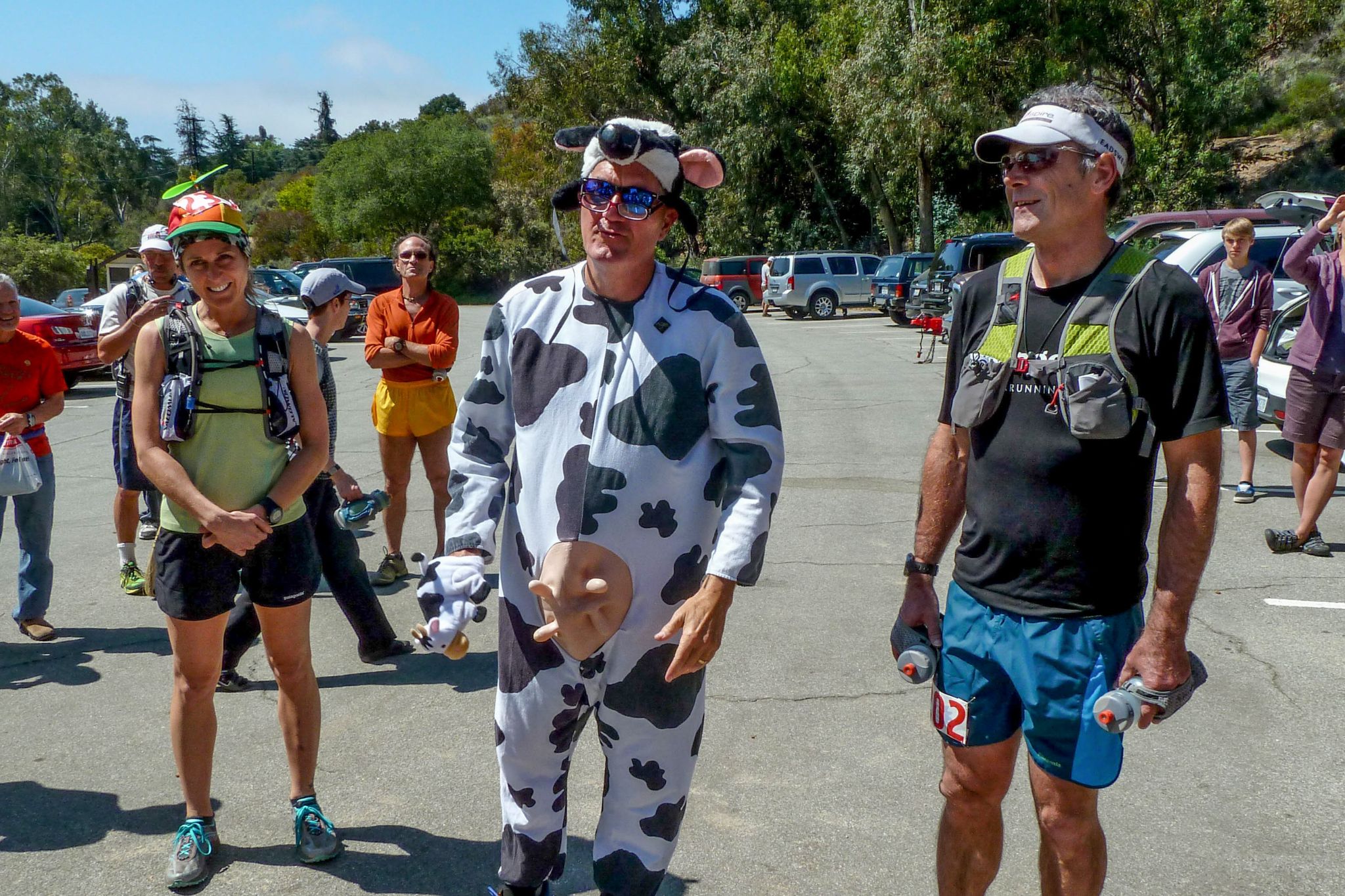
On a Friday evening at the mouth of Sisar Canyon in Ojai, California, a small group of runners gathers beneath the looming Topatopa Bluff. Ahead of them lies 100 miles of rugged mountain running, 53,000 feet of climbing and descending, two sunsets and a race that refuses to take itself too seriously.
After a 13-year hiatus, Coyote Two Moon — once described as “festive, wacky and a bit unhinged” — has returned to the Topatopa Mountains.
Originally conceived of by trail running folk hero Chris Scott, the race (Mooners cringe when you call it a “race”) begins on a Friday evening at the mouth of Sisar Canyon, the main route ascending Topatopa Bluff, a dramatic mile-long face of striated sandstone and shale that crowns the Ojai Valley mountainscape. Owing to its irregular east-west orientation, the bluff alights each evening in a fuchsia alpenglow. The psychedelic geography of the Topatopas is only matched by the merry prankster culture of the race itself.
Coyote Two Moon is the evolution of the Mugu 50-50 and Coyote Fourplay, a crescendo of difficulty and play designed by Scott to harken participants back to ultras of a bygone time. “We tried to bring the best from other race venues and throw them together into marginally chaotic organized fun—for runners and aid stations alike—on some fairly challenging terrain,” Scott wrote in one race report. “Add the simplicity of a course that has runners drop down off a ridge only to turn around and go right back up, and solitude becomes nearly impossible.”
In the inaugural Coyote Two Moon in 2008, Karl Meltzer, who has won more 100-milers than any other human, won the 100-mile race, and David Goggins placed fourth in the 100k. In 2011, Meltzer and Jeff Browning were somewhere around mile 70 when heavy snow from an early spring storm forced the coordinators to call off the race. Current race director Mauricio Puerto was also at mile 80 when the race was called off—staggered start times ensured most runners finished within a couple hours of one another. Scott moved to Vermont after that event and Coyote Two Moon continued to exist for several more years in a self-supported guerilla format before fading away.
More than a decade later, the race returned almost by accident. In 2022, Ojai runner Mike Scarber was out on a trail run when he wondered aloud why a place with mountains like the Topatopas didn’t have its own ultramarathon.
Scarber sought Navy veteran Mauricio Puerto, who was an integral part of early Coyote Two Moon days and the effort to keep it alive. With Scott’s blessing, Scarber and Puerto rebooted Coyote Two Moon. In 2023, winter storms wiped out their first restart attempt and trail damage nearly grounded the 2024 event.
The race is the ultimate for nighttime running. The course traces the spine of the Topatopa range, dropping runners into four steep canyons on out-and-back routes through montane chaparral and conifer forest. The mountains themselves are geologic oddities — an “overturned” formation created by millions of years of tectonic compression that flipped the rock layers nearly vertical. Marine fossils appear even near the 6,300-foot summit of Topatopa Bluff, reminders that this surreal landscape was once ocean floor.
In its first year back, 30-year-old Aaron Kubala won the 100-mile event. But before he could settle into the lead, race organizers handed him a spinning propeller hat at mile 3 and told him he had to wear it for the rest of the race.
Kubala laughed — and kept running.
“It sets the tone immediately,” he said later. “Coyote Two Moon is fundamentally unserious in the best possible way… It favors an experience-forward approach to ultrarunning, divorced from conventional rules and hypercompetitive attitudes. That’s not to say it’s not hard — 27,000 feet of climbing in any race is going to be a slog. But the vibe is festive, wacky, and frankly a bit unhinged.”
Mid-race antics are part of the culture. Kubala was asked to carry a bag of electrolytes up one climb to an aid station in exchange for a few minutes off his time. Later he choked down an entire pickle for another minute. Limoncello shots at mile 70 shaved off yet another.
Luis “El Coyote” Escobar is the founder of All We Do Is Run and race director of Born to Run and Santa Barbara Nine Trails, among others. Escobar said part of Scott’s genius was attracting incredibly talented athletes to participate in shenanigans before, after and throughout the event—acts of silliness that create vulnerability and bonding. “The shenanigans are a vehicle to bring people together,” Escobar said. “It was never about running. It was about people being people, hanging out together.”
At the pre-race meeting at a local brewery named for the mountains, Scarber joked that whoever bought him his favorite beer first would receive a one-minute time deduction. Kubala walked up with a round. Scarber scribbled in a notebook: “Aaron — minus one minute.”
Kubala stared, “Are you serious?”
Kubala reflected a year after his Coyote Two Moon experience, “In some sense this grassroots, local, scrappy race feels more authentic to ultrarunning to me than many of the higher profile events — it’s a group of crazies in pursuit of experience, throwing a party in the middle of mountains and celebrating taking on hard things.”
“You’re out here to have fun,” Scarber said. “Yes, you can put yourself through something difficult. But if you can’t laugh while you’re doing it, then go do something else.”
Today the event—now directed by Mauricio Puerto—offers 10k, 30k, 55k, 55-mile, 100k and 100-mile distances, but retains the same mischievous ethos that defined Scott’s original creation: a gathering of runners willing to embrace equal parts suffering and silliness.
“The course is a little funky, unconventional, no doubt. It doesn’t follow the rules, and it definitely doesn’t try to be predictable,” Puerto said. “But that’s exactly the point. That’s exactly how we like it.”
The next running of Coyote Two Moon begins under a full moon on Friday, May 1, 2026, at the mouth of Sisar Canyon — where the sun will set on the bluffs and runners will disappear into the Topatopa mountains for two moons on the trail.