
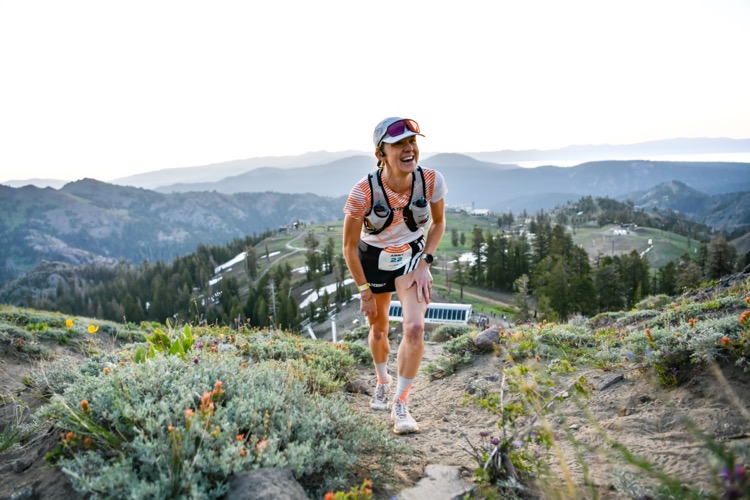
This article was originally published in the August/September 2025 issue of UltraRunning Magazine. Subscribe today for similar features on ultra training, racing and more.
For Western States women’s champion Abby Hall, the 2025 event will long be remembered as a race defined by destiny as well as one of recovery from a devastating injury. Hall, 34, of Flagstaff, Arizona, had watched much of the race while on crutches just two years ago.
Hall, who didn’t know she would be in this year’s field until mid-April after a couple of near-misses at Golden Ticket races in Arizona and Italy, ran a race that was notable in its confidence and totality.
Running at, or near, the front of a deep women’s race until her strong “uphill grind” move a little beyond halfway, from the bottom of El Dorado Creek to Michigan Bluff, vaulted her into the lead for good, and she finished in the fourth-fastest time ever: 16 hours and 37 minutes. For the second year in a row, Fuzhao Xiang of China finished as runner-up in 16:47 (seventh-fastest all-time at Western States), with Canada’s Marianne Hogan finishing third in 16:50.
“It’s all kind of hitting me now,” Hall said. “Not just my own journey, but the fact that each of us in the race all have these journeys that lead to bigger stories. Race day just tied it together so beautifully for me.”
Just as impressively as Hall’s performance was that of men’s champion, Caleb Olson, of Draper, Utah, who had found a way to put his own personal imprint on Western States.
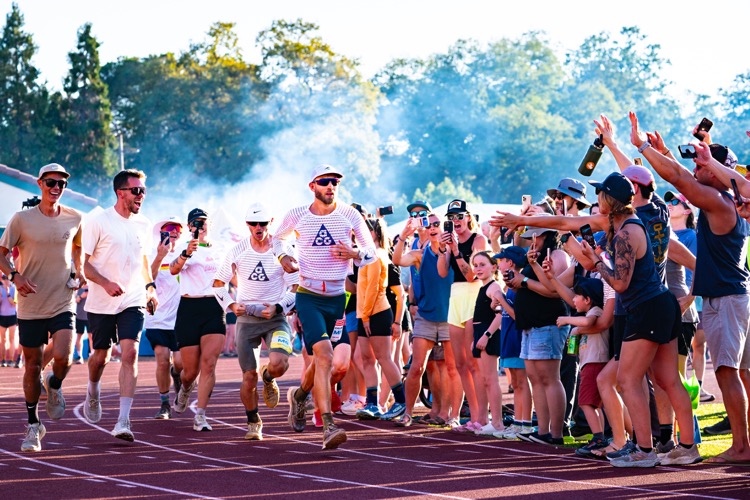
Caleb Olson rounds the track at Placer High School to win the 2025 Western States Endurance Run. Photo: Gary Wang
Olson’s story in the days leading up to the race had been one of supreme confidence in his training preparations while also feeling a tug of doubt that often accompanies becoming a new father. Olson and his wife, Morgan, welcomed son, Marshall Ranger, into the world in May. Although Morgan made it clear to Olson that it was alright for him to continue his training for Western States in the days and weeks following Marshall’s birth, Olson admitted there were many days where he wondered if running Western States was the right call.
“Morgan has always been so super-supportive of all the things I do, and she knows how important running is to me,” he said. “She knows I can be a better dad when I’m also doing the things that I love to do. Honestly, I would’ve been happy focusing for two months on the baby. I give all the credit to Morgan. She told me it was all going to be OK.”
Olson ran the second-fastest time in race history, finishing less than 2 minutes behind Jim Walmsley’s 2019 course record and capturing the men’s title in 14:11. Chris Myers, of Nederland, Colorado, who ran with Olson for much of the first half of the race, finished second in the fourth-fastest time ever: 14:17. Kilian Jornet, the 37-year-old legend from Spain who now lives with his family in Norway, made his return to Western States again this year. Previously, Jornet ran to a third-place finish at Western States in 2010 and was featured in the documentary, Unbreakable. He then returned in 2011 and won the race in 15:34. This year, he finished third in the fifth-fastest time in race history: 14:19.
For Olson, as he chased a course record, the 2025 race was just as much about discovery as it was about anything else.
For Hall, Western States was a reminder of how it was her destiny—even when few others thought it possible—for her to win this year’s race.
ABBY HALL’S PHONE WAS LIGHTING UP on that mid-April afternoon as she was making her way out of one of her favorite training places in the world: the Grand Canyon.
Hall’s season had already been eventful. Before it began, her goal was to earn a spot into Western States at a Golden Ticket race. At Black Canyon in February, Hall, after struggling early, was buoyed by some encouraging words from her husband, Cordis, over the final 10 miles, to finish as strongly as she could. Although she finished in fifth place—two spots away from a Golden Ticket entry—Hall’s determined swoop over the final miles seemed to pulse with a new-found type of confidence.
“It was so cool because I didn’t know what it was leading to other than the fact that I was able to really push it even after the opportunity for a Golden Ticket was over,” Hall said. “It was a moment where I realized that so often it needs to be ‘you versus you,’ and that’s all that really matters. And that became my mantra: ‘You versus you.’”
Although there was some disappointment with her fifth-place finish, Hall came away from Black Canyon fortified. In fact, it was a minor miracle that she was even back competing at the highest levels in the sport only about 20 months after suffering a tibial plateau fracture in her left leg while out for a run near Flagstaff. Ironically, that fateful 2023 run had come as Abby and Cordis—whose home is seemingly open to any and all ultrarunners from all over the world throughout the year—were hosting their good friend from England, Tom Evans, who would go on to win Western States in 2023.
Although she was on crutches at the time, and the coming months would include a bone graft, LCL reconstruction, tibiofibular joint reconstruction, medial meniscus repair and a painful bout with deep vein thrombosis in her calf, Hall made it a point to be part of Evans’ crew when he won Western States.
“It’s no joke to go through something like that,” Hall said. “But I put a big emphasis on staying close, being close to what I love and against my husband’s and my parents’ wishes, I forced myself to Western States two weeks later,” she said. “I was pretty useless. I was always propped up on chairs and crutches.
“But you know what? Even with all of that, there was this magic to everything I was experiencing. The magic—that was why I was there. I distinctly remember laying there in the infield on that Saturday night at sunset, with my crutches, and seeing all the people there, seeing all the finishers and trying to soak up all that energy that was there that night. That was important to me. That kept the fire alive for me.”
A month after Black Canyon, another attempt for a Golden Ticket came at the Chianti Ultra Trail 120k in Italy, with Hall finishing fourth—again, just shy of an automatic spot into Western States.
And then came her run into the Grand Canyon on April 16. Near the end of her run, when she was back in cell service, texts and calls had been coming in from Reno, Nevada, ultrarunner EmKay Sullivan, who had earned the third and final Golden Ticket at Black Canyon back in February.
When the two runners connected, Sullivan said she was pregnant, and had actually run while in the early stages of her pregnancy at Black Canyon, though she didn’t know it at the time. She was opting to use Western States’ pregnancy deferral for this year’s race.
In a twist of fate, Hall was now in the race.
“I remember sitting on the edge of the Grand Canyon and looking out and it just felt momentous,” Hall said. “I was feeling the excitement for EmKay and Tommy (Sullivan’s husband) at this stage in their lives. And getting this opportunity, at this place that has always been so meaningful to me, a place that I love to run and just always feel so alive.
“It was just so cool. I think it’s a really cool story for the women in our sport, that you can be EmKay and journey into motherhood.”
And then Hall paused.
“And it’s funny,” she said. “I hadn’t really let go of it yet (being in the 2025Western States). I didn’t have a logical reason to feel that way, but all the time, throughout 2025, even before EmKay called me, I just felt it was meant to be.”
ABOUT TWO WEEKS LATER, ON MAY 1, PARENTS Morgan and Caleb Olson welcomed Marshall into their family. Morgan and Caleb had always been an active couple, having spent as much of their free time together hiking, climbing and running in the mountains.
Morgan’s pregnancy made Caleb realize that with one of life’s most prized additions would come change and perhaps, most importantly, the realization of how many immediate demands are often made upon a new mother. And here Olson was, one of the best ultrarunners in the world—he had finished fifth at Western States the year before, in the fastest Western States debut time ever—facing a key two-month training build-up leading into a race he’d been circling since the previous December.
“I don’t know, but I think guilt is probably the right word to describe how you feel about it,” Caleb said. “Morgan has been great about everything. She would just basically sacrifice every night’s sleep to let me sleep in another room, and we worked out a schedule with the help of my mom where she would come in after I helped out a little bit in the morning, then I would go for my run. And then there would be meetings I’d have, and sometimes that would get tricky where I would simultaneously be doing (remote) meetings and take care of Marshall and then Morgan would take over and I’d go for my second run.
“It felt pretty unsustainable. And it’s definitely been a busy past couple of months. I know this affected Morgan in a lot of ways, and I know she has had this worry about how this would affect me and my running. All these hours staying up and letting me sleep, all that stuff, Morgan deserves a ton of the credit. She’s made so many sacrifices.”
Physically, Olson knew he was ready. He’d won the Transgrancanaria 126k in record time in February. The early-season Western States talk had centered on a match-up between Walmsley, 2025 second-place finisher Rod Farvard, 2025 third-place finisher Hayden Hawks and Jornet, making his return to Western States for the first time in 14 years. Walmsley and Hawks would withdraw prior to the race due to injury, and Farvard, who had dueled Walmsley to the brink and back in 2024, would drop this year at mile 91.
“It definitely didn’t change my training into the leadup of the race,” Olson said. “You can only control your fitness and your preparation. It maybe changes my mindset a little bit—if Jim and Hayden had run, that whole race could’ve had a different dynamic. I knew I had a lot of confidence going in. I was in a good spot to match moves and see what was going on at the front.”
Two days before the race, Olson attended a party near Olympic Valley. He knew he was ready, and he knew that he and Morgan had a plan for Marshall, with Morgan’s parents set to watch the newborn so that Morgan could be part of Olson’s race.
And then seven-time Western States champion Scott Jurek walked up to Olson.
“We chatted a bit, and that was a fun moment,” Olson recalled. “And Scott said, ‘You have what it takes to win.’ Scott’s a really nice guy, and it was nice of him to say that.
“And at the time, I just thought he said that because, you know, he’s a really nice guy.”
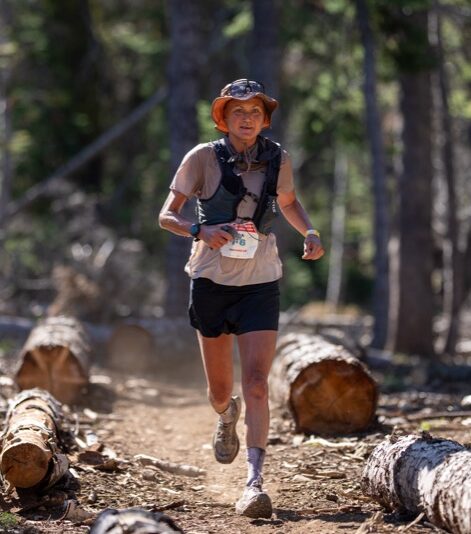
Ida Nilsson runs in the women’s front pack near friend and training partner Abby Hall. Photo: Paul Nelson
ON AN ALREADY WARM MORNING, AND ON A DAY where the high temperature on the course would reach 99 degrees at the Rucky Chucky river crossing at mile 78, the women’s race quickly strung itself out. Abby Hall was always among the top three along with Ida Nilsson, who would finish fourth in 17:00 and Poland’s Martyna Mlynarczyk.
Hall, feeling strong and steady, was either in the lead, or near the lead, through Last Chance at mile 43.
“I was and I wasn’t,” she said when asked if she was surprised to be in the lead or close to the lead early on. “I had planned to be racing from the very start, and my approach was I didn’t want to wait for it to unfold. I wanted to position myself well and have a fun day and feel momentum through Robinson Flat. I was surprised that there weren’t more women that came with us.”
She was familiar with Mlynarczyk and considered Nilsson, who is a legendary figure in Flagstaff for a record-setting track and cross-country career while running for Northern Arizona University, a good friend and training partner.
“At times, I was trying to think of it as another long run with Ida,” Hall said.
Hall has always been an exceptional climber, particularly on the long, grinding ascents like those in Deadwood Canyon to Devil’s Thumb at mile 47 and in El Dorado Canyon to Michigan Bluff at mile 55. “We were all within eyeshot of each other (to Last Chance) and I was focused on being really patient for the canyons, where I knew I would be able to make some moves on the climbs,” Hall said. “I passed Ida on the climb to Devil’s Thumb, and then into Michigan Bluff I passed Martyna and put a solid gap between us.”
Hall built a 10-minute advantage over Nilsson into Foresthill. She said, “I was really pleased that my legs were still there after the canyons,” she said. “I was happy to feel like I could run smoothly, and I was fueled on the crowds of both Michigan Bluff and Foresthill. It started to sink in that winning was becoming more realistic.”
Joined by pacer Scott Traer, Hall said, “I tried to focus on staying in my own bubble. I didn’t want to have too big of a spike and stay level and not get too emotional. My crew was a well-oiled machine. I had a great stretch to the river with Scott. He has that inherent energy that always helps, and we were starting to pick off some of the top men. I wanted to frame that momentum when I switched pacers from Scott to Cordis at the river, and we were able to do that.”
Hall sped the 2-mile uphill stretch from the river crossing up to the Green Gate aid station (mile 80) in about 24 minutes. The goal was to “rinse and repeat” what Cordis had exhorted Hall to do in February during the late stages of Black Canyon.
Around 6 p.m., Abby Hall had run away from her challengers. Yet she found herself increasingly asking Cordis to refresh his phone, to check the latest race data for updates on who was behind her.
“I didn’t want to get emotionally attached to an outcome that hadn’t happened yet,” she said.
CALEB OLSON, ALONG WITH A MEN’S LEAD pack that sometimes included as many as 15 runners, stormed through the Granite Chief Wilderness and onto Robinson Flat under Jim Walmsley’s course record pace from 2019.
“That was probably the most fun,” Olson said. “That’s the most beautiful part of the course. I was feeling good. The temps were cooler and I didn’t have to put too much thought into pacing. I was near the front, but not at the front.”
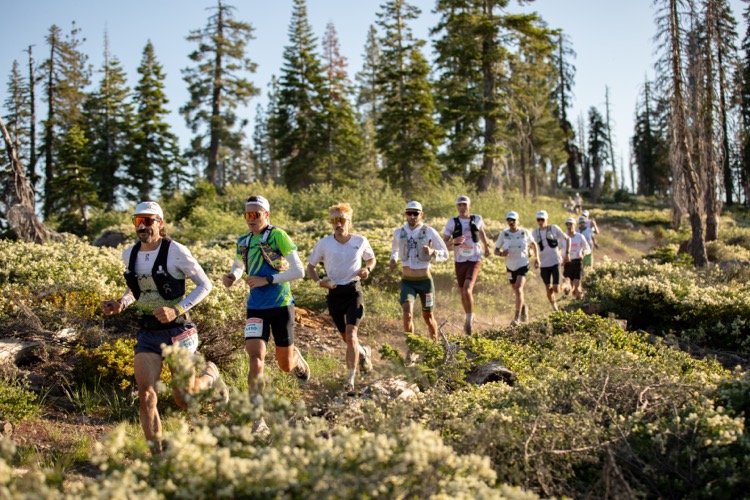
The elite men make their way through the high country. Photo: Jesse Ellis | Let’s Wander Productions
Olson found himself running with Farvard and fourth-place finisher Jeff Mogavero, who would finish in 14:30, as well as Myers, who endeared himself throughout the race with antics that included doing light-hearted things like wearing a snorkel and goggles as he crossed the river.
“We were all just chatting and using each other and motivating each other, and that helped a lot before we really got rolling,” Olson said.
It wasn’t until Last Chance (mile 43) that Olson and Myers created a small gap from the rest of the leaders. At Devil’s Thumb (mile 47) they had 3 minutes on Jornet, looming large in third place.
Both Olson and Myers couldn’t help themselves at this point. They were 3 minutes ahead of perhaps the most influential figure the sport had ever known in Jornet. “We’re very much aware we’re in the front of this thing, and we’re not even halfway, and we both made comments, something to the effect of that we should almost declare victory at that point,” Olson said with a laugh. “Kilian’s right behind us, and Chris is a lighter mood kind of guy who has this nice energy when it’s serious and competitive.”
Olson said he started to “do his thing” into El Dorado Canyon, but Myers kept him close.
On the climb up to Michigan Bluff, “I did give it a little more gas,” Olson said. “This is where my strengths are, and I was thinking, maybe if I can open up a minute or two on Chris, it would be really nice to have a gap on him leaving Michigan Bluff. It felt natural and not a huge surge, but it was enough.”
By Foresthill, Olson was about 9 minutes ahead of Walmsley’s course-record pace and held a 4-minute lead on Myers. Along with pacer Anthony Costales (third at Western States in 2023), Olson surged down the 16-mile California Street stretch.
“It’s hot, and I’m working hard, and it’s definitely the hottest I’ve felt all day long,” Olson said. “It was like being in an air fryer down there. There were spinning waves of heat. I started to take a little longer at each aid station so I could refresh my ice and my bottles. I felt like I had plenty of juice left in my legs, but I could feel the dehydration and stomach issues really starting to set in.”
At Green Gate (mile 80), though he had moved well on the climb, Olson could feel that his stomach issues—painful cramping that often forced him to stop and take a deep breath before he could muster a swallow—would need his undivided attention. “I had crossed the line too far to really fix them, and it became a game to take in just enough to feel OK for 2 hours,” he said.
Pacer Jacob Grant helped Olson hold things together, and the two made the realization over the final miles that victory was enough. Olson was still close to Walmsley’s course record, but “I was kind of zoned out and had this extreme tunnel vision,” Olson said. “Jacob kept me motivated and kept reminding me that I had come this far and I just had to see it through. I wanted to win. That was super important. And I know that the course record was a goal at one point, but in that moment, I didn’t care that much about time. I would’ve really had to go to the well in order to do it. I knew how bad of a state I was in, and if I went over the edge and cramped up and tripped on Robie Point, I don’t know what would’ve happened.
“I just wanted to soak in the moment and enjoy it.”
In a full circle moment, just as Olson crested the final hill in the Robie Point neighborhood with less than a mile to go, Scott Jurek darted out from the screaming crowds. The gray-haired Jurek ran up to Olson’s side, flashed a huge smile and gave him a fist bump.
“There’s Scott!” Olson remembered thinking. Then he added, with a laugh: “He’s right there. I guess I do have what it takes to win, and this is a cool moment.”
In all the races Caleb Olson runs, whether he finishes first or not, the first person he always seeks out is Morgan, who usually waits right at the finish line to greet her husband. As Olson ran through the four-deep throngs overflowing onto the lanes of the Placer High School track, he looked for his wife but did not see her. He crossed the line, arms raised and then felt as if he was like a dry towel, completely wrung out and twisted.
“At first I didn’t see Morgan, and I’d thought she would pop out and hand me Marshall before I crossed the finish line so I could run across with him,” Olson said. “And then I looked around, and she popped out of nowhere and handed me Marshall right after I’d finished. It was a pretty cool thing for her to do, to wait until it was over, so that we could all experience our first big finish line together.
“I think about everything she sacrificed, way more than just the past two months, all she had done, and I think that’s the big thing you realize in a moment like that. We’d done this together. It was definitely a moment I’m never going to forget.”
ABBY HALL RAN UNTIL SHE COULD RUN NO MORE. Under a blazing headlamp that seemed to flood the track with a combustible sense of closure, and with Cordis running in full flight to keep up, Hall sprinted for a finish line she had been dreaming of for two years.
In 2023, on crutches and facing an uncertain athletic future, she had watched the finishers and let the majesty of their finishes absorb into her soul. Now it was her turn, not just to finish, but to win in rather resounding fashion.
If there had ever been a sense of loss, a feeling that the odds were too insurmountable, a pang for the ease of life before her injury, it was all gone now as Hall heard her name called out in the Auburn night as the 2025 Western States champion. This was destiny. And Abby Hall ran for it with all of her might.
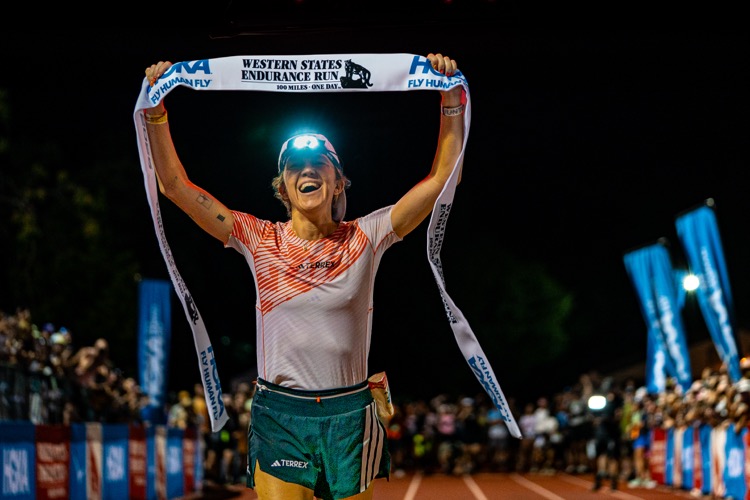
Abby Hall crosses the finish line in 16:37, winning the 2025 Western States Endurance Run. Photo: Paul Nelson
“I chose to give it everything to the finish, and that was really for me,” Hall said. “I felt so proud to be in that position; to have been able to race and end up winning the race. I’ve never nailed a 100-mile race … at all … in my life. This was the day I’d been waiting for and dreaming of for years.
“I wanted to make every second count. I totally emptied myself and crossed the finish line. And then I let myself soak it all in—all the hugs, the high-fives. The energy throughout Robie to the finish was surreal. I don’t know, maybe our wedding day was the closest thing I’ve ever experienced to how I felt at the finish line. I’ve always believed that it’s not something inherent about the Placer High track on the last Saturday in June that makes it so special, it’s the people that are there, what they’ve been a part of and you’ve been a part of, that brings the magic. That’s the magic. I felt the weight of that.”
If not preordained, something special had been destined to happen all along for Abby Hall. What should have haunted her only made her stronger. What resided in her now, as she bowed at the waist after finishing and momentarily covered her eyes with her hands, was a mysterious power to see all the magic in the world, and embrace it and make it her own.
“My injury really deepened my capacity not only to endure, but to feel love for what I’m doing and for my life,” she said. “I can genuinely say that this victory would not be as meaningful without the context of how I got there. The whole experience really reminded me that there are only so many opportunities we have, and I wanted to make my opportunity count.”