
 Our reviews are 100% organic. We do not accept payment for reviews or bundle with advertising budgets. In most cases, the brand is providing the product to our reviewers free of charge.
 If you’re not familiar with the Komperdell brand, you probably haven’t spent much time in Austria where the company has been manufacturing mountain and Nordic gear for over 100 years. Their product line is heavily focused on racing suits, snowshoes and several categories of ski and trail poles. We spent the summer testing three varieties of folding trail poles (about 5,600 miles away from Austria) in the Sierra Nevadas and coastal California mountain ranges: one is intended for high-level skyracing, one is for all-purpose training and racing and the third is for general trekking and lower intensity/longer duration use.
FXP Composite Trail ($200)
This racing model comes in fixed length increments of 5cm, from 105 to 135cm, and it’s a good time for us to point out that Komperdell sizing seems to run slightly long compared to just about every other brand we have tested, generally by a factor of 2 or 3 cm. This isn’t a huge issue for adjustable length poles, but for fixed length poles it’s an important consideration, so if you are between sizes, we suggest you go smaller. This sleek model has a straight cylindrical shaft with a width of 16mm from top to bottom, and a relatively narrow handle head of approximately 20mm that discourages excessive use which we often prefer on descents. This model utilizes a self-deploying FXP mechanism to extend the poles to full length with a single, easy pull, making them quickly available for use once removed from your pack.
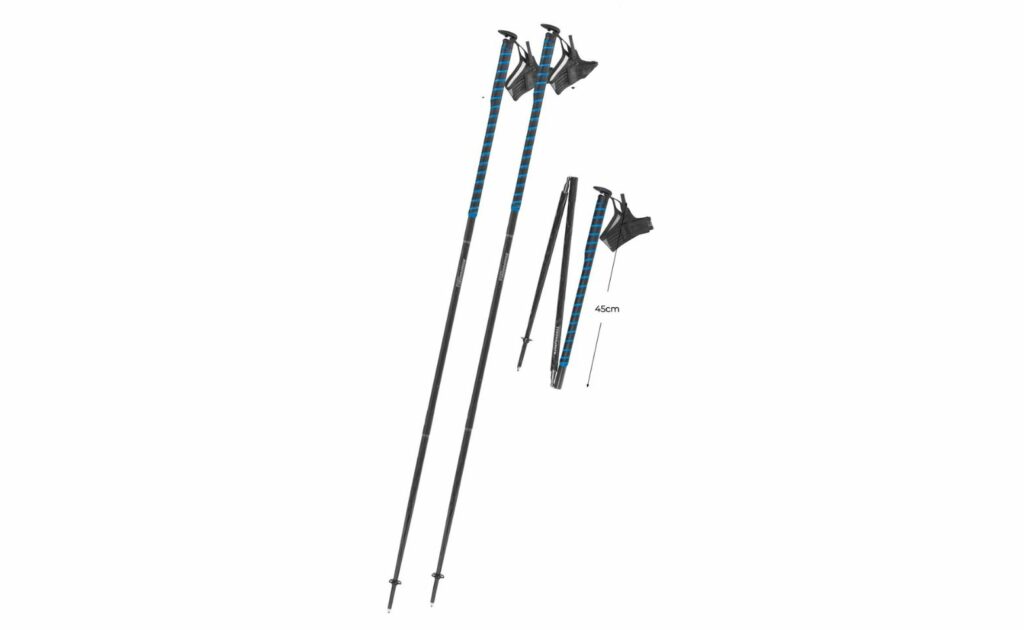
FXP Composite Trail
An extensive grip area at the top of the shaft is slightly expanded through the top 15cm and continues another 22cm below to provide a large contact area if you need to choke up on the grip in super steep terrain. Otherwise, this pole utilizes a Fly Sport strap that is similar to LEKI locking systems, with two significant differences: the “glove” portion of Komperdell’s strap system is extremely lightweight and the strap connection into the pole is looser and much more fluid than LEKI poles that sometimes take some muscling. This is great for ease of clipping in at the base of a hill, but we also had a couple occasions when our strap inadvertently came loose from the notch on smoother slopes. If the glove-notch method isn’t your thing, the FXP Composite Trail is also compatible with a standard Fly Loop strap. When using the loop strap, the loose notch is a particular problem, as the straps actually fell out of the notch during our testing when carrying the poles horizontally on flat trails. For this reason, as well as general overall comfort, we prefer using the Fly Sport system that comes with these poles.
FXP Composite Trail poles come in three grip color options to choose from: blue, green or pink. But if you want to accessorize your poles to match your mood, Komperdell offers nine different solid, striped, or patterned interchangeable non-slip grip tapes that are easy to apply and remove. Each color is sold separately for $20 and allows for customization of each pole.
Carbon Pro Zero ($190)
The most versatile of the trio we tested, the Carbon Pro Zero is a great all-purpose, all-season telescoping adjustable pole that is built for heavy training blocks but is also light enough for midpackers to use on race days. The pole’s material composition uses 100% carbon for the top two sections, and the lower portion is a material called Titanal, an alloy of mostly aluminum that has high strength and a number of qualities suited to outdoor equipment. Titanal has enormous impact resistance, and also maintains its strength when it is being torqued in any direction, which can sometimes happen when a pole tip gets lodged in a rock or divot and undergoes twisting or bending forces from above. Forged aluminum is also employed on the Powerlock 3.0 mechanisms that adjust the pole length, and their lockdown is impressive: we set our length preference in place prior to our first run, and after at least 100 miles of steep vertical and rocky terrain, we haven’t had to readjust it once.
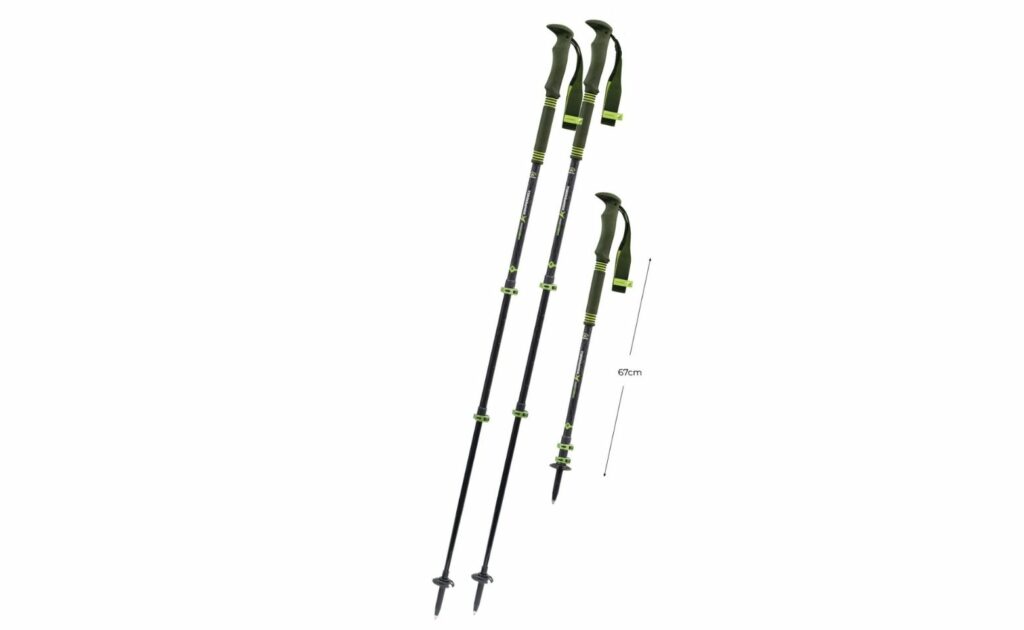
Carbon Pro Zero
Grips of the Carbon Pro Zero are made from Trek Pro 280 foam, which is lightweight and has a comfortable feel, along with a nice firmness to maintain its shape during prolonged use. The pole has a wide head at the top (35mm compared to 20 on the FXP Composite) that rests well against the palm when checking ourselves downhill, and an extended grip zone for steep slopes. The foam is comfortable in a wide temperature range but got a little slick on hot days when our hands were sweaty. This pole uses a conventional strap system, but with a comfort padded strap that adds a thin layer of cushioning underneath your fifth metacarpal bone (on the pinky side). The improvement in comfort with this small amount of padding is definitely noticeable and worth a few grams of weight from our standpoint. Telescoping poles generally have longer pack lengths than true folding poles, and that is true with this model. \Komperdell makes a Comp version that has a shorter adjustable range (90 to 120cm) and packs down 10cm shorter than the standard Carbon Pro Zero.
Explorer Zero ($150)
Think of this as the aluminum counterpart to the Carbon Pro Zero, as it has similar functionality and most of the same supplemental features aside from primary material construction. Shafts of the Explorer Zero are made from an aluminum compound called 7075-T6. The “7075” identifies a high strength alloy frequently used in aircraft construction because of its high strength and corrosion resistance, and “T6” indicates a degree of tempered enhancement that elevates its strength to a level comparable to many steel alloys. The resulting compound is about 20g heavier than the carbon version and is still lightweight enough for easy training, but may feel cumbersome if you’re trying to move fast. On the plus side, because aluminum is cheaper than carbon fiber, this is an affordable entry-level pole if you’re newer to mountain running or more interested in the comfort rather than quantity of your miles.
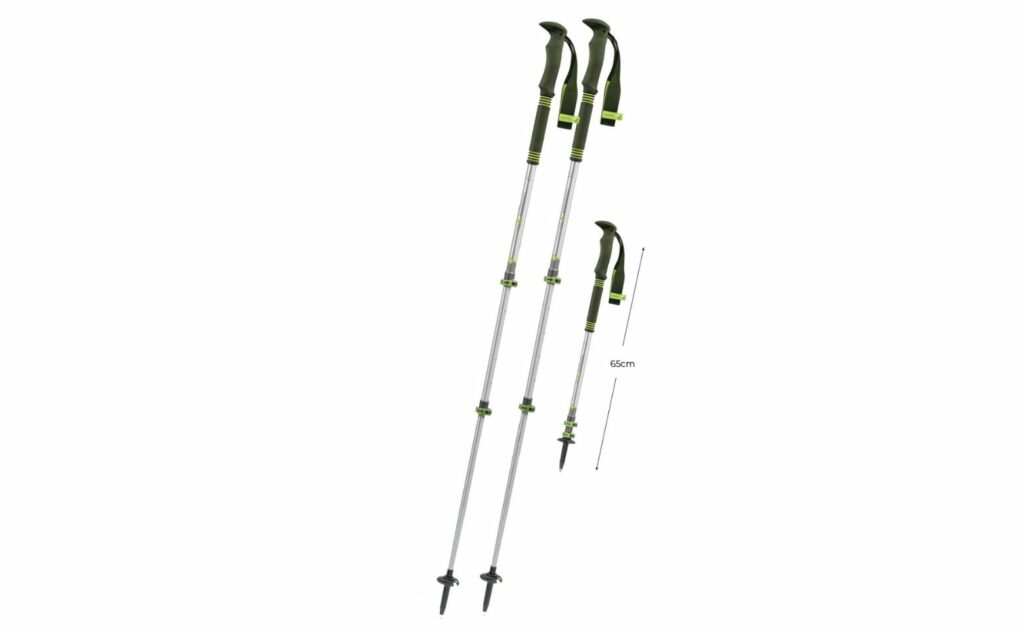
Explorer Zero
Otherwise, construction of these poles is identical to the Carbon Zero, with the same shaft width and geometry from top to bottom, Trek Pro Foam 280 grip with comfort padded strap and Powerlock 3.0 forged aluminum locks for the same adjustable range of 105-140cm on both poles. Both models also include interchangeable baskets that have a wider version for winter use and narrower profile option for summer.
A few other guiding principles of Komperdell poles worth noting are the company’s commitment to environmental stewardship and responsible manufacturing practices. Their production process uses pollutant-free and partially recycled materials, energy generated by hydropower, water-based varnishes and filtered exhaust to extract aluminum dust. The entire development, design and manufacturing system is contained to the company headquarters, so the only transit-related carbon footprint is in shipping.
Another nice feature of Komperdell poles is their three-year warranty on all of the poles included here, and a “no questions asked” repair policy that extends to every country, regardless of how a product might have been broken, and without even needing to show a receipt of purchase. The entire Komperdell collection is available to United States customers at us.komperdell.com.