
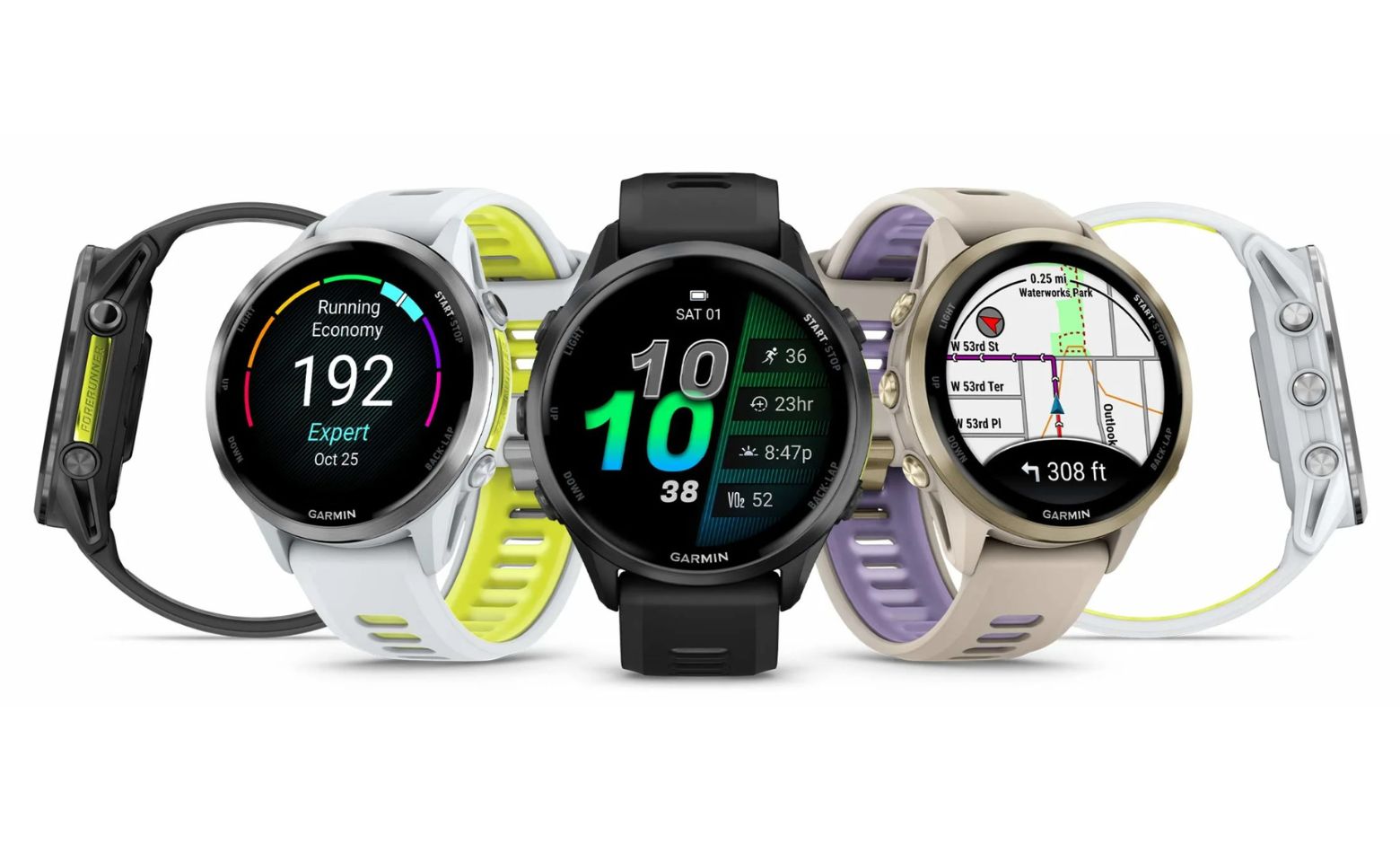
 Our reviews are 100% organic. We do not accept payment for reviews or bundle with advertising budgets. In most cases, the brand is providing the product to our reviewers free of charge.
 There is something of a demarcation line among endurance athletes when it comes to sports watches. Some like the robust, expedition-style watch that says, “I do epic sh*t.” Others prefer a sleeker, more understated device that blends well with everyday apparel but can still handle extreme activity. In Garmin’s ecosystem, the former crowd is served by Fenix and Enduro series watches, while the latter gravitates towards the Forerunner series. Following last year’s release of updated “big” watches, this year, Garmin launched the Forerunner 970 with an MSRP of $749.99, which is an update to the previous Forerunner 965 released in 2023.
Predictably, the Forerunner 970 includes a number of advances in its hardware and analytic features, many of which aren’t currently seen on any Garmin watch. It also sees a price jump of $150, which isn’t great news, and adds another challenge in that some of its advanced analytic features are only operable with the purchase of a separate chest strap that costs an additional $170. Some of the debut analytic features will eventually roll out to other devices, but the trickling down isn’t as extensive as it has been in the past. As of this writing, Garmin only plans to add the new software features into the Fenix 8, Enduro 3 and Tactix 8 watches.
NEW FEATURE HIGHLIGHTS
Key improvements to the 970 compared to the 965 model are as follows:
Hardware and interface updates:
- Garmin Elevate Gen5 optical HR sensor with ECG and skin temperature functions
- Three-level LED flashlight with red mode
- Increased AMOLED display brightness and map clarity
- Speaker, microphone and voice commands
- Migration setup from previous Garmin devices
- Font size options
- Updated feature navigation to match Fenix 8 interface
- Updated battery specs
Analytic features:
- Evening report
- Running tolerance
- Impact load factor
- Running economy (requires HRM-600 strap)
- Step speed loss (requires HRM-600 strap)
- Predicted race time predictor
From our perspective, a few of the hardware updates are notable and interesting, but the headline advances are focused on running analytics, such as assessing your recovery and attempting to quantify what your body is capable of for any given workout or training block.
BATTERY LIFE & AMOLED DISPLAY
One of Garmin’s taglines for the Forerunner 970 is: “Our best and brightest running smartwatch.” While “best” has some subjectivity based on user preferences, “brightest” is unassailable. The AMOLED display on this watch has noticeably improved brightness and clarity compared to any watch in the Garmin lineup and a color palette that matches anything from Apple or Google watches. It is remarkably clear even in bright sunlight, and substantially easier to read in all conditions compared to previous Garmin AMOLED watches we have tested.
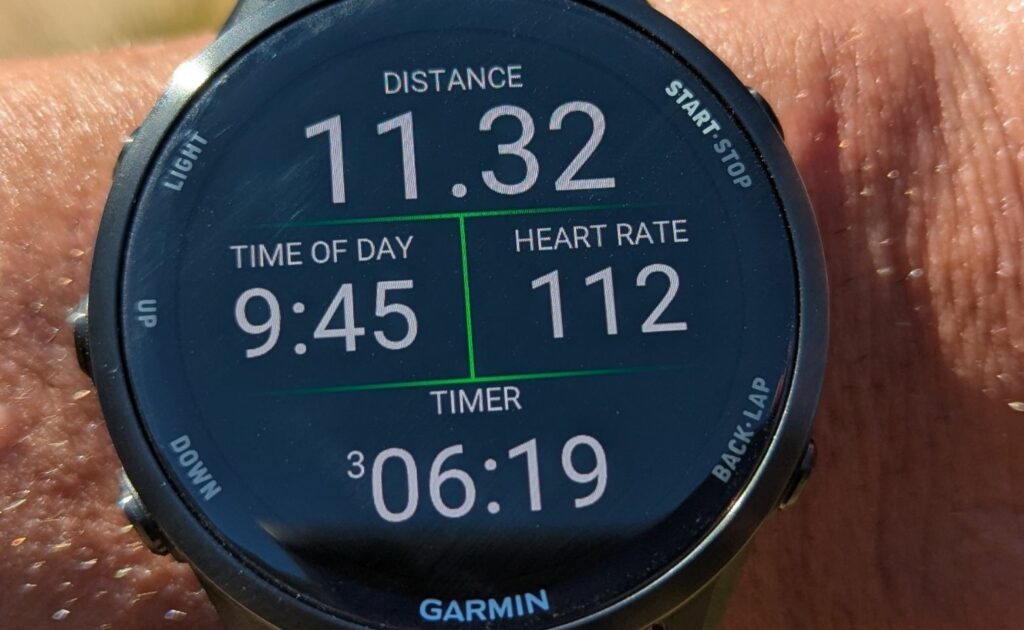
Garmin Forerunner 970 in sunlight.
The flip side of amazing brightness and clarity is battery drain, and in its default settings, the Forerunner 970 actually has a shorter battery life than its predecessor.
For a point of comparison, the Forerunner 965 has a battery life in smartwatch mode of 23 days. However, there has clearly been some tweaking of battery burn rate with different features, for example, the SatIQ GNSS spec on the 970 is one hour longer than the 965, and the all-systems mode of the 970 is almost 25% greater than on the 965. Furthermore, there are a couple quick adjustments you can make to the brightness setting and/or display mode of the 970 to increase battery life by almost double.
In terms of recharging needs for routine use, a normal week for us typically consists of four to five runs of 1 to 5 hours in duration, plus an equal number of non-GPS activities (pool swimming or gym work). With the default settings, we needed to recharge the 970 every 3-4 days, which is not nearly long enough for our liking. With the brightness lowered to one third — which is still plenty bright to see — and the display changed to gesture-based instead of always on, we have been charging the 970 once per week with anywhere from 5 to 15% remaining at the time. And by further comparison, we charge our Enduro 3 watch about once every three or four weeks. That spec alone may be the key factor for many ultrarunners when making a decision on which model works best for them.
It’s worth noting that the highest battery spec, in GPS-only mode, is 26 hours — or in ultrarunning terms, that’s less time than it takes most people to run Western States. For efforts over 24 hours, you’re looking at running with a charging cable and topping off mid-run, which is kind of a throwback hack from the 2010s but not always the simplest feat to pull off.
FLASHLIGHT & SPEAKER
There’s not much new when it comes to Garmin’s flashlight except that it’s been around for a couple of years (on other models) and everybody seems to love it (us included). The version on the 970 matches the brightness of those on the recent Fenix 8 and Enduro 3 releases, along with the functional options of three brightness levels and a red mode. There’s also a strobe option to improve your visibility to cars if you’re on the roads after dark. Truthfully, the flashlight is a feature most of us utilize during indoor activities and when it helps you find your way to the bathroom in the middle of the night, you’ll appreciate it.
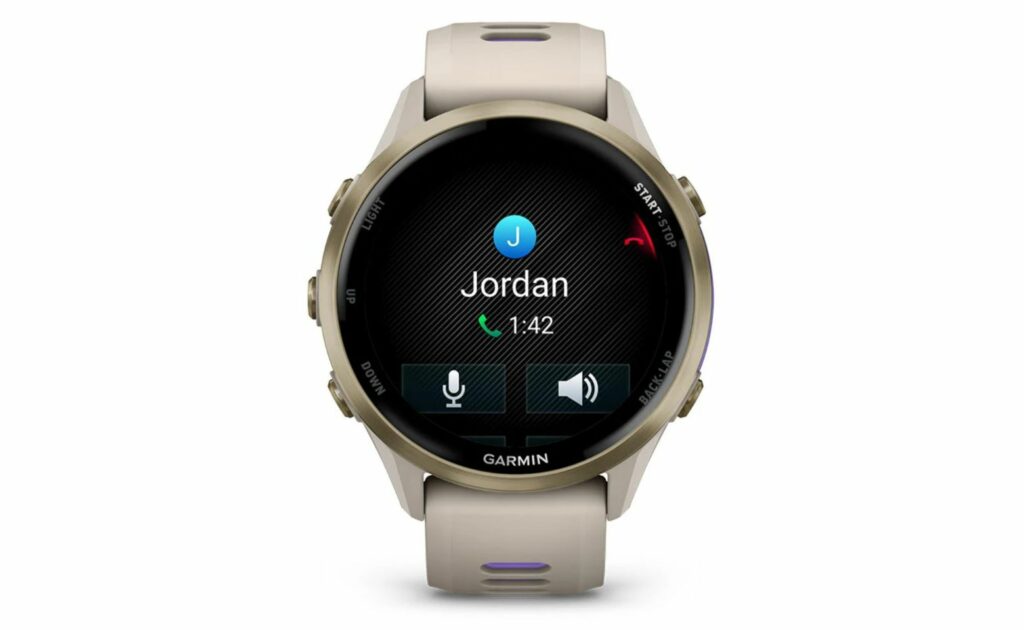
Garmin’s call setting
More notable is the inclusion of a speaker and voice control as seen on the Fenix 8 series launch. A couple important caveats here are that you need to be within range of your phone (i.e., carrying it with you on a run), and the convenience of these features isn’t, in our experience, any easier than just pulling your phone out to do the same tasks. However, if voice and speaker interfaces are your jam, there’s a lot to work with. The primary uses are making or receiving phone calls from your wrist and activating whichever Apple/Google/Samsung smart assistant on your phone. Audio accuracy on the watch is pretty solid in its ability to understand what you’re saying and respond appropriately, but the audio clarity of the speaker is a notch below the speaker option on our phone app, and significantly worse than the audio quality through a pair of headphones. Parenthetically, most running headphones are compatible with phones and smart assistants, so if you frequently run with headphones, having these same (less refined) features on your watch isn’t really a huge deal.
FONT SIZE & SETUP MIGRATION
One of the coolest features of the 970 is something you’ll probably only use once, but we were super psyched to see it. When going through the initial setup, you’ll be asked if you want to migrate your settings from another Garmin watch. In other words, all of your customized activity screens, heart rate alerts, widget views, alarms and most other saved settings from your previous watch become established on the new one. The only exception to this is customized message responses to incoming texts or calls, but this feature is a huge step in converting an older Garmin watch to the 970.
Another great user-friendly new feature is the ability to increase or decrease font size for those who are somewhat visually challenged (that’s us) or who may be concerned about other people reading incoming messages over their shoulder. Neither of these new features are necessarily game changers but are great additions to the overall user experience.
IMPACT LOAD, RUNNING TOLERANCE & RACE PREDICTOR
On the analytic side, probably the most useful new feature for ultrarunners is impact load, which aims to quantify how demanding any particular run is with consideration of the terrain involved. Essentially, it is very similar to Strava’s Grade Adjusted Pace feature, but uses that information about pace and slope to estimate how demanding your effort was and how much recovery time you’ll need afterward. We’ve all told stories of the “five miles that runs like nine,” and the impact load feature will help you prove that you’re not simply exaggerating the difficulty. There’s potential for this feature to also consider factors like heat and altitude which would be awesome, but for now the primary variables are terrain, pace and effort level.
After quantifying your impact load, this metric is then folded into a macro-level running tolerance feature, which assesses what overall training volume you should be capable of based on your recent history of workouts. This is intended to provide guidance, so you don’t ramp up your training too quickly and risk injury. The running tolerance screen identifies your actual seven-day running mileage, along with how those miles equate to “impact load” miles, and estimates a manageable volume of work for you in the upcoming week. If you are staying within a safe mileage range, the display includes comforting purple and blue tones, but if you are overreaching in comparison to what Garmin thinks is safe, that display turns cautionary shades of yellow, orange or red.
A third analytic feature that has interesting potential is the race time predictor, which (as the name implies) predicts your finishing time within a small range for any upcoming race that is entered into your Garmin race calendar. This builds upon the existing race predictor feature in Garmin Connect to provide estimates for a specific race at a specific time. The key determinants for this are the race date, meaning, how many more training weeks you have, and your recent training quality along with factors like VO2 max and lactate threshold. In its initial configuration, this seems more applicable for road races where it’s typical to expect keeping a somewhat consistent pace on relatively flat terrain, but this is another area with potential to become more ultrarunning-applicable in the future. If this metric can consider overall vertical gain, average altitude, technicality of terrain (which could be estimated by crowd-sourced pace comparison data) and existing metrics like hill score and endurance score, it would be interesting to see how close an estimate could be for a race like the Speedgoat 50K.
RUNNING ECONOMY & STEP SPEED LOSS
These are the two features that require the optional HRM-600 heart rate strap, and we did not use the strap in our testing of the 970. The short version of these features is they assess your foot impact to extrapolate how efficient your running stride is. For instance, if you routinely “land heavy,” you spend more microseconds in contact with the ground rather than propelling forward, and are less efficient as a runner. There was a time when a handful of companies built insole sensors to measure these same metrics from the inside of your shoes. Most of them had problems processing the data into something trainable, so attempting to do the same thing from a wrist-mounted device will likely face the same challenges. However, we haven’t actually tested this hypothesis to know for sure.
SUMMARY
One reason we didn’t test the HRM strap is that we like to prioritize convenience and versatility of use when considering high-end GPS watches with significant price tags. If you’re saving up to purchase a multi-purpose watch, you shouldn’t have to then purchase additional accessories to utilize key features. Fortunately, the two features that require the HRM-600 aren’t critical to the overall utility of the Forerunner 970.
For previous Forerunner 965 users, the new hardware features of a flashlight and voice/speaker capability are significant improvements that will be more utilized by some, more than others. The impact load and running tolerance features are undoubtedly great tools to objectively assess the intensity and volume of your training, which is frequently a blind spot for mileage-obsessed ultrarunners. If Garmin sticks to its intention of not rolling these out to the 965, there’s a case to be made for justifying an upgrade from the 965 to 970.
For dedicated ultrarunners, there is a clear decision point in selecting the Forerunner 970 over the current Fenix or Enduro models: how much are you willing to trade battery life for a sleek profile and brilliant display? If you regularly log long GPS recordings and are on the trail morning through night, you may get frustrated with the frequency of recharge that’s needed. On the other hand, understanding that not all of us run 100-milers or multi-day events on a regular basis, if you’re cool with more recurrent recharges than those larger watches, the Forerunner 970 matches or exceeds those models in every functional category.
The Garmin Forerunner 970 is now available at www.garmin.com.