
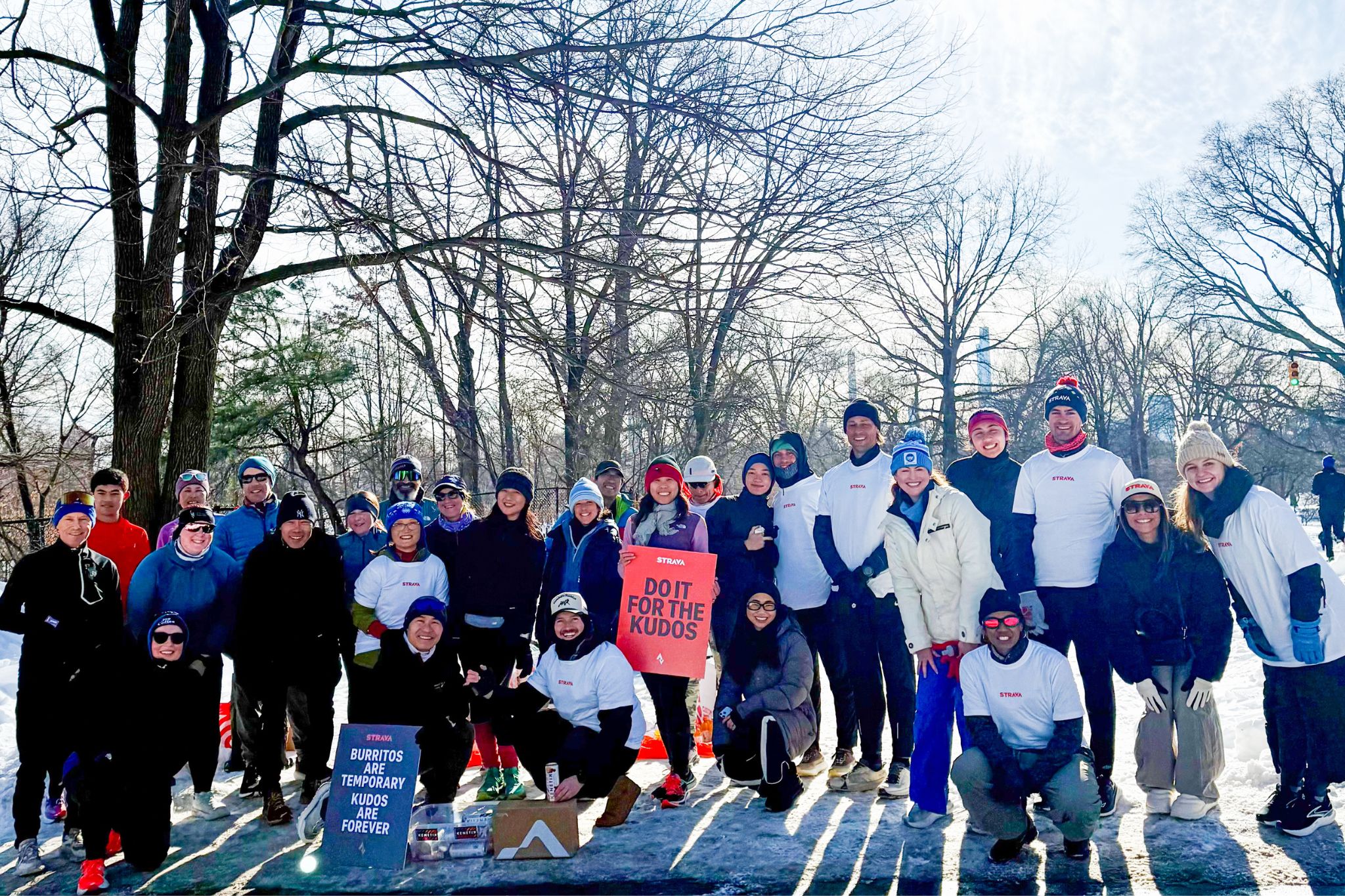
Like many in our community, I spent much of January running in circles. Also, like many in our community, I spent much of February turning the dial way back down, measuring time with TV episodes rather than Strava segments for Burrito League.
That time to recover gives the mind an opportunity to reflect. While it’s certainly not unique, I’d been grappling with many questions that popped into my head. Why run a marathon on a 500-meter loop? Why cancel plans and wake up early to run more laps? Is this healthy — mentally or physically?
We each have our own answers. Before I go too far into sharing any little wisdom I may have, I must say that my writing comes with a major grain of salt. Our Burrito League winners ran five times more than I did. I’m sure I ranked well in the hundreds who participated, and in terms of most qualified to judge the Burrito League. Nevertheless, contemplating these questions allowed me to reflect on what makes the Burrito League special while suggesting a more sustainable method of participation.
My first long day at the New York City Burrito League, I went out for a 16-mile training run. Entering an hour at marathon effort, I soon synced paces with a very strong runner who joined me in conversation. I learned he had run a 2:50 marathon on the segment the day before and was now running his first-ever ultra as a recovery day. That hour with Joe DeAngelo, our eventual winner who doesn’t even like burritos, flew by. I transitioned to a 10-minute cool down, which — before I knew it — had turned into a 10-mile cool down with new friends for a spontaneous marathon. What?
During my second week in the Burrito League, things fell apart. While I had no shot at prizes, I was competing for the top five and seeing how far I could push my weekly mileage PR. A snowstorm was coming on Sunday, and I wanted to do something big.
After three consecutive long days Tuesday through Thursday, I settled in for 3 hours on the segment Friday morning. Loop after loop, my foot started to feel worse. I walked a lap. Was it time to call it? Nope, just before I was about to throw in the towel, I got roped into another conversation. Slowly, my foot eased from a sharp pain into a gentle ache.
Returning to my apartment, I quickly knew the damage was done. I could hardly get up from the kitchen table, and I was limping badly. My body was furious with me. What was I doing?
That week, though, I proved myself as part of the community. I became more than just a visitor and established myself as a regular. And I enjoyed it. Where else in New York City could I possibly be hypothesizing about a Hardrock Golden Ticket series or talking about the future of the World Trail Majors before 7 a.m.? Yes, we were ecstatic to discuss ultras for once, somewhere other than the comments section of the @AidStationFireball account on Instagram, but we also shared our life stories, worries and desires. It was addictive.
Even at the top of the leaderboard, fierce rivals showed care and support for one another. Witnessing Joe battle Roland Mann, now the New York City runner-up, I saw the friendship that emerged and the respect that was gained through the hundreds of loops they spent together.
While I didn’t share as many loops with them, the battle for first between our eventual women’s winner Elise Gelbard and Kumi Redpath — who had a 24-hour race in the middle of the month — was no less inspirational. I was also fortunate to share miles with Rachel Mann, our fourth-place woman, who amazed us all with her relentlessly positive spirit and ran her first marathon, and first ultra, on the last day.
The last week of January, I was an afterthought to the NYC Burrito League. After a few days walking to rest my foot, I still ran to exhaustion that Thursday morning, my last day before heading out of town. Four weeks later, my foot still isn’t fully healed as I continue to manage the symptoms of plantar fasciitis.
The Burrito League gave me a sense of running community I had yet to experience in New York City. I met friends who shared my interests, saw people inspire themselves and others with grit and determination, and got to witness the overwhelming support people displayed for each other. Yet the addictive undercurrent of the League led to me pushing myself to injury, ignoring other commitments and priorities in the process.
Is this physical recklessness necessary for the benefits of the Burrito League? For segment winners and contenders, of course it is. For the rest of us, I’m not so sure. My physics-inclined mind perceives the League as a scale of miles invested versus benefits reaped, and each of us have a different balance point on that scale. It feels silly to be analyzing a running competition for burritos so seriously, so maybe there shouldn’t be any critical thought at all. If there is, though, I believe it’s important to keep that mileage-benefit scale in mind: whether we find a healthy balance or knowingly blow way past it, we will grow as humans and runners if we take a step back to think a bit deeper about the ways in which we spend our time.