
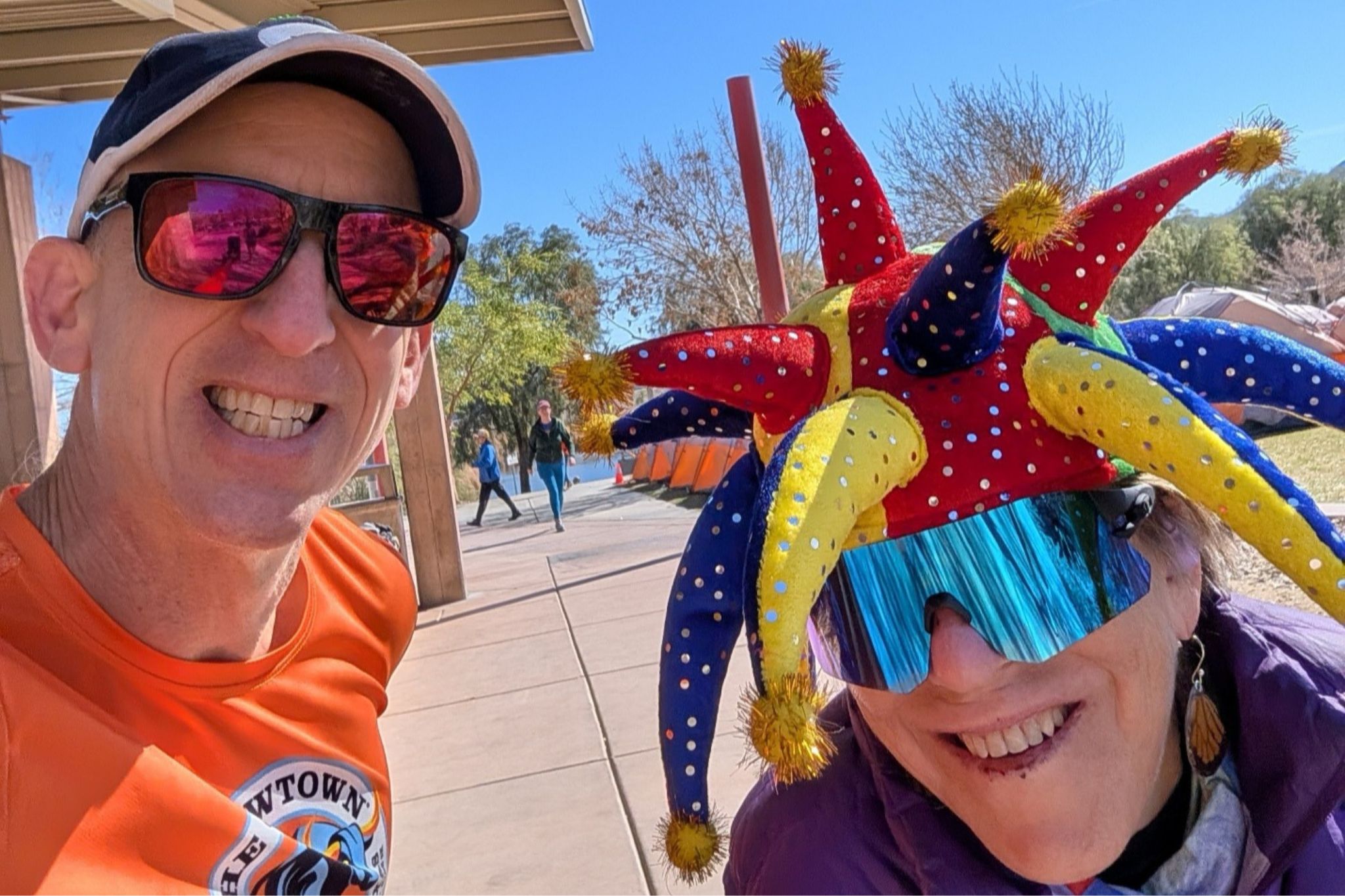
I showed up at the Jackpot Ultra in Henderson, Nevada, feeling hopeful. I used to run 100 miles in 24 hours routinely. But I haven’t run that distance in 10 years. In other words, I’ve slacked off, and the race was going be redemption.
Last fall, I decided to step back up from 12-hour to 24-hour events, specifically at the Hainesport New Jersey Endurance Run, put on by Beast Coast Productions. At the event I’d done 70 miles, being very careful, since it had been so long, to not overtax myself – I didn’t even use up all the time. A month later, I ran in the Fat Ox Ultra in Phoenix, Arizona, feeling supremely confident – and reached 74 miles. Not quite the incremental gain I’d hoped for.
Over winter, my home in New York state got blanketed with snow, and I spent quality time on the treadmill in my garage, working on both my easy running and power-walking pace. Now I was in Henderson, feeling optimistic that if I didn’t nail 100 miles decisively, I’d at least get closer to it.
The Jackpot Ultra takes place on a 2-mile paved loop in a municipal park. I was unfamiliar with the course, but the event came highly recommended. As I stepped up to the starting line, I felt the concrete surface underfoot, smooth and comfortable – which is important to me as a barefoot runner. Although, it was also my understanding that a short portion of the course was unpaved.
At 8 a.m. sharp, we headed out, and I settled into a lazy jog. This was going to take all day and night, so the right mental mindset was to let the time pass fluidly unless there’s a mileage goal, in which case, you glance at your watch every now and then. Indeed, my watch indicated that I was moving leisurely.
After a mile or so, I hit the unpaved section and found it was hard-packed dirt with a sprinkling of sharp grit which prickled my unprotected feet. Annoying, but I ran through it.
The first couple of laps passed by uneventfully. The sky was clear and blue, and the Nevada sun was strong, even though it was still February.
“John!” I cried out, spotting someone I knew from back east as the path looped back on itself and runners crossed in both directions.
A little while later, I spotted him again, up ahead, wearing a white shirt emblazoned with black cat faces and striding next to an older woman. She was dressed in a costume of some kind, big blue wrap-around sunglasses that shielded her face, and atop her head sat a court jester’s hat made of plush multi-colored fabric decorated with sequins. She was bent over, slowly pushing a walker.
I caught up to them and listened as John told her all about the Hainesport Endurance Run, which he organizes, and invited her to participate. A brief discussion ensued of timing and travel logistics. Wanting to be helpful, I jumped into the conversation, mentioned that I’ve run at Hainesport multiple times and always had fun. And then I continued on.
The 2-mile loop starts on smooth pavement, then turns onto a bridge across a pond where the surface consists of plastic planks with swirls of faux grain. From there, it’s back onto concrete and then a stretch of asphalt near some homes, after which the trail runs through the dirt and grit, crosses back onto sidewalk, curves onto a section of slick polished pavers, and then it hits the grit again for quite some distance before crossing that bridge and swinging back to the start.
On the backside, I caught up to the woman in the jester’s hat again and suddenly it dawned on me that it was the legenedary ultrarunner Ann Trason. Later I’d look up her results to find she’d set no less than 20 world records and in her prime, had dominated the Western States 100-miler, one of ultrarunning’s most iconic races, with 14 wins. According to the commentary on social media, she’s only 65, but has struggled with rheumatoid arthritis, which has left her body riddled with the disease. In what must have been a spirit of defiance, she had returned to ultrarunning just a month or two before, using her walker.
It’s not every day that you get to hang out with royalty, so I walked with Ann for a minute or two. I asked about her favorite races (Western States, of course), and it turned out we had some friends in common.
Around noon, the gritty section had started to become a problem. During first couple of laps, I ran straight through the uncomfortable little rocks. Over the next few laps, I settled for a brisk walk. Now, the sharp points were poking more painfully into my feet, since there was no give to the hardpacked surface, and nowhere else for them to go. Sometimes the pinpricks startled me – I would pull back, pause and shift my balance before resuming, but I placed each step with more care, and my walking pace got slower.
In the distance, I heard a cackle and burst of laughter. Over on the pavement, Ann Trason was walking with someone and pointing at me. She shouted, “That looks stupid and painful!”
I didn’t take offense, although the comment hurt my pride. Barefoot brings this amazing feeling of light-footedness and a sense of joyful self-reliance but the practice does face limitations, and there is some logic to her statement.
It was early afternoon, and my race goals were under review for possible revision. On the grit, I swung my arms deliberately, imagining a line of thread from my hands to feet which took some of the weight off of the prickly surface. When the grit finally ended, I paused for a moment to collect myself before resuming a slow jog on the concrete sidewalk. I decided to make this event a training session by getting in some intervals at marathon pace, but I had to run with caution because little pieces of grit were sprinkled throughout the pavement, too, and it was no fun to land on them unexpectedly. In the morning, I could spot them easily from their small, but sharp, shadows. With the sun overhead, I had to scan the gray surface for the tiny obstructions.
An aid station with an assortment of food and fluid was located at the start. I pulled in for a couple slices of watermelon and a piece of dried ginger. I was eying a small cup of M&Ms with indecision, when I looked up and there was Ann Trason again, but without the jester’s hat. She was now wearing a bright yellow plush chicken on her head, with its feet hanging down by her ears.
“I hope you don’t mind that I was making fun of you,” she said slyly, looking down at the food.
“Not at all.”
I took off at a slow jog then picked up the pace, as if to show that I could still run, at least in some places, but then I slowed down because where the trail curved to the right, there was a scattering of small gray rocks.
Her laughter stuck with me, however, even as I accelerate, briefly, to marathon pace across the bridge, where the faux grain swirls started to feel edgy and irritating underfoot. To runners comfortably shod in the latest maximalist shoes, barefoot running must indeed seem “painful and stupid,” but to non-runners, the entire sport of running is pointless and masochistic. Why subject yourself to any kind of pain unnecessarily, whether it’s in the bottom of your feet, leg muscles, knees or hips or any other part of the body? Why would you do this to yourself?
The answer is, that we need pain. We need the intensity. We need the contrast between what hurts and what feels good to discover who we are. All philosophers agree, the path to transcendence takes self-knowledge. Think of it this way – a life without pain would be like eating ice cream for breakfast, lunch and dinner for the rest of your life – by day two or three, you’d be ready to vomit. You might as well seek out pain under your own terms, before it comes looking for you.
I passed Ann one more time, only this time she was wearing a fluorescent pink flamingo hat with a yellow bill and dangling legs. The hat was beautiful.
“Do you really think barefoot running is painful and stupid?”
“Yes.”
I was ready with a prepared retort: “Well you’re right!”
She laughed.
Notwithstanding the grace she brought to the sport with her speed and determination, I would venture to guess that Ann Trason understands stupid pain as well as anyone. And she appeared to revel in it.
As for me, I’m no fool. According to my GPS watch, the nightmare grit represented 0.7 miles out of the 2.3 mile-loop, or fully 30%. Given the limitations of my peculiar practice, this wasn’t going to be a 100-mile experience.
It was late afternoon when I finally made the command decision – go for the easy win – and settle for the slowest marathon of my career.
I limped off the course feeling grateful for the chance to spend time in motion and bag another finisher’s trinket. As for getting a laugh out of Ann Trason – that’s a win I’ll long remember.
Kenneth Posner is a barefoot runner with more than 100 races complete (including 29 marathons and ultra’s), a barefoot hiker who’s climbed more than 600 mountains without shoes, and author of Chasing the Grid: An Ultrarunner’s Physical and Spiritual Journey in Pursuit of the Ultimate Mountain Challenge, available on Amazon at https://a.co/d/06MwkaMx