
David Laney, a professional runner with Craft and retail education specialist, has finished in the top five at UTMB twice. Topher Gaylord, formerly with The North Face and current President of the Board of Directors for the Western States Endurance Run, was the business leader who supported the creation of UTMB in 2003. He finished in the top 10 twice, including second place in 2003. We sat down with both of them to find out what they thought key differences were between the US and Europe when it comes to athletes running UTMB Mont-Blanc.
UR: Why have American men historically had a harder time performing at their best at UTMB?
David Laney: The difference between US ultra racing and Euro ultra racing is massive, much of it cultural, some of it geographical and some of it economic. Geographically, the trails in Chamonix are categorically different from those in the US, even from those in the high alpine of the US. Trails in the US are, on average, less steep. The Alps have vertical kilometers in seemingly every town. The US has very few trails that climb 1,000 meters in less than 5k because we just did not build our trails in that manner. Going up and down a trail that climbs 1,000 feet per mile is so different from running up and down a trail that climbs 500 feet per mile.
Topher Gaylord: Living in the US and training for UTMB is indeed really hard because most of the highest and biggest mountains are in the western United States, but the air mass there is much drier. There is nowhere near as much humidity. In Europe, the humidity is much higher in the summer. Also, a lot of the climbing in the western United States was originally designed for horses, so it can be hard to find truly steep climbs. Utah probably has some of the best terrain in the US for training for UTMB. Even places people think of right away, like Hardrock and the San Juan Mountains, have incredible terrain, but they are too high. UTMB mostly lives between 1,000 and 2,500 meters, so it is hard to simulate the exact conditions you get around the Mont Blanc massif. It is humid, it is cold and it is steep. So yes, I do think the conditions are different enough.
UR: What about the cultural side of things?
David Laney: Historically, US racing was typically a little more “cowboy,” meaning you could show up with a pair of shorts and a race number and maybe put a gel in your pocket and not consider any required gear. Until the last five years, with the emergence of “by UTMB,” rules were surprisingly loose for a society that’s fairly litigious. I think it was that way because no one was going to sue a race that had no money. Now that the sport has professionalized and race directing is a business, race directors have insurance companies telling them what they can and cannot do. Finally, US distance runners traditionally came from more “running” backgrounds, like track and road racing, and it is hard to take the road racer out of the runner. For someone like me, it was mentally hard to forget much of what I knew about training and reorient myself to running 14-minute miles rather than 5-minute miles. I think Euro runners have historically had a richer background in skiing, cycling and mountain sports and typically are more versatile, understanding the fundamentals of endurance sport rather than simply how to run a 2:17 marathon. That, I believe, has changed in the last five years. Americans are now understanding much more about the “well-rounded athlete” and learning how to really race in the mountains the way we would on the roads or track. Additionally, you show up to Western States and the elite field is relatively small, but at UTMB, the elite field is like 150 people. US races are just really constrained by permitting and wilderness rules, so 500 people is a big race.
Topher Gaylord: Obviously, the American women have done great at UTMB. They’ve always done well there around Mont-Blanc. I mean, there have been so many American women champions: Krissy Moehl (2003, 2009), Nikki Kimball (2007), Rory Bosio (2013, 2014), Courtney Dauwalter (2019, 2021, 2023) and Katie Schide (2022, 2024). But on the men’s side, it took 20 years before Jim Walmsley finally won the race. And for an American to do that, he had to commit himself to at least a two-year project. He lived with sort of the “Yoda of the UTMB,” François D’Haene, and he assimilated culturally to try to figure it out. And ultimately, he had an incredible run when he won in 2023 on his fifth attempt. And I do think one part of it is that living in the culture is definitely an advantage. Someone like Ben Dhiman, and Katie Schide as well, have something important: they are living right there. That was true for me too, you know. I lived in Italy for eight years, and all of my best performances at UTMB came while I was living there, racing as a European.
UR: The average size of a 100-mile race in the US is usually under 300 runners. UTMB is a race that is ten times larger, in terms of field size. That must be an important factor.
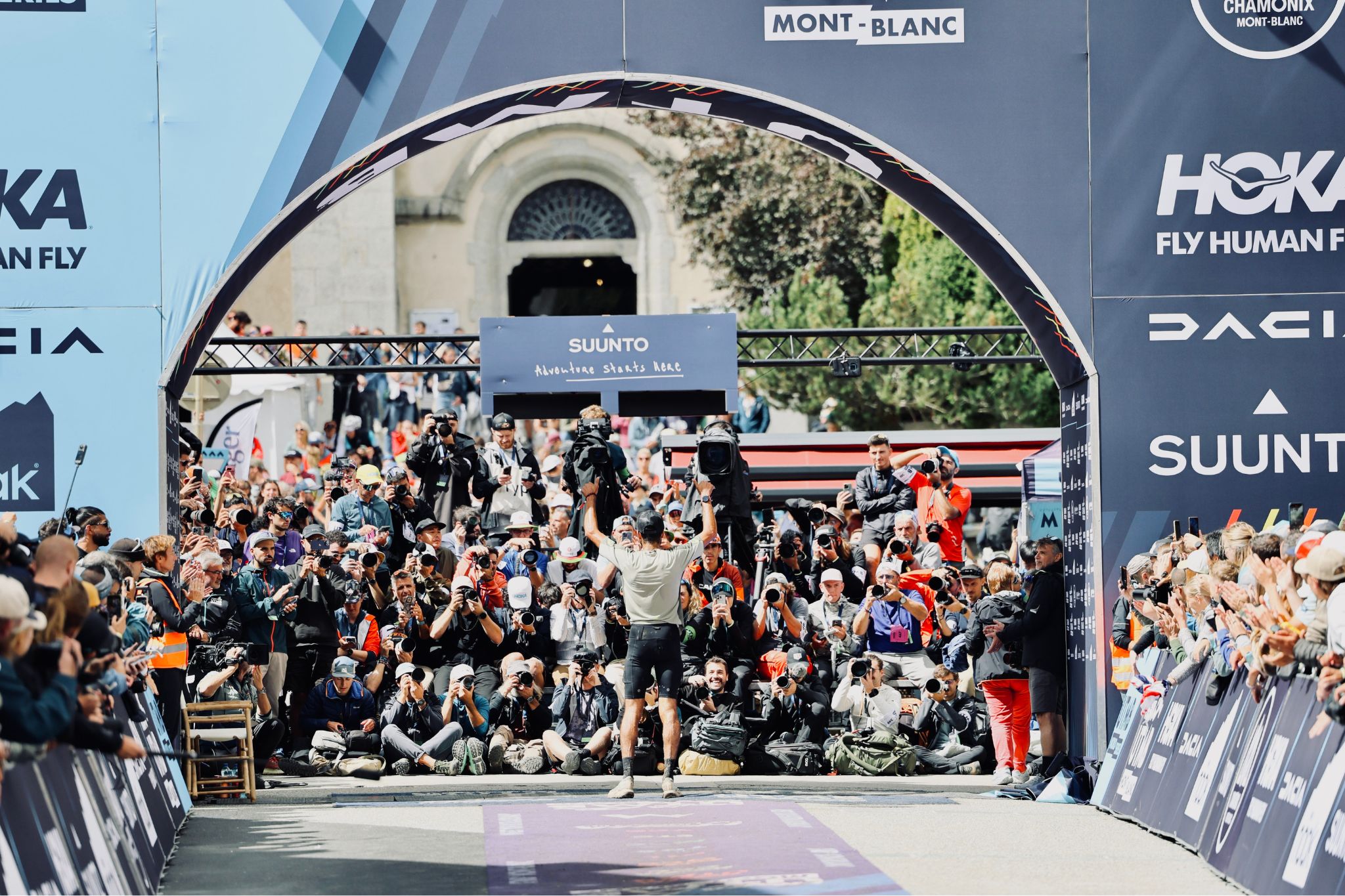
Topher Gaylord: The media and the crowd energy, especially in the first 30k, are so intense. They often consume even the best athlete’s energy in a very particular way. And you touched on it in your question with the media hype – the obligations, the size of the competitive field. In a US ultra, with the possible exception of Western States, a competitive field usually means maybe 10 to 12 elite athletes. At Western States, you might have 25 to 30 elite men and women. But at UTMB, you might have 50 elites.
UR: And so, what’s the economic reason?
David Laney: I believe Europe professionalized trail running about five years before we did in the US. Maybe not in the sense that there were more “professional” athletes, but in that many semi-pro Euro athletes seemed to have much more work flexibility, allowing for more race travel and training trips. In 2014, I remember traveling to Europe a few times and making friends, and all these guys had full-time, career-type jobs but were able to travel for 5-8 weeks a year to train and race, while in the US, 2-4 weeks is kind of the maximum. There are definitely lots of other factors, like the use of poles, crewing vs. aid stations, jet lag, etc. I think all these little things add up. Overall, I think it will eventually even out, especially as the sport continues to provide economic opportunity.
UR: UTMB is now so famous that elite athletes come from all over the world. You don’t see such international diversity in the US, even at Western States, even if it is starting to change with more Asian and European runners. And that matters, because at a race like UTMB you end up having more and more elites at the start that you’ve never really seen or heard about.
Topher Gaylord: It’s also true that brands incentivize athletes to come to those biggest races. I know they pay bonuses that are larger for UTMB than for other races, so the athletes want to come. I think it is really the combination of all these things that has always made it difficult for Americans to stand on the very top of the podium, with the exception of Jim (Walmsley). And I absolutely think the mandatory kit is another major factor. It is really the only time American runners are forced to carry that much gear. Unless someone in America is training with that mandatory kit all the time, their pack is almost always heavier at the start of UTMB than they expected. And then there is the organization of it. If you look at Kilian Jornet, François D’Haene or any of those European pros, their jackets come on and off seamlessly all the time during the race. Americans are often hesitating, waiting a little too long, or fumbling when they put the jacket on or take it off. They are not always managing that gear as efficiently as their European counterparts.
UR: All of this makes sense, but it still does not explain why American women have done so well there. I cannot just say it is because there is less competition on the women’s side.
Topher Gaylord: I have not done the math on it, but one area worth exploring is the percentage of women racing ultras in the US. My impression is that the percentage of women racing ultras, and especially 100-milers, is higher in the US than it is in Europe. It may also be that the US is simply producing more competitive or more professionalized female ultrarunners than some other countries. At Western States, I think women make up around 23-25% of the field. I do not know the exact number for UTMB, but I think it is around 10-12%. So again, it is not that there are no women at UTMB. In fact, UTMB still has the largest women’s field in the world. It could also be that American women, especially in the early years, and Krissy in particular, were simply smarter in the way they approached training and tapering before the race. A lot of American men came over and either overtrained going into it, or got so excited once they arrived that they were drawn into how fast the race starts. UTMB goes out very fast, and I think a lot of American men get lured into that pace. The American women, on the other hand, always raced smarter. Beyond that, I do not know if there is one definitive reason. I think if you look at the deepest pool of competitive athletes, there are just so many incredibly strong European and international men. And when you compare that with the percentage of really strong American runners, I think the balance is a little different on the women’s side.